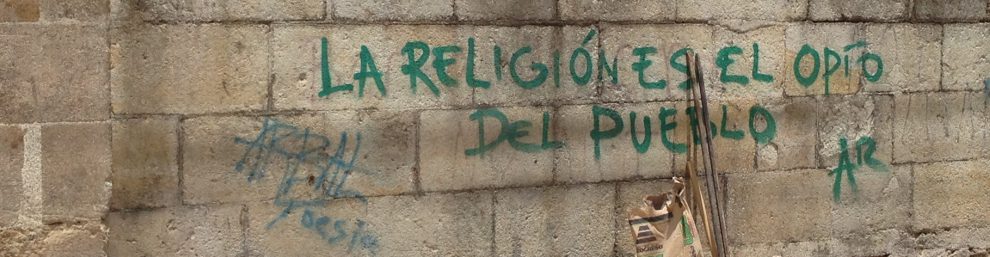
I shared these words with the Madison community during a vigil in honor of the victims of the recent massacre in Orlando. | Compartí estas palabras con la comunidad de Madison durante una vigilia en honor a las víctimas de la reciente masacre en Orlando.
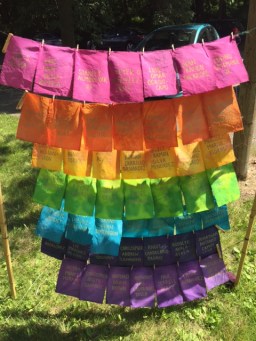
Rainbow flag with the names of the victims of the Orlando massacre. | Arcoiris de banderas con los nombres de las víctimas de la masacre de Orlando.
Buenas tardes, y gracias por decir “presente” en esta vigilia de recordación de nuestros hermanos y hermanas en Orlando. Soy el Rvdo. J. Manny Santiago, director ejecutivo de “The Crossing” un ministerio ecuménico para estudiantes en la Universidad de Wisconsin – Madison. Estaré compartiendo con ustedes unas palabras en español y luego en inglés. | Good afternoon and thank you for being here at this vigil honoring the siblings we lost in Orlando. I am the Rev. J. Manny Santiago, Executive Director of The Crossing campus ministry at the UW-Madison. I will share some words in Spanish first and then in English.
—
Español
No es fácil para mí el encontrar las palabras para compartir con nuestra comunidad. Hay ocasiones en el ministerio cuando tragedias como la que hemos sufrido nos dejan así: sin palabras, con dolor, con furia y confusión. Al mismo tiempo, sabemos que necesitamos levantar nuestras voces, ya sea para animarnos los unos a los otros, para denunciar injusticias o, en ocasiones, hasta para cuestionar la bondad de Dios cuando solo que podemos ver es violencia y muerte. Todo eso es parte del proceso de duelo y nadie nos debe decir que no sintamos estas cosas. Para mí, he pasado por todas esas etapas en menos de una semana: he sentido dolor, rabia, miedo, confusión y hasta he cuestionado la bondad de Dios que sirvo.
¿Por qué? Pues porque la tragedia de Orlando me ha tocado muy de cerca. No solamente tengo familia en Orlando – algunos de los cuales asisten al Club Pulse de vez en cuando – sino que, igual que la mayoría de las víctimas, soy Latino, puertorriqueño y abiertamente gay. Sí, soy un hombre Latino, pastor y gay. Desde pequeño escuché que esas cosas no podrían vivir juntas en una sola persona. Ese discurso de odio y rechazo que escuché de pequeño en la Iglesia me llevó a cuestionar, no solo mi identidad, sino el mismo amor de Dios y mi familia. Hoy muchas personas – políticos, líderes religiosos, etc. – están tratando de borrar las identidades de las víctimas de la masacre de Orlando. No queremos reconocer que son personas LGBTQ, no queremos reconocer que en su mayoría eran Latinos, no queremos reconocer que había entre ellos personas sin documentos… Algunas personas incluso han intentado poner a nuestras comunidades Latinas o LGBTQ en contra de la comunidad Musulmana.
Para mí, como persona de fe, Latino, puertorriqueño, gay, quiero dejarle saber a todas las personas que estamos tratando de hacer sentido de la tragedia: no va a ser un proceso fácil. Necesitamos crear espacios para procesar el dolor, el miedo, e inclusive para cuestionar la bondad de Dios. Pero en ningún momento podemos dejar de luchar por la justicia, por la paz, por reformas legislativas que ayuden a las comunidades de minoría. Reconozcamos que, en especial en nuestras comunidades Latinas, es tiempo de rechazar el machismo, la homofobia, la violencia, el racismo, la islamofobia y el heterosexismo que tanto permea entre nosotros. Es tiempo de levantarnos en unidad, en honor a todas las victimas de tragedias como esta y decir: ¡BASTA!
Que el Dios que se revela de muchas formas y de muchos nombres nos llene de valor, de amor, de sabiduría y de paz para hacer el trabajo…
___
English
It is not easy for me to find the words to share with you today. There are moments in ministry when tragedies like the one we have just witnessed leave us like this: without words, in pain, furious, and confused. At the same time, we know that we must lift up our voices, whether to support each other, to denounce injustices and even, on occasion, to question God’s goodness when the only thing we can see is violence and death. All this is part of the mourning process and nobody should tell us that we should not have these feelings. As for me, I have gone through all of these stages in the past week: I have been in pain, furious, scared, confused, and yes, I have questioned God’s goodness.
Why? Because the tragedy in Orlando is too close to me. I have family in Orlando – some of whom frequent Pulse Club – but also because, like the majority of the victims, I am Latino, Puerto Rican and openly queer. Yes, I am a gay, Latino pastor. Since childhood I’ve heard that these things cannot coexist. This discourse of hatred and rejection that I heard in Church brought me to question, not only my identity as a human being, but also God’s and my family’s love towards me. Today, many people – politicians and religious leaders in particular – are trying to erase the many identities that the victims embodied. Many do not want to recognize that the victims where LGBTQ, they do not want to recognize that the victims were Latino, they don’t want to recognize that among them there were people without proper documentation to work in the USA… Some have even tried to put our LGBTQ and Latino communities against the Muslim community.
As for me, as a person of faith, as a Latino, a Puerto Rican, and gay, I want to make it clear to all: trying to make sense of this tragedy will not be easy. We must build spaces to process the pain, the fear, and even to question God’s goodness. But under no circumstances must we stop working for justice, for peace, and for legislative reforms that would support minority communities. We, Latinos, must recognize that it is time to reject our machismo, our homophobia, our worshiping of death and violence, our Islamophobia, our racism, and our heterosexism. It is time to rise up, together, in honor of these victims and all the other victims of past violence, and say: ENOUGH!
May the God who is revealed in many forms grant us courage, and love, and wisdom, and peace for the work ahead of us…

 “What are you?” is, then, the amalgam of the identities we espouse and embody. These are identities that we have chosen and identities that are inherent to our being. The problem comes with the way in which the question is posed. Humans are not things. We are a very complex animal with both physiological and psychological characteristics. The integration of these characteristics is what makes us unique in the animal realm. Humans can overcome our desire to associate by tribe – or herd, or school, or pack, or whatever we call the different groups of animals that exist – precisely because we can answer the question “what are you?” Yet, the answer to this question is not an “it is” but an “I am”. In using this form of recognition of the self – something that other animals lack – we acknowledge that we are more than just our instincts.
 SocioTheology
You must be logged in to post a comment.