Category Archives: Culture

Yes, I Am Mad as Hell!

A few years ago, while working on a predominantly white environment, I experience much racially and ethnically based discrimination. Some of this discrimination came in the form of what scholars now call “microaggressions”, while other was more overt such as questioning my abilities, my qualifications for the job or the like solely based on my ethnicity and accent. For some time I just shrugged it off as ignorance and lack of education on the part of the people who did it. At the same time, I would do an effort to educate.

fist-md However, the discrimination continued. Not only that, but I started to meet with other people of color who were also involved with this organization and heard their own stories of rejection, discrimination and paternalistic attitudes towards them because of their national origin, their accents, their skin color and the like. The pressure continued to mount inside me. I felt like a pressure cooker… until it exploded. The event that marked my anger explosion was the murder of Trayvon Martin in Florida.

Trayvon Martin’s untimely death and its circumstances touched me in a way that I was not expecting. However, many things coalesced at once. On the one hand, another young, unarmed, black human being was being gunned down for no reason. On the other hand, the murderer was a white, Hispanic man who had let his white-privilege rule his life and how he connected with the world around him. Listening and reading the reports of this tragic death, made me even angrier. The media outlets could not grasp the idea that a Hispanic person could possibly be the perpetrator of a racial crime. They also had troubles understanding the complexities of race within the Hispanic communities. But more than that, they totally misunderstood the intricate layers of relationships among the different minority groups in the United States. All of this was too much for me at the time; and I exploded in rage.

I was mad – still am. For years I had tried to understand the historical realities that have made the United States the dangerous place for people of color that this country is today. I had tried to understand that not all white people were responsible for racism. I had tried to justify many actions of racism as ignorance and lack of education on the perpetrators. I had tried to understand that my own Hispanic community was dealing with our own prejudices on top of being the target of discrimination. I had tried and tried and tried to understand and keep my composure. But I could not do it any longer.

At some point I shared my feelings with the community. I told them how it was tiring to be trying all the time to make people understand that we – people in the minority – were not the enemy. I was getting tired of being an educator at all times. I was getting tired of pretending that the words and the actions of white people didn’t hurt me. I was getting tired of pretending that I was going to understand their historical and sociological circumstance. I was getting tired… and this feeling was making me mad and angry.

As I look around and see that things have not changed a bit since the murder of Trayvon, and that black human beings continue to be murdered and their assassins walk free… As I look around and notice that other members of minority groups stay silent… As I look around and notice that the white “supporters” keep calling for what I call a “Kumbayah moment” without acknowledging the centuries of oppression that have brought us to this place… As I look around and see that even the President keeps silence when everyone is waiting for him to talk, to speak up, to raise his voice and use his power… As I look around and notice that the violence on the streets of Ferguson, Missouri are becoming just another excuse for the white majority to justify their oppression… As I look around and continue to notice all of this oppression… the only thing I can say is that I am fucking mad as hell!

Yes. Yes, I am mad. It is not a rage that started yesterday or the day before or the day I experienced racism at that institution I mentioned earlier. It is a rage that comes from a deeper, way deeper place. It is a rage that comes from fourteen years of living in a country that treats me as less than my white counterparts. It is a rage that comes the time that my country was invaded by a white, US navy that tried to impose on my ancestors their language, their religion, their way of life. It is a rage that comes from knowing that half of this country was built on lies and stealing from the natives peoples and when that was not enough, of the other settlers who lived there and spoke my language and shared my customs. It is a rage that comes from knowing that millions of my sisters and brothers’ ancestors – and I am sure mine too – were forced out of their Motherland to be brought here in chains and by force. It is a rage that comes from all the rage accumulated throughout the centuries… throughout the generations… throughout the ancestors who still live in me and within me… Yes, we are mad, and yes, we are going to continue being angry for as long as it takes for the systems to change. And yes, that anger is going to be at times violent and at times peaceful. But I do not care anymore about what the white majority thinks of my anger. I don’t care about what my Hispanic community thinks of the anger that makes me be in solidarity with my black sisters and brothers. I don’t care that my white friends – even those who are close to me and whom I love – hear me saying that I often doubt their good intentions.

I am mad as hell, and I am not going to apologize for it.

Leave a comment

Filed under Black, Culture, discrimination, ethnicity, Hispanics, History, justice, Latino, Peace, race, racism, Sociology, United States

Seeing God in Abuela

When my father and my mother forsake me, then the Lord will take me up.
Psalm 27.10, KJV

My abuela Palmira left this world on March 30th, 2014. She was the last one of my grandparents to leave us. I had been blessed with three sets of grandparents as my father had two sets of parents, his birth parents, abuelo Quino and abuela Margot, and the couple of welcomed him into their family when he was quite young and working away from his hometown, abuelo Jobito and abuela Ester. My maternal grandfather, abuelo Juanito, left us when I was 8 years old but I still remember him very well. Every Sunday afternoon, when the family gathered at their home, he would sit on his rocking chair and tell us funny stories that would make us laugh for hours. Abuela Palmira would stand next to him and laugh with all of us.

Abuela Palmira   There was something peculiar about my maternal grandparents. They practiced Spiritism, a religion in which every human being is of sacred worth and where spirits guide us to be in communion with the Great Spirit that is sometimes called God. At their home, everyone was welcomed and celebrated. They never rejected anyone. My grandparents believed in serving everyone and in welcoming everyone without distinction. Although I was too young when my grandfather died and thus not even aware of my own sexual orientation, I know that my grandfather would have accepted me and celebrated me. My grandmother, however, had the chance to know who I am as a whole person and she always, without doubt and without excuses, celebrated me for who I am.

When I think about abuela Palmira, the verse that always comes to mind is that of Psalm 27.10: “When my father and my mother forsake me, then the Lord will take me up.” When my parents rejected me for being queer, it was abuela who welcomed me. She always supported me and celebrated my life. When I introduced her to my now husband, I was told that she spent months telling everyone who would listen about the wonderful man I had met. Recently, while talking with an aunt, she told me how they found among abuela’s personal items the wedding invitation I had sent her for my marriage. I knew she would not be able to attend my wedding due to health problems, but she had kept that invitation as an important memento. Through these actions, I can say that abuela embodied the Holy One in my life. Thus, when my parents disowned me, God took me up through the love, support and affirmation of my abuela Palmira.

The Sunday before abuela departed this world, my husband and I spent time with her. We had been in Puerto Rico for vacation, and of course I had to go visit abuela. She made us laugh with her witty remarks. This was abuela. She was always making jokes and laughing about things, even when her health wasn’t the best, she always found joy in living. I am not naïve to say that she was perfect, because none of us are. She had her flaws and made mistakes like the rest of us. But her love and support meant the world to me, and it is those values that will stay with me throughout my life. Her love, her support, her laughter that last time I saw her will always be the manifestation of God in my life. I will keep her memory alive as long as I live and I will always share with the world the values that she shared with me.

Abuela Palmira, you are now gone from us, as you would have said, you are now “unfleshed”, but your spirit will continue to guide me just as the spirit of abuelo Juanito has never left me. Gracias por todo, abuelita.


Leave a comment

Filed under amor, Culture, Dios, familia, Gay, Heritage, Hispanics, Latino, Lesbian, LGBTQ, Puerto Rico, Queer, Theology

Celebrating LGBT-Affirming Bapitsts

Today a Baptist minister who lived spreading a message of hatred and damnation to the gay, lesbian, bisexual and transgender communities died. I do not rejoice in his death, nor do I feel particularly wont of publishing his name. I believe that the best thing to do with people like him – and with others who also have a message of hatred, such as a certain US Senator from Texas, a Governor from Arizona and others – is to retrain from publishing their names. After all, most of them are always looking for exposure. I prefer to publish the names of those who are working for justice and reconciliation…

AWAB logo

As I reflected on how the media and even LGBTQI organizations continued publishing their reaction to his death, I decided to take a different approach. This approach is more consistent with my principles of inclusion and reconciliation. Today, I want to make public the work of a Baptist organization that is hard at work opening the doors of our communities to LGBTQI individuals. The Association of Welcoming & Affirming Baptists (AWAB) was born out of the need to proclaim a message of inclusion, celebration and integration of LGBTQI individuals in the life of Baptists communities of faith.

In 1997 I was a junior at the University of Puerto Rico in Mayagüez, and I was finally coming to accept my sexual orientation. As someone who grew up in a Baptist church, I could not imagine my life without a faith community. However, accepting my sexual orientation meant that there was no more room for me within the Baptist congregation in which I grew up. Although my childhood church was not proclaiming the same message of hatred as the recently deceased Baptist minister did, the truth was that there was not a message of inclusion either. The message of a God who rejected people with diverse sexual orientations was well ingrained in the overall message of my congregation.

This message of exclusion was so strong that many times I wanted to just disappear from this earth. I thought that I could just solve my problems by erasing myself from the picture. Several times I thought of ending my life, since there was no way that I could find comfort in the arms of a God who hated LGBTQI individuals.

It was at that moment, in 1997 during my junior year at the UPR-Mayagüez that I went to the library and started searching for answers. I clearly remember sitting in front of the computer and typing the words “gay” and “Christian” and “Baptist”. I had no idea of the surprise that awaited me! The first page that showed up on the search engine was that of the Association of Welcoming & Affirming Baptists.

Finding this organization helped me realized that I was not alone. I read the list of churches on that page and realized that, even though these churches were thousands of miles away from me – one of the earliest supporters of AWAB is the Church of Covenant in Palmer, Alaska, which is a few thousand miles away from Puerto Rico – there were people like me out there. Oh, what a joy! There were other gay Baptists out there! Not only that, but the page had their logo published, which at the time was the official logo of my denomination, the American Baptist Churches, USA, with the colors of the rainbow. I was so happy that I printed the logo and pasted it on my Bible. I have had that Bible with this logo for all these years… as a reminder of how AWAB saved my life and showed me that it is possible to be gay and Baptist.

This is my story. This is why today, instead of publishing the name of a Baptist minister who spent his life hating, I prefer to make public the name of the Baptist organization that helped me overcome my pain. I am glad that AWAB exists. I am glad that so many Baptist ministers have spoken out in favor of LGBTQI individuals, and that they have worked hard to include us the many Baptist communities of faith that joyfully welcome, affirm and celebrate the diversity of God’s creation!

1 Comment

Filed under Church, Culture, Gay, Hispanics, Latino, Lesbian, LGBTQ, Theology, trans, worship

Las mantillas evangélicas

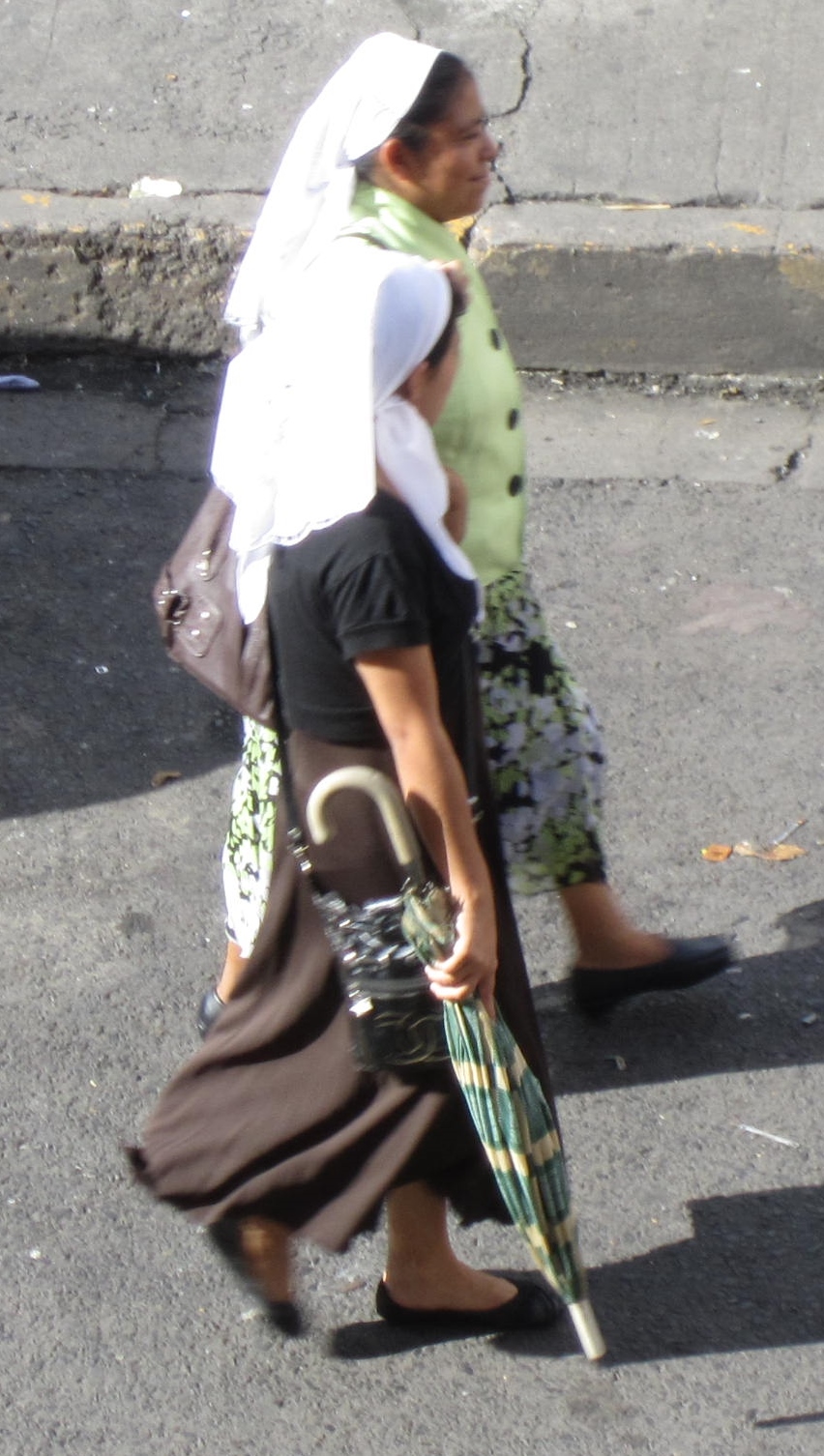
IMG_3419En mis años de infancia, cuando visitaba de vez en cuando la parroquia de Nuestra Señora de la Medalla Milagrosa en Castañer, Puerto Rico, veía una que otra viejita usando mantilla. Las mantillas son esos velos que cubren la cabeza de las mujeres católicas devotas. Por lo general son negras. Las mantillas eran utilizadas mucho en los años antes del Concilio Vaticano II. Pero luego de éste Concilio, la Iglesia Católica decidió que no era necesario el que las mujeres utilizaran mantillas en la iglesia. Así que el uso de mantillas se ha mantenido solamente entre las viejitas que todavía se aferran a la tradición y a los grupos Católicos ultra-ortodoxos.

Bueno, eso era lo que creía yo, hasta que visité El Salvador hace unas semanas. Resulta que caminando por las calles de San Salvador – y en muchos otros lugares que visité en el país – me encontré con mujeres de todas las edades vistiendo mantillas. Todas llevaban mantillas blancas. Elaboradas con perlitas de mentira y bordadas con hilo fino blanco. Me pareció interesante ver tanta mujer católica aferrada a su tradición, así que le pregunté a mi amigo el porqué de tal devoción.

“¡Esas no son mujeres católicas! Quienes llevan esas mantillas son evangélicas.” Eso me dijo mi amigo. Me quedé estupefacto. ¡Mujeres evangélicas vistiendo mantillas! Yo había sido testigo de mujeres de grupos evangélicos judaizantes utilizar mantillas (en Puerto Rico, la Congregación de Yahweh es una de estas iglesias), pero nunca en público. Por  lo general, el uso de mantillas es exclusivo para el culto privado. Después de todo, aun si leemos al Apóstol Pablo literalmente en 1 Corintios 11:1-16 éste hace referencia al uso del velo por la mujer solamente en el contexto del culto.

Lo interesante de ver tanta mujer en El Salvador con velo/mantilla es que me recordó cuán similares somos a pesar de nuestras diferencias. De seguro que si les preguntara a esas mujeres evangélicas qué piensas de sus hermanas católicas, nos dirán que las católicas están mal. Criticarán su fe y su forma de expresar el cristianismo. Así mismo, las mujeres católicas quizás critiquen o no entiendan a las mujeres evangélicas. Pero interesantemente, las mujeres evangélicas son herederas de una costumbre católica romana. La han adoptado y adaptado para sí. De hecho, a quien siguen e imitan es a la misma María de Nazaret, cuya imagen siempre lleva velo/mantilla, pero cuya imagen es tan rechazada por las mismas mujeres que siguen su ejemplo.

Seguimos teniendo divisiones por cosas que no deben dividirnos. Seguimos construyendo muros que nos separan aun cuando somos similares. Seguimos rechazando otras personas porque no comprendemos el porqué de sus costumbres… Así somos… Ojalá que un día estas hermanitas evangélicas se den cuenta que sus mantillas no son suyas, las heredaron de sus hermanas católicas romanas y de María la Madre de Jesús.


Leave a comment

Filed under Church, Culture, Dios, Español, Hispanics, iglesia, Latino, mantilla, Theology, worship

Hispanic Heritage Month 2013 Reading List

September 15th through October 15th is “Hispanic Heritage Month.” Here is a list I put together of books that talk about the Hispanic/Latin@ experience in the United States from different perspectives. I have only included books I have read and deemed interesting. I have also tried to capture different aspects of the Hispanic/Latin@ vida: from religion to sociology to economy to immigration… (I still have a very long list of other books to read… once I do read them, they will show up on this list!)

It is my hope that you can grab at least one of these books during this month and learn more about the Latin@/Hispanic experience in the United States. All of the books are in English, as my intention is to reach out to the English-speaking friends of all ethnicities and races. Hope you enjoy!

9.15.12.HispanicHeritageMonth


Religion:

1. Mañana: Christian Theology from a Hispanic Perspective by Justo L. González

2. En la lucha / In the Struggle: Elaborating a mujerista theology. A Hispanic Women’s Liberation Theology by Ada María Isasi-Díaz

3. La Cosecha: Harvesting Cotemporary United States Hispanic Theology by Eduardo C. Fernández

4. Latina Evangélicas: A Theological Survey from the Margins by Loida I. Martell-Otero, Zaida Maldonado Perez and Elizabeth Conde-Frazier

5. Galilean Journey: The Mexican-American Promise by Virgilio Elizondo

Literature:

1. When I Was Puerto Rican: A Memoir by Esmeralda Santiago

2. Almost a Woman by Esmeralda Santiago

3. The Turkish Lover by Esmeralda Santiago

4. The House on Mango Street by Sandra Cisneros

5. The Circuit : Stories From the Life of a Migrant Child by Francisco Jiménez

6. Breaking Through by Francisco Jiménez

7. Reaching Out by Francisco Jiménez

8. How the Garcia Girls Lost Their Accents by Julia Álvarez

9. Christ-Like by Emanuel Xavier

10. Americano: Growing up Gay and Latino in the USA by Emanuel Xavier

11. Santo de la Pata Alzada: Poems from the Queer/Xicano/Positive Pen by Lorenzo Herrera y Lozano

12. My Beloved World by Sonia Sotomayor

History

1. Bacardi and the Long Fight for Cuba by Tom Gjelten

2. Latino Americans: The 500-Year Legacy That Shaped a Nation by Ray Suárez

3. Latinos: A Biography of the People by Earl Shorris

4. Harvest of Empire: A History of Latinos in America by Juan González

5. Latinos: Remaking America edited by Marcelo M. Suárez-Orozco and Mariela Páez

6. Historical Perspective on Puerto Rican Survival in the United States edited by Clara E. Rodríguez and Virginia Sánchez Korrol

Cultural Studies

1. From Bomba to Hip-Hop: Puerto Rican Culture and Latino Identity by Juan Flores

2. It’s All in the Frijoles: 100 Famous Latinos Share Stories, Time-Tested Dichos, Favorite Folktales, and Inspiring Words of Wisdom by Yolanda Nava

3. Latinos in America: Philosophy and Social Identity by Jorge J. E. García

Social & Contemporary Issues

1. Empire’s Workshop: Latin America, the United States, and the Rise of the New Imperialism by Greg Grandin

2. HIS-Panic: Why Americans Fear Hispanics in the U.S. by Geraldo Rivera

3. Illegal People: How Globalization Creates Migration and Criminalizes Immigrants by David Bacon

4. The Presumed Alliance: The Unspoken Conflict Between Latinos and Blacks and What It Means for America by Nicolás C. Vaca

5. “They Take Our Jobs!” And 20 Other Myths About Immigration by Aviva Chomsky

Leave a comment

Filed under Culture, Heritage, Hispanics, History, Latino, Puerto Rico, United States, USA