“What are you?” If you are a person of color, a person of non-white ethnic background, a practitioner of a non-Christian faith, or someone who does not follow conventional gender roles or expression, it is very likely that you have heard this question multiple times throughout your life. Heck! You might have heard this question multiple times just today! For some reason or another we all want to know where others “belong” – what tribe each person is a part of. Although I do not have scientific evidence to say this – it is a blog page after all, not my dissertation page – I believe we do this as a survival strategy; finding groups of people who will support each other in order to thrive, survive and protect each other based on the commonalities we share. However, we are humans. With being human comes the complexities of relationships and what it means to be in relation with each other, even those with whom we disagree.
 “What are you?” is, then, the amalgam of the identities we espouse and embody. These are identities that we have chosen and identities that are inherent to our being. The problem comes with the way in which the question is posed. Humans are not things. We are a very complex animal with both physiological and psychological characteristics. The integration of these characteristics is what makes us unique in the animal realm. Humans can overcome our desire to associate by tribe – or herd, or school, or pack, or whatever we call the different groups of animals that exist – precisely because we can answer the question “what are you?” Yet, the answer to this question is not an “it is” but an “I am”. In using this form of recognition of the self – something that other animals lack – we acknowledge that we are more than just our instincts.
Humans are the intersectionalities of our identities. These identities converge in order to create complex realities that define WHO – not “WHAT” – we are. I am… Puerto Rican, male, queer, cleric, cisgender, Latino, middleclass, a professional, Protestant, writer, advocate, light-skinned, etc. Each one of these identities reflects a part of who I am. Each one of these identities as well as when I choose to use them also reflect my values and what I treasure the most. Note, for instance, that I often identify as Puerto Rican first and foremost. This part of my identity is so crucial to my being that I cannot just ignore it or place it at the end of the list. With it come a whole lot of other realities that define what it means to be “Puerto Rican”. The context in which I experienced my Puerto Ricanness – growing up in the mountains, with a stable household, eldest son of a married couple, living in a coffee farm, Spanish speaker, exposed to the USA’s cultural realities while also keeping the history of a former Spaniard island possession, etc. – informs this part of my identity. Yet, my “self” is not complete without the interaction of the myriad other identities I embody or have chosen for myself.
Our realities are always intersections of the many identities we carry within ourselves. There are times when those identities are messy and even in contradiction with each other. Yet, this is part of the human experience. What makes us human is the capacity to navigate these apparent contradictions in a way that makes sense to US individually. What do I care about what others say about me? They cannot experience my identity the way I do, nor can I experience their identity the way each one of them does. My only responsibility is to try to acknowledge these differences and honor them by recognizing that each person’s multiple identities and how they converge are none of my business.
There is one aspect of the intersectionality of identities that is crucial, especially when it comes to living in a multi-everything society. Solidarity.
Solidarity is the ability to stand by the side of those who suffer because one or more aspects of their identities. Solidarity is recognizing that one or more parts of our identities might be attacked by others who do not understand the beauty of diversity. Solidarity is being wise enough to recognize that our lives are always being intertwined in such a way that the fight for justice is never to be done in isolation. As Blessed Martin Luther King taught us: “Injustice anywhere is a threat to justice everywhere.” If we do not see how the many identities we carry are intrinsically connected with the multiple identities of others, we will lose sight of the fight for justice and liberation.
There is no doubt that the question “what are you?” will continue to be a part of the daily experience of many of us. As a theologian, I like to reflect on the way in which the God of the Bible addressed this question when it was posed to God. According to the story found in Exodus, when Moses met God for the first time, he asked God whom should he say that send him to liberate God’s people. God’s answer was straightforward: I AM. That’s it! I am… You are, and others are too. It is in this present “being” that we can find commonalities in the midst of so many intersectional realities that make us who we are. Thus, the next time someone asks you “what are you?”, just answer: I AM.
 dependents. More recently, they have been trying to put students’ lives in danger by proposing to allow criminals to openly carry handguns and other firearms around university campuses and even into classrooms. Now, they are also coming after whole families: immigrants, people of color, and other groups that do not conform to the wealthy, white, WASP majority. Two proposed bills are now before the Assembly, to criminalize brown people just for being brown. The legislators swear is to “protect” the communities, but this is just code talking to say that brown peoples are not to be trusted and we must be controlled just as the police has been encouraged to control black people by threatening their lives.
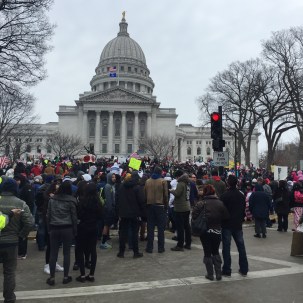 suffering, they also want us to completely disappear, just as we bring them water, and tea, and their meals; just as we clean their homes and cultivate their fields or milk their cows; just as we tend to their wounds, and teach their children, and run their businesses… It is not enough. Never enough! Brown bodies are to be disposed of as if we are trash. To this, our comunidad says ¡BASTA!
 un trabajo estable. La vida en el campo y el trabajo de la finca son duros.

 ting of the year for a large, international organization. As there were going to be new members for the board, it was needed to go around and introduce ourselves. There were people from the four nations where the organization has a presence plus individuals from other nations who reside in one of the four nations represented. Everyone was sharing their names, location, and their job. It was right there when it happened…


 SocioTheology
You must be logged in to post a comment.