Category Archives: Hispanics

Hispanic Heritage Month 2013 Reading List

September 15th through October 15th is “Hispanic Heritage Month.” Here is a list I put together of books that talk about the Hispanic/Latin@ experience in the United States from different perspectives. I have only included books I have read and deemed interesting. I have also tried to capture different aspects of the Hispanic/Latin@ vida: from religion to sociology to economy to immigration… (I still have a very long list of other books to read… once I do read them, they will show up on this list!)

It is my hope that you can grab at least one of these books during this month and learn more about the Latin@/Hispanic experience in the United States. All of the books are in English, as my intention is to reach out to the English-speaking friends of all ethnicities and races. Hope you enjoy!

9.15.12.HispanicHeritageMonth


Religion:

1. Mañana: Christian Theology from a Hispanic Perspective by Justo L. González

2. En la lucha / In the Struggle: Elaborating a mujerista theology. A Hispanic Women’s Liberation Theology by Ada María Isasi-Díaz

3. La Cosecha: Harvesting Cotemporary United States Hispanic Theology by Eduardo C. Fernández

4. Latina Evangélicas: A Theological Survey from the Margins by Loida I. Martell-Otero, Zaida Maldonado Perez and Elizabeth Conde-Frazier

5. Galilean Journey: The Mexican-American Promise by Virgilio Elizondo

Literature:

1. When I Was Puerto Rican: A Memoir by Esmeralda Santiago

2. Almost a Woman by Esmeralda Santiago

3. The Turkish Lover by Esmeralda Santiago

4. The House on Mango Street by Sandra Cisneros

5. The Circuit : Stories From the Life of a Migrant Child by Francisco Jiménez

6. Breaking Through by Francisco Jiménez

7. Reaching Out by Francisco Jiménez

8. How the Garcia Girls Lost Their Accents by Julia Álvarez

9. Christ-Like by Emanuel Xavier

10. Americano: Growing up Gay and Latino in the USA by Emanuel Xavier

11. Santo de la Pata Alzada: Poems from the Queer/Xicano/Positive Pen by Lorenzo Herrera y Lozano

12. My Beloved World by Sonia Sotomayor

History

1. Bacardi and the Long Fight for Cuba by Tom Gjelten

2. Latino Americans: The 500-Year Legacy That Shaped a Nation by Ray Suárez

3. Latinos: A Biography of the People by Earl Shorris

4. Harvest of Empire: A History of Latinos in America by Juan González

5. Latinos: Remaking America edited by Marcelo M. Suárez-Orozco and Mariela Páez

6. Historical Perspective on Puerto Rican Survival in the United States edited by Clara E. Rodríguez and Virginia Sánchez Korrol

Cultural Studies

1. From Bomba to Hip-Hop: Puerto Rican Culture and Latino Identity by Juan Flores

2. It’s All in the Frijoles: 100 Famous Latinos Share Stories, Time-Tested Dichos, Favorite Folktales, and Inspiring Words of Wisdom by Yolanda Nava

3. Latinos in America: Philosophy and Social Identity by Jorge J. E. García

Social & Contemporary Issues

1. Empire’s Workshop: Latin America, the United States, and the Rise of the New Imperialism by Greg Grandin

2. HIS-Panic: Why Americans Fear Hispanics in the U.S. by Geraldo Rivera

3. Illegal People: How Globalization Creates Migration and Criminalizes Immigrants by David Bacon

4. The Presumed Alliance: The Unspoken Conflict Between Latinos and Blacks and What It Means for America by Nicolás C. Vaca

5. “They Take Our Jobs!” And 20 Other Myths About Immigration by Aviva Chomsky

Leave a comment

Filed under Culture, Heritage, Hispanics, History, Latino, Puerto Rico, United States, USA

Lo que la decisión de la Corte Suprema significa para mi familia

Hoy ha sido un día histórico. La Corte Suprema de los Estados Unidos ha determinado que el gobierno federal no tiene razón constitucional para negar los derechos a las parejas del mismo sexo que hayan entrado en contratos matrimoniales donde esos contratos sean aceptados. O sea, que si vives en un estado de la Unión donde el matrimonio igualitario es una realidad, entonces el gobierno federal tiene que reconocer tu matrimonio.

A veces pensamos en asuntos de derechos y los vemos como cosas que pasan “por allá”, “a otra gente”, pero pocas veces le vemos las caras a quienes se afectan por estos hechos. Pues hoy quiero que sepan que estos asuntos tiene nombres, apellidos, familias y que queremos futuros seguros. Mi esposo y yo somos parte de esas miles de parejas que, a partir de hoy, tenemos accesos a derechos que antes no teníamos. Hace un mes somos esposos. Hace poco más de un mes, mi empleador, la Iglesia Bautista Universitaria de Seattle (University Baptist Church) le ofrece seguro médico a mi esposo. Hace ya casi dos años que vivimos juntos, compartiendo todo en el hogar. Sí, el nuestro es un HOGAR. Somos una FAMILIA.

Pero no es hasta hoy que el gobierno federal ha reconocido nuestra relación.

Esta es nuestra situación: hasta hoy, teníamos miedo. ¿Por qué? Pues porque mi esposo está en este país sin los documentos necesarios para residir legalmente en los Estados Unidos. A pesar de que trabaja, paga impuestos, contribuye a la nación, tiene seguro médico, tiene familia en el país, etc., su estatus migratorio nos mantenía en vilo. Hasta hoy, no había nada que pudiéramos hacer. Vivíamos en miedo. Pero hoy ese miedo se ha convertido en alegría…

Hoy mi esposo y yo nos regocijamos de que podemos comenzar el proceso para normalizar su estatus migratorio. Hay por fin una luz – una luz intensa y esperanzadora – al final del túnel. Hoy, gracias a la decisión de la Corte Suprema, puedo patrocinar a mi esposo para que viva y trabaje legalmente en los Estados Unidos. Más que eso, ya no tenemos que tener miedos.

Estas decisiones cambian vidas. Esas vidas que esta decisión ha de cambiar son reales. No importa lo que fundamentalistas pseudoreligiosos digan, estamos hablando de personas, de familias, de seres humanos… Hoy, mi humanidad y la humanidad de mi esposo fueron afirmadas. Nuestros derechos fueron reconocidos. Derechos que hasta hoy solo eran el privilegio de parejas heterosexuales. Pero no. Hoy la Corte Suprema dijo que YO TAMBIEN SOY PERSONA y que mis derechos son tan importantes como los de cualquier otro ciudadano de este país. Mi familia es hoy feliz y no vive en miedo nada más.

Leave a comment

Filed under amor, boda, familia, Gay, Hispanics, Latino, Lesbian, LGBTQ, matrimonio, Puerto Rico

Everyday Hispanic Heritage Project – Ms. Haydeth Tavira

Ms. Haydeth Tavira

Pantry Manager

West Side Campaign Against Hunger, New York, NY

Hunger is a real issue in the United States. After the economic collapse, food pantries across the nation saw a dramatic increment of clients. In New York City, there are several organizations supporting families and individuals who suffer from hunger and other needs. One of these organizations is West Side Campaign Against Hunger (WSCAH.) This is where our Everyday Hispanic Heritage heroine currently works.

Haydeth Tavira moved to the United States from her native Mexico. She is a single mother of three who has lived in New York City for many years. Her commitment to her children didn’t allow her to pursue full time employment, and as luck would have it, she was unemployed or underemployed for long periods of her time. But this did not deter this courageous woman. Instead of staying home, she decided to volunteer with nonprofits in her community. That is when she came to be part of the corps of volunteers at WSCAH.

Haydeth provided support to the staff and clients of the organization. You would find her sorting through donated clothes, unpacking loads of canned food, helping elderly people fill out paperwork, running errands for disable clients of the food pantry and overall doing anything that was needed. She was never discouraged, she never stopped.

Besides volunteering for WSCAH, Ms. Tavira was active in school PTAs, tutoring programs, and any other of her children’s needs. She would often join other women in the community who came to learn English in the program offered by the Church of St. Paul & St. Andrew, where WSCAH rents space. Her courage and determination has always been an example for other immigrant women – single, married, with or without children – who came through the doors of the food pantry.

After many years as a volunteer, Ms. Tavira is now on the staff of WSCAH, and continues serving on other community initiatives. She continues with her commitment to end hunger in New York City and continues being an exemplary mother and friend. Her life is an example of the strong will of the Hispanic people, and for this, Ms. Haydeth Tavira is today’s Everyday Hispanic Heritage heroine!

Leave a comment

Filed under Church, Español, Hispanics, Latino

Everyday Hispanic Heritage Project – Prof. Christian J. Roldán Santos

Prof. Christian J. Roldán Santos

Instructor of Mathematics – Black Hawk College

Rock Island, IL

The Quad Cities between Iowa and Illinois is not precisely the place to find many Latin@s, although, as everywhere else in the USA, this is rapidly changing. There is a new influx of Hispanics due to both immigration and second and third generation Hispanics moving up in the economic ladder. However, it is always difficult for those moving to new places to find the resources to adapt to their new environments. This is why we need all the help that we can get from those who are already established and who are willing to extend their hands in solidarity.

Today’s Everyday Hispanic Heritage hero moved to the American heartland over ten years ago to attend the University of Iowa in Iowa City, IA. Christian Roldán Santos graduated with honors with a degree in Mathematics from the University of Puerto Rico in Mayagüez and immediately moved to Iowa City to pursue a graduate degree. Currently, Mr. Roldán is pursuing a PhD in Higher Education at Illinois State University, Normal, Il. He fell in love with the area and decided to make of the Midwest his home.

Mr. Roldán is originally from Juana Diaz, Puerto Rico. As a gay, Puerto Rican, Latino immigrant he has found that his life is always in limbo. He states that he is “too Puerto Rican and Latino for the United States, too American for Puerto Rico, and too gay for either place.” Perhaps this is what has brought him to be deeply involved in working for justice for Latin@ immigrants as well as for the LGBT communities.

There are many fields in which Latin@s are underrepresented, and Mathematics is one of them. However, Christian has a passion for this field and through his actions has shown the upcoming Latin@ generation that it is possible to pursue a career in Math and Sciences. Mr. Roldán is currently a professor of Mathematics at Black Hawk College in Moline, IL. At Black Hawk he is the advisor to two organizations, the Association of Latin-American Students (ALAS) and Phi Theta Kappa; he also serves as the vice-president of the school’s Senate, coordinator for the school’s International Festival, and volunteers during orientation session to help with international students.

Christian is also very involved in his local community. He regularly visits local schools to give talks and presentations on college life, leadership, success, and diversity awareness. More recently, he is schedule to be a presenter at the Latino Youth Summit at Black Hawk in October. Mr. Roldán also volunteers with the newly created LGBT Metro, an organization that supports gay, lesbian, bisexual, and transgender individuals in the Quad Cities area.

Certainly, Hispanics and Latin@s moving to the heartland of the USA will find inspiration and a supporting presence in Christian Roldán Santos. For all that he does for his community in the middle of the Iowa-Illinois border, Christian is today’s Everyday Hispanic Heritage hero!

Leave a comment

Filed under Español, Gay, Hispanics, Latino, Lesbian, LGBTQ, Puerto Rico, Queer, Sociology, trans

Everyday Hispanic Heritage Project – Dr. Ralph (Ed) Myer, MD

Dr. Ralph (Ed) Myer, MD

Sea Mar Community Health Clinic

Seattle, WA

Hispanics are a very diverse people. More than a common language, Hispanics share a common history, culture, and ethos. Countries in Latin America have welcomed immigrants from Europe, Africa, Asia, the Middle East, and Oceania. This is one of the reasons why so many people find it difficult to define who, exactly, is Latin@. This can be the case with today’s “Everyday Hispanic Heritage” hero.

Ed Myer was born in the state of Washington, USA, to Mennonite missionaries, who shortly after his birth moved to Puerto Rico to serve a small, rural community called Castañer. Ed’s parents served as medical missionaries at the Castañer General Hospital, and his siblings were born there. After their time in Puerto Rico, the Myer family moved to Mexico, where Ed grew up enveloped by the rich culture of the country. After finishing high school, Ed moved back to his home in Puerto Rico where he finished his degree in Family Medicine at the University of Puerto Rico – School of Medicine. He then served at the San Juan General Hospital and a residency at the Merced Community Medical Center of the University of California before moving back to Wenatchee, WA where he worked at the local community clinic.

After some time in the USA, Dr. Myer moved to Nicaragua where he served for many years in rural communities during the civil unrest in the country. He has spent most of his professional life serving poor or rural communities throughout Central America, Mexico, and Washington State. Currently, he is on the staff at Sea Mar Community Health Clinic in Seattle.

None of his patients think of Dr. Myer as a “white” or “Anglo” doctor. On the contrary, very few people believe him when he tells them that his family is actually from the United States. Ed is, for all purposes, a Puerto Rican-Mexican-Nicaraguan and a true Hispanic. His roots are in rural Puerto Rico and Mexico, and his heart still lives in the jungles of Nicaragua where he lived and served for so many years. Providing health care to the Hispanic community in the King County area of Washington state comes easy to Dr. Myer, as he understands this as part of his commitment to this own people.

Ed Myer lives a simple life. He is deeply committed to the environment and proudly states that he produces enough house waste to fill only one bag every month. He has spent decades serving and supporting peace organizations. Dr. Myer commitment to social justice has also led him to be a vocal advocate for immigration reform, economic reform, peace building, and many other important issues of social reform. For all the work that Ed does in his local community and all the work he has done with his Puerto Rican, Mexican, and Nicaraguan communities, Dr. Myer is today’s Everyday Hispanic Heritage hero!

Leave a comment

Filed under Español, Hispanics, Latino, Peace, Puerto Rico, Sociology

The Everyday Hispanic Heritage Project

In the United States we observe Hispanic Heritage Month from September 15th through October 15th. During this time the country is encouraged to reflect on the influence of Hispanic and Latin@ culture to the larger culture of the United States. Often this means to remember and honor the great heroes and heroines of our communities like Gloria Anzaldúa, Dolores Huertas, César Chávez and other Latin@s who have helped raised awareness about the influence of Hispanics in the country. However, seldom do we hear from the “everyday Hispanics” who make a difference in their local communities.

How many of you have heard of the work of Pedro Julio Serrano, Norma Zavala, Sylvia Rivera, Karen Leslie Hernández, Karlo Karlo, Luis Alvarenga, Julio Granados…? The list can go on and on. There are millions of little known Latin@s throughout the country making a difference in their communities. This is why I have decided to start a project, the Everyday Hispanic Heritage Project, featuring one or two of these amazing individuals.

Of course, this is not and could never be a complete list. This is just the beginning. My goal is to raise awareness of the millions of unknown Juans, Marías, Pedros, Gladys, Josés, Anas who give of themselves to make their communities a better place to live.

The project has its limitations of course. One of these limitations is the fact that I do not know all the places where Latin@s are working day to day to transform the lives of others. Therefore, if you know of an amazing story of an unknown Latin@ who is doing great work locally, please feel free to email me and let me know. You can reach me at jmannysantiago@outlook.com .

Leave a comment

Filed under Hispanics, Latino, Puerto Rico, Sociology

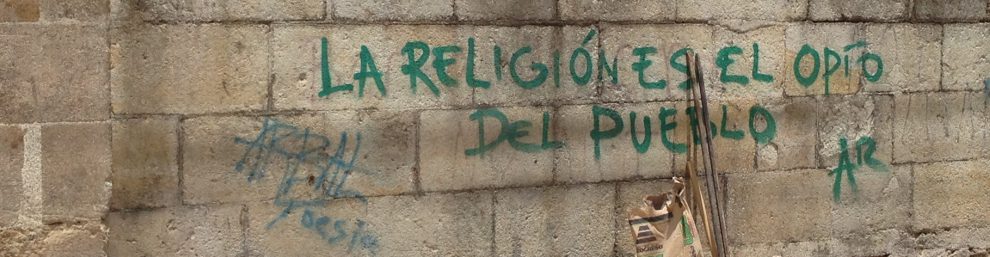
The Problem of Religious Violence in Puerto Rico

Religious violence and fanaticism is nothing new. Both of these have had many manifestations throughout the centuries. In the history of the Church in the West – both Roman Catholic and Protestant expressions – we have seen and experienced religious violence. Within Roman Catholicism this violence was manifested in the institution of the Office of the Holy Inquisition, which accused thousands of people of heresy and brought them to death by horrible means. At the same time, Roman Catholicism fostered the religious wars of the Crusades, which were used to regain control of Jerusalem and Palestine, taking these lands from the Muslim faithful.

Less known are the manifestations of religious intolerance and violence within Protestantism. In the 16th and 17th centuries in Europe, as the Protestant faith was taking shape, pretty much every country had to overcome religious violence. Even the Martin Luther, the main reformer of the church in the West, was guilty of persecution when he condoned the execution of hundreds of peasants who wanted to take his reforms too far in his native Germany. In England, thousands of Catholic martyrs were killed because of religious persecution thanks to the actions of Queen Elizabeth, who sought to keep her political and religious stability through bloodshed.

More recently, in the Americas, we have seen religious wars between Roman Catholics and Protestants in the Mexican state of Chiapas, where faithful from both parties accuse each other of having desecrated the Christian faith. Puerto Rico has not been exempt from these manifestations of violence, especially expressed through the work of self-proclaimed religious leaders who frame their religious sermons in war rhetoric. For instance, often times during religious meetings in Puerto Rico, the term “spiritual warfare” is used to describe the relationship between those who profess the Christian faith on any given way and those who have a different understanding of the faith or those who have no faith. The problem with these manifestations of religious intolerance is that bring us to demonize “the other” thus taking away their personhood and transforming them into objects of hate.

Religious intolerance in Puerto Rico has much to do with the little theological education of the religious leadership. More often than not, this lack of theological education is more evident in those institutions that are not related to an established denomination. In Puerto Rico we have seen a sprouting of faith communities of charismatic theology and many “independent”  churches where the leadership role is filled by people who have proclaimed themselves “Apostles”, “pastors”, or “bishops” without having gone through the rigorous theological training required by many established denominations.

The proliferation of independent and charismatic/Pentecostal churches has also left a deep imprint in those faith communities that have traditionally been theologically educated. This is so, I believe, because those churches that require theological training do not have the resources to compete with those who send out without theological training to the pastoral field. Because of this lack of resources – particularly economic resources to send people to theological schools – both Roman Catholic and mainline Protestant communities are very often led by lay people without any or very little theological training.  This creates an environment where the leaders bring their own theological interpretations with multiple local biblical interpretations based on the social mores and understandings of the leaders. Unfortunately, these local interpretations of Scripture either dismiss or do not take into consideration the evolutionary reality of the development of the dogma and doctrine. There is no attention to how one belief is developed and why it exists.

Although the Puerto Rican people have tried to dismiss our Latino history and identity, preferring a pseudo-Americanization based on a myth, the truth is that we still show our plantain stain[i]. We are a Latin/Hispanic country. As such, we tend to grant power to those people who show greater charisma and personality. Church communities in Puerto Rico show this reality when they (us) grant leadership positions to those who claim to have received a direct message from God appointed them – or rather, self-appointing – as “God’s chosen and sent.” This is in spite of their lack of theological education for the most part. It is in this context where most religious leaders whose congregants are also voters come to be the perfect place for the political elite of all stripes to gain support.

Politics in Puerto Rico is also a manifestation of our latinidad, and thus it grants power and authority to those with more charisma and personality. The political ideas or platforms are irrelevant if a political party has enough money to buy the conscience of the people who watch sparkly TV and newspapers ads. Religious leaders are the perfect people to bring voters to the voting booths, regardless of the policy positions of the political parties. This is even more evident when we see in Puerto Rico the overwhelming support that Roman Catholic, conservative candidates receive from Pentecostal, charismatic, and conservative evangelical leaders in spite of these leaders’ violent and open anti-Catholic rhetoric. This makes for very interesting bedfellows, and to my knowledge, is not very common in other democratic societies, with the exception of the USA, country to which Puerto Rico belongs. These alliances are, perhaps, just a way for conservative religious leaders to gain access to power and prestige in order to impose their own religiously-motivated policy agendas.

Church-State separation in Puerto Rico is but a historical footnote printed in our Constitution. This separation is not practiced because it does not favor the establishment of political-religious elites. Historically, this separation was brought up with the idea of keeping the Church safe from the intervention of the State. The Baptist community, of which I am a part, fought incessantly to protect this separation. There are thousands of Baptist martyrs who died because of their position on this particular theological principle. Unfortunately, within the greater Baptist family, the principle of Church-State separation is but a mantra that is repeated without understanding what it means or how much it cost us to gain. It is even more unfortunate to see how a multitude of religious groups with a charismatic and Pentecostal tendency have influenced in the way in which our Baptist faith communities interpret this Biblical principle of separation.

Recent manifestations from self-appointed religious leaders in Puerto Rico are also a testimony to the lack of theological education that these people have been exposed to. Often, when any form of theological education has taken place, is in the form of a “Bible institute” in which you are taught how to memorize Scriptural texts but any contextual interpretation of the Bible is dismissed. These institutes tend to prefer a so-called “literal” approach. What the people trained in these institutes do not realize is that their “literal” reading of the Bible is actually a way of interpretation, in which their own mores and socialization is read into the text. Moreover, these literal readings of the Sacred Text lead people to the sin of idolatry, putting the Sacred Text en par and often times above the Triune expression of the Divine Mystery.  This form of idolatry, bibliolatry, has been extensively studied in recent years.

In more concrete ways, we note how the religious leadership in Puerto Rico has tried – often times very successfully – to influence the creation of public policy. By implanting laws that take away rights from the LGBT communities and protections to women in particular, the religious leaders have demonstrated that their interest goes beyond religious intolerance. These actions are actually a representation of these people’s desires to establish a form of “constitutional theocracy” where only those deemed “right” should have rights and be protected. This is an extension of their erroneous eschatological theologies in which the Reign of God is to be established by all means necessary.

This, of course, does not contribute to create a peaceful environment. These are in fact the roots of the cultural wars we are continually exposed to. What the religious leaders forget, though, is our call as people of faith to imitate Christ and to open stop closing the doors to those who are different from us/them. Interestingly, if these leaders paid any attention to the New Testament, they will see that it is filled with instances in which Jesus rebuked those religious leaders who wanted to implement their own interpretations of the Sacred Scriptures upon others. Again, we note how the religious leaders in Puerto Rico put the laws of the Bible above the example of Jesus, committing bibliolatry.

Ecumenical conversations in the Island are – from my perspective – not very useful either. Ecumenism in Puerto Rico is reduced to a series of liturgical celebrations and very few, watered-down, and sporadic round-tables. Even these ecumenical instances are marked by their lack of diversity. In Puerto Rico, ecumenism often takes place in one of three ways:

– Roman Catholic “ecumenism” that tries to bring the lost back to Rome.

– Mainline Protestant ecumenism that is watered-down and downplays the role of difference in Biblical interpretation in the name of “peace” and “unity.”

– Conservative evangelical and Pentecostal ecumenism that is more often than not a way of “saving” those lost Roman Catholics and mainline Protestants who have let theological education and church history “rot their minds.”

Perhaps it is time for ecumenical conversations in Puerto Rico to start anew, bringing to the table both what unites us and what separates us. Perhaps it is time to revive those ecumenical actions that happened during the people of Vieques’ fight to get the US Marine out of their island-municipality. Perhaps it is time for religious people in Puerto Rico to finally acknowledge the presence of Buddhist, Muslim, Jewish, Santero, Espiritist, and other forms of religions that are widely practiced in the Island and invite them to the conversation.

When Puerto Rico suffered the recent systematic killing of gay, lesbian, and especially transgender individuals, no church, to my knowledge, raised their voice of protest to denounce these atrocities. Yet, when a great Puerto Rican humanitarian like Ricky Martin brings his concert, a myriad of religious leaders came to protest. Why? Perhaps because Ricky is doing exactly what they are not: saving children from the hands of unscrupulous predators through his foundation to stop human trafficking. This is something that the churches in Puerto Rico are not doing. The shame that these religious leaders must be feeling might have moved them to raise their voices… These religious leaders are often more interested in “saving the souls” of the little kids while ignoring their current oppressed realities. This is certainly deplorable.

Many of us have already experienced the pain of having been excluded because of our theological leanings, our sexualities, our socio-economic realities and even our racial backgrounds. I was one of this people who suffered this pain both from society at-large but more painfully from the church. I believe that if there is any hope for the Church in Puerto Rico to be redeemed it will be when the Church – in all its expressions – publicly confesses its sins of rejecting God’s diversity in creation. In the meantime, the violent environment they have created from their hostile pulpits will continue to foster violence, deaths, murders, attacks to LGBT people, oppression to women and the working class, and a plethora of other social ills. This hostility from the pulpit has also reached the Legislature and the Executive branch and it is the primary responsible for bringing about the pain of death and violence in our Island. It is time to put an end to the bully pulpit of the Puerto Rican Church, and to begin living out the blessing of having God’s diversity in creation recognized. Until them, a peaceful living will be hard to achieve.


[i] There is a saying in Puerto Rico, “se te nota la mancha de plátano”, which translates to “you show your plantain stain”, making reference to the difficulty of hiding our identity as a historically rural-based and farming country.
Leave a comment

Filed under Church, Gay, Hispanics, Latino, Lesbian, LGBTQ, Peace, Puerto Rico, Queer