Category Archives: Philosophy

There Is No Pie! A Reflection on Power Dynamics and Racism

There is no pie.

None. I am not writing about food, though. I am writing about power, power dynamic, and how language fails us to explain these concepts and what it is that communities of color demand from our white colleagues and fellow humans. This is a semi-long opinion essay. Here I discuss several concepts and ideas, starting with language in general, some theological concepts, and finally, various sociological concepts related to social dynamics and power. If these things interest you, this will be a fun read. (Or maybe I have a weird sense of humor…)

Language is probably the most important human invention. It is so important that many anthropologists consider language to be the human invention that helped differentiate our ancestors from other primates. Language is important and one of the most powerful tools we have at our disposal. Nevertheless, like any human invention, language is not perfect. Although language helps us to communicate as clearly as possible, there are still limitations. Many of these limitations can be seen more clearly when it comes to explaining, describing, and understanding immaterial concepts.download (3)

As many communities in the United States engage in difficult conversations about racism, anti-blackness, power dynamics, social interactions, and other relevant realities, I thought of sharing my ideas on how language fails us to describe power dynamics.

In many occasions, humans make use of the tools we have within our languages to make sense of difficult immaterial concepts. It is common for us to use similes, metaphors, analogies, and other linguistic tools to explain difficult concepts. Allow me to use some examples from a field I am quite familiar with: Christian theology.

Perhaps one of the most difficult theological concepts to explain is the Trinity. In the history of Christian theology the concept of the Trinity has been tried to be defined and explained by both Trinitarian Christians and those who object to this understanding of God. If you were raised in any form of Christianity, the concept of the Trinity was presented in simple, easy to understand analogies… that probably were far from what the theological concept of the Trinity really is. You probably heard about the Trinity being like water, which can be liquid, solid, or gas and yet it’s still H2O. Or perhaps you are more familiar with the egg analogy, where the yolk, white, and shell are all part of the egg yet not the whole egg. The analogies are many, and none actually explains what the Trinity is without falling into some sort of heresy, according to historical Trinitarian theology.

A good, simple theological explanation of the Trinity is this: a theological mystery that explains the relationship between the three Persons who make up the reality of God as Parent, Incarnate Expression, and Holy Spirit, all three being one while also being separate from each other but never subjected to each other, they each exist from eternity to eternity and are coequal with each other. Simple, right? Ha! Now you can understand why the tools our languages have to express complicated immaterial realities always fails us. There is no simple way of expressing this theological concept and thus, most theologians hold on to the simplest of explanations: the Trinity is a mystery. Period.

Thankfully, if unless like me, you are not a theologian, this mental gymnastics is not going to affect your life. Nevertheless, there are immaterial concepts that are difficult to explain in simple words and yet affect our daily lives. This is where the concept of “the pie” comes into play.

Power dynamics in the USA live in the context of a complicated history. I will not go into historical details, but I believe we can agree on certain general points that are accepted for most people. First, the USA has a history of racism with which it has not dealt appropriately. Second, racial relations – as well as other power dynamics – permeate pretty much every interaction among people in every social context, from shopping to parenting to education and politics. I would argue that even those hegemonic contexts in which everyone belongs to the same perceived racial background are not exempt from these racial realities. White people assume their superiority based on their socialization regardless of whether they have the chance to interact with people they have been socialized to believe are inferior. On the other hand, communities of color are always aware of these social and power dynamics regardless of whether we are in the presence of white folk or not. In fact, it has been my experience that even in non-academic, family interactions where all are Latino people, we implicitly or explicitly engage in conversations strategizing how to survive and thrive in the majority white contexts in which we interact. Take for instance, when my own family engages with the youngest members of our family to encourage them to be successful in school and life… making use of the patterns, systems, strategies, goals, and mores established by the white majority. We do not have to name the systems and who developed them in order to engage in conversations on how to move within them. Finally, a capitalist and an historical European, Protestant work ethic permeates these power dynamics. Those who can adapt to this socio-religious-economic ethic will have more chances of survival than others.

imagesHere comes the “pie chart” that characterizes most conversations about resources. Power is, in my opinion, another resource. It can be used by those who have it in order to advance, or to access opportunities, or to affect change – good and bad – in society. The problem is that, what I call “the pie understanding of sharing power” negatively affects the way in which we engage in conversations about what it is that minority communities demand from the majority.

In the European Protestant work ethic, resources determine success. The person with more resources has earned the favor of God, therefore, it is their right to continue amassing power. Moreover, since power is a resource granted by God, and salvation is an individual transaction between a human and their God, it is expected that individuals continue finding ways to gather power, even at the expense of others who will lose their power. This is, I believe, at the core of capitalism. This is also a self-preserving system. The more power you have, the more you show that God has favored you. Therefore, you need to continue amassing power in order to show how much God has favored you. Those with no power have the option of finding ways to obtain power, and with it, show that God has also favored them. Since power can be amassed, those who have it present themselves as an example of how you, too, can receive and amass power if you only work hard enough for it. The problem comes when everyone starts thinking that power is finite. There are several ways to obtain power, but in this context only two are relevant: you earn power by buying it from others, or you fight for it at the expense of others who will lose it to you. Or in simple terms: some people will have large pieces of the pie, others will have slimmer pieces, and others will have no pie whatsoever.

Therein lays the problem with the pie analogy for power. There is no pie! None!

The recent conversations on racism have revolved around how to divvy up the pie. It seems like for the most part, people think that communities of color and other minoritized peoples have been trying to get a piece of the pie that majority groups have been cutting for themselves. To many people who noticed that their pieces of pie were larger than that of others, this is a problem they want to fix by either redistributing the pieces of pie, or – in my opinion, the ones that are a bit more advanced in their understanding of the complex racial realities we live under – they try to share their own pieces in order to show solidarity. Both of these approaches are honorable, as those with pieces of the pie have never experienced any other way to interact with their power. They are, in my opinion, a bit closer to understanding the demands of oppressed communities. Nevertheless, I reaffirm: there is no pie.

The pie analogy is one of the ways in which language fails us. It tries to simplify a very complex concept in order to make it more digestible (yup, pun intended!) Power is, like the Trinity, a complex, immaterial concept that cannot be explained in simple terms. Just like the Trinity is neither an egg nor water, power is neither a pie nor a table in need of more chairs to accommodate minoritized communities. Although these concepts can help us start the conversation, they cannot be the ones used to engage in deep, comprehensive, and serious conversations about systemic change and power relations.       pie-fight-group-cartoon-people-cream-pies-46001112
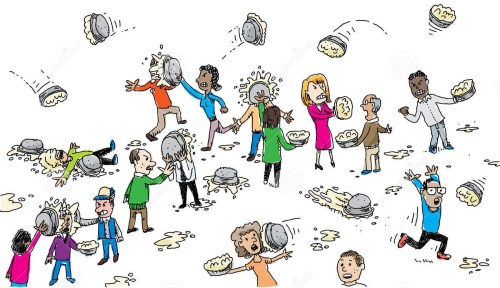
Marginalized, minoritized, and oppressed communities are not asking to share the pie. In fact, for many of us, is not even about being able to bake a pie! At the heart of the matter is what types of systems are needed to share power in order to identify the needs of the whole. It is also about coming up with solutions that address the very complex realities in which we live. It is about sharing power in all of its complexity, without taking power away from anyone. That is something the pie analogy doesn’t address. Moreover, it is this flawed analogy of the pie the one that makes it scary for the majority to engage in conversations about power dynamics. The thought of losing a piece of the pie is scary, especially when you have been socialized to believe that the piece of the pie is the seal of favor and success from your God.

Language will continue being the most important tool in human history. It is also important to know how to make use of it. Language affects the way in which we interact with each other and whether we can advance in our understanding of each other’s needs and wants. Using analogies will help us start conversations, but it cannot be the end of it. In fact, when an analogy doesn’t help frame the conversation in the best way, perhaps it is time to stop using it. My suggestion is to stop framing the conversation in relation to how the pie is to be sliced and shared, and instead talk about the nuances of shared power and systemic structural changes that will allow for more people to collaborate. The conversation can be framed in ways to collaborate and learn from each other. Instead of scaring people by suggesting that they will lose something in order to share with others, let’s start talking about the infinite amount of resources that exist in our social contexts to help collectively solve complex problems. Besides, I have never liked pies anyway…

Leave a comment

Filed under Culture, discrimination, Human Rights, Leadership, Philosophy, power, race, Racial Relations, racism, Social Movements, Sociology, USA

Disruptive Nature

I don’t remember when was the last time I posted something to this blog. I do know that it’s been a very long time, and that much has happened since then. At some point I thought I would just leave this blog there, untouched, with a series of mementos that were put into writing. But among the many things that have happened in the time since my last post, is the disruption of our lives to such an extent that I needed to write again.

It’s already been months since a novel coronavirus disrupted our lives. By now, I have been working from home for almost a month. My husband is also home for about the same length of time, due, first to a cough that kept him away from work and then because the restaurant where he works laid him off after having to close that location during the pandemic. Adjusting to this new reality has been rough, to say the least. It’s taken us some time to adjust and find our new routines.

One of the things I do now daily is take long walks around my neighborhood. Every day after I finish with work, I put on my jacket, hat, and walking shoes, place a little bottle of disinfectant on my pocket, grab the keys and head for a walk. It’s been really enjoyable to see things from a different perspective. I prefer to walk without any headphones. I want to enjoy the sounds around me. Cars passing by. Birds chirping as they welcome the first glimpses of Spring. People jogging or families walking together while chatting. The sound of a lawn mower in a sunny early evening. The orchestra of leafs and branches captivating my attention as I walk by. I see new things that I rarely if ever noticed when driving by the same places. Light. Colors. Forms. Beauty.

IMG_3537

This afternoon during my walk I noticed sometime that made me stop on my walk. Although I rarely take pictures during my walks, I took the picture that accompany this writing today. These little flowers are some of my favorite. They are wild flowers that grow wherever they feel like growing. Wherever a bee or a butterfly or a beetle or the wind took their seeds, there they grow and blossom.

These past few months we have experienced how nature can drastically disrupt our lives. A tiny, microscopic living being — a virus — has come to disrupt our lives in such a way that nothing will feel or be the same again for us. Nature can disrupt our lives in this way; without notice. As a theologian — albeit, atheist by choice, but a theologian nonetheless — this feels like creation. The disruptive nature of a world that is always being created, never stopping, always changing… It is the disruption of what we thought natural, orderly, comforting. This creation that along with the hurricanes that devastated my Island, and the earthquakes that finished it up, shake us up to the core and leave us in pain, grieving, mourning, pleading achingly for a moment of rest in the midst of all the chaos.

And then, on my walk, I find another sign of the always happening creation: a tiny plant breaks through the earth, and the grass that surrounds it, and parts of the human-made pavement that tried with all its apparent might to drown it. Nature disrupts again. It disrupts to remind us that, little and as insignificant as we might think it to be, it can burst through it all and still blossom.

I stopped. I touched this marvelous tiny piece of creation. I smiled to and with it. I acknowledged that just like the virus that has disrupted our lives, this too is creation. Nature disrupts us in ways we cannot imagine. It has done with in painful ways. It also does it in beautiful, inspiring, uplifting, and hopeful ways. Let it be. Let nature disrupt us with its beauty and passion. Let nature disrupt us with the reminder that it can burst out of the most unimaginable places to remind us that there will always be beauty and strength.

Leave a comment

April 1, 2020 · 8:01 pm

Seven Words of Christmas

Word ArtThe news have reported that the current White House administration instructed the Centers for Disease Control (CDC) from using seven words on their budget documents. With seven days left for Christmas, I decided to take the time to write a piece each day highlighting one of the seven words.
In the Christian tradition there is the sharing of the Seven Words. These are phrases that Jesus shared while being crucified. Many Christian churches share and preach on these Seven Words during their Good Friday liturgies. The Seven Words are the climax of what Christian theology calls “the story of salvation.” The last words that Jesus shares are: “it is finished” (John 19.30) and “into your hands I commend my spirit” (Luke 23.46.) After these words, Jesus expires.

According to the timeline of events, after Jesus expires on the cross he is placed into the tomb and on the third day he is resurrected. This is the hope of the Christian person: no matter how difficult the journey is, no matter how painful the culmination of life is, there is always the hope of resurrection. This is the message of Holy Week.

Why am I writing about Holy Week on the season of Advent leading into Christmas? Because the Seven Banned Words of the CDC are a mirror of those other Seven Words of Holy Week.

The current federal administration has been crucifying the remnants of the facsimile of democracy that the United States had. With each carefully orchestrated move, the current administration tries to diminish the people’s confidence and trust on institutions serve the country. They are intentional in the use of words to describe the institutions that keep some resemblance of democracy. The administration’s furious attack on the free press, their obsession with political rallies a year after elections, their systemic appointment of people completely unprepared and unqualified to lead the agencies they are appointed to oversee, their deliberate construction of lies disguised as truth, the unashamed use of FOX News as state propaganda television, and a myriad other big and small actions that undermine democratic processes are just the tip of the iceberg. The United States democracy is being crucified.

Diversity

Fetus

Transgender

Vulnerable

Entitlement

Science-based

Evidence-based

These words represent all that society stands for when they are on their way to progress. French philosopher and founder of Sociology, Auguste Comte, wrote about the stages of human progress. In Comte’s theory, societies move towards progress. There are three stages of society: theological, metaphysical, and positivist. A theological society looks at an unknown occurrence and places all responsibility on unseen beings that control our destinies. Any possibility of progress is thwarted by the society’s fear of angering their mythological beings. A metaphysical society is in the middle stage. Societies in this stage begin to understand that there are certain things that have an explanation. The understanding of actions and their consequences are part and parcel of this society’s natural development. Neither one of these two types of societies is inherently corrupt or ignorant. You cannot know what you do not know. However, these are not ideal societies. The ideal society is one in which members are exposed to a systemic way of understanding truth. To this Comte called a “positivist society.”

Although Auguste Comte’s positivist approach to explaining society is not ideal, it does have merit, especially taking into consideration the banning of words in certain official documents by the current administration. A positivist society understands that humanity is on a journey forward. This journey cannot be contained, no matter how much the powers that be may try to stop it. Resurrection is the conclusion to the crucifixion. Progress is the conclusion to temporary repression.

Democracies are vulnerable entities. They can suffer from the ego of leaders who place power over service. Interestingly, Christmas is the time of vulnerability. In the Christian tradition, Christmas commemorates the birth of a vulnerable child, from a vulnerable family, who was threatened, even as a fetus, with destruction by its enemies – political, economic, societal, cultural, and religious, among others. Christianity proclaims that this child that was born transcended what humanity understood at that moment about the relationship between humanity and its divine sovereign. Some theologians propose that this transcending experience of God made Sophia, the common image of God as Wisdom, take the form of Christ in the person of Jesus, thus making God a transgender reality showing humanity how close the Divinity is to all of humanity. The diversity of opinions that ages of science-based social studies and evidence-based conclusions have shown us, is evidence that societies do tend to move forward towards progress and positivism. It is our responsibility, our duty, and even out entitlement as engaged members of a functional society, to be in solidarity with the vulnerable democracy that we are so desperately trying to save. Resurrection is the conclusion of crucifixion, even during the time of Advent and Christmas.

Leave a comment

Filed under Academy, Creativity, Culture, discrimination, Human Rights, Identity, LGBTQ, Philosophy, Queer, resistance, Sociology, Theology, trans, transgender, United States, USA

The Church Is Not A Safe Space

The last time I was in church was for the installation service of a close friend. I attended because she invited me to preach and that was a huge honor. The last time I attended church before that was the Sunday after election in the USA. Having been raised in the Church, I often relied on this community to be the safe space where I could bring my fears into with the hopes of being healed.

When Republican Party enthusiasts, emboldened by the rhetoric of President Trump and Republican leaders in the USA Congress, led a group of white supremacists, Nazis, and Ku Klux Klan sympathizers to march on the streets of a public university in Virginia, I felt the need to return to Church. I woke up on Sunday with the idea of finding a nearby congregation to attend. Somehow, I had equated church with healing and community and restoration. But then, I started to doubt it. I stopped to think about what Church had really been for me. All throughout my life, Church had not been a welcoming, healing, restoring community. On the contrary: Church was the people marching on the campus of the University of Virginia with torches, threatening many of my communities with violence and death.1374087_10152239912835620_459114692_n

Since my childhood time in Church, I had only heard hatred and violence against “sinners.” The goal was to rid the World from the sinful; to establish God’s kingdom, where the violent will reign with Christ and the Earth would be transformed into their playground. The images of fire and destruction were the ones used to exemplify this future. The King will stand to divide the crown and send some – the goats – to the pits of hell to rot for eternity, with pain and punishment unimaginable. Others – the sheep – will be lifted up to heaven to be with their Ruler.

I have been in several churches throughout my life, both as a parishioner and as a pastor. Every church has been different: my rural Baptist church in Puerto Rico, the underground Metropolitan Community Church also in Puerto Rico which I led for a few months before going to seminary, the urban, large Baptist church that sent me off to seminary, the suburban, white, moderate Baptist church that ordained me, the small, urban Hispanic Baptist church in New York City that welcomed me as their pastor, the multicultural, urban Methodist church also in NYC that provided refuge and welcomed me as a leader, the urban, liberal, white church in Seattle that made me question my call to ministry and which proved me that liberal churches are no safer than conservative ones, and the little suburban Episcopal church in Wisconsin with a worship service in Spanish that offered a few months of refuge while I served other ministries.

Here is what Church has done to me:

Church was the place where my first conversion therapy sessions happened. It was the place where I was made ashamed of my sexuality. It was the place where I learned to be secretive and embarrassed about liking men. It was the place where people gossiped about their neighbors throughout the week while coming to pray together on Sunday.

Church was the place where I had to hide my sexuality even as I was both on the ordination process and as I served as a pastor. It was the place where I was asked not to be creative with liturgy as this was not welcomed. Such experience was once again relived as I was invited to write for a white denomination’s worship resources and my work was deemed too “intimidating” because it didn’t fall within the liturgical styles of the white church. Both homophobia and white supremacy were present this weekend in Virginia. Both homophobia and white supremacy were present in this church experience for me.

Church was also the place where the white visitor who saw me walking down from my office responded to my greeting by saying “Are you the janitor?” No, I was not. I was the preacher that day, and perhaps that’s why you didn’t come back?

Church was the place where, behind closed doors and without ever telling me, the congregation had the excellent idea of paying for speech classes for me to become a better speaker of English… instead of learning how to accommodate their ears to a different accent. But that’s OK for them, because they are “liberal” and they “get it.” They too were present at the demonstrations in Virginia.

Church was the place where the fragility of the person who bullied me was most important than my safety. It was the place where I approached with caution because each time I pulled over to the parking lot, my hands started to shake and my heart started to race as the bully’s car was parked there too. It was the place where her dismissal of my leadership was encouraged; the place where they welcomed meetings with her behind my back to talk about the supposedly weak pastoral care I was providing the congregation, without ever knowing that I was often visiting, listening, calling, and praying with the elders who had asked me point blank to please keep this woman away from our household because they were afraid of her too… But I could not tell her that without facing the doubtful stares of cheering crowd. Church was the place that didn’t allow me to fall asleep from Friday night to Sunday night just because of the fear I had of coming to worship on Sundays. Even after trying different prescriptions – yes, prescriptions from my doctor – and relaxation methods, I could not do it. The bullying was that strong, and the lack of support was too much. This white fragility that didn’t allow this bully to recognize the leadership of a Latino man in church also marched in Virginia this weekend.

Church was the place where the priest addressed the violent rhetoric of the election season and the overwhelming support of white supremacists for President-elect Trump by calling the small group of Latino and Latina people by asking us… us… to come together with our oppressors and to find unity.

This was the last drop. I had tried long enough to make the Church a place of respite and community. The Church has not been such a thing for me. I need to break from this abusive relationship for good. Church, you are not safe for me as long as you march with torches and hatred.

Perhaps Church has been different for you, and for that, I am glad. Perhaps you will send a few words of “encouragement” and some apology on behalf of the Church. Don’t. I do not need them, nor do I need to explain more than I had already expressed here. Theology as a discipline and a field of study will continue to be a passion for me. The Church as a place for community, on the other hand, will not.

2 Comments

Filed under Church, Culture, discrimination, ethnicity, Gay, Human Rights, Identity, LGBTQ, ministry, Philosophy, Queer, race, racism, Sociology, Theology, United States, USA

Trying to Argue With Circular Logic

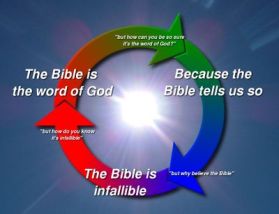
When I was in college I was introduced to the concept of circular logic or circular reasoning. This is a form of logical fallacy in which the reasoner starts with the argument they want to use as their conclusion. To some extent, the argument can be made that this type of logic is the bedrock of religious reasoning. In fact, it was through religion that I was introduced to use circular logic as my modus operandi for reasoning: the Bible is the Word of God because the Bible says it is the Word of God, therefore, it must be true that the Bible is the Word of God. There is no way of going away from this reasoning… you just have to either accept it altogether or reject it altogether. But if you are a religious person who has never been exposed to any other way of reasoning, leaving this type of logic is not an option.400px-bible_cycle

It has been a while since the last time I had a conversation with anyone who used circular logic. For the most part, I try to stay away from trying to engage in philosophical conversations with people who use this type of reasoning. Sure, I could have wonderful conversations about the weather, aspects of life, work, ourselves, etc., but it is impossible to have real conversations regarding faith with people who only use circular logic for their religious arguments. There are some people who might realize that they use this type of reasoning and, not wanting to step away from it, just accept that other people have other ways of looking at things and move on. But there are others for whom circular logic is so ingrained in their lives and way of thinking that they cannot comprehend why someone would step away from this way of thinking in order to find answers somewhere else. For some of them, trying to convince you to go back to using circular logic is not only their mission: it is their duty in life as the lives of those around them depend on it!

Unfortunately, I fell for this not long ago. When I noticed that I was engaging in a one-way conversation with someone who could only use circular logic, it was too late for me to step away. I tried, but failed miserably, to point out the invalidity of the arguments. Of course, this was to be expected! How can an argument be invalid if the only way to validate it is by going back to the premise that made the argument valid in the first place! Ha!

Although I grew up using circular logic for my religious arguments, I have come to grow in my understanding of religion and faith. I now use all the tools available to me in order to understand the religious premises that I live by. I have also come to understand that other people will have different ways of approaching the same questions I have, and that many times, depending on the approach, the answers will be different. The fact that the answer is different doesn’t make it invalid; it just makes it… well… different! I accept that. Thanks to the wonderful mentoring of Angela Figueroa, who was the sociology of religion professor who introduced me to the world of deductive and inductive logic and how to step away from circular logic, I have come to grow in my understanding of religious arguments and how to use them. I have also come to understand that “feelings”, “hunches”, and “inklings”, are not valid reasons to start arguments and to come to conclusions. That doesn’t mean they do not have a valid place in the human experience of the immaterial (or God, or the Divine), it only means that they cannot and should not be used as the bedrock of argumentation.

When I stepped out of using circular logic to “prove” my religious believes, it was a painful process. For a very long time I felt lost, confused, and completely out of control. There was a time when I even came to accept as my reality that there was no evidence of a Divine being, and therefore, there was no such thing. It took me a long time to understand that I could still be faithful, religious, and connected to a Divine being without the need to base my beliefs in circular logic. But again, this is a long and painful process. In my recent conversation, I failed to understand and accept that the person using this type of logical fallacy could have been deeply hurt by stepping out of their way of thinking. I only hope that our conversation was a small seed planted in them to be able to see the wonderful, fulfilling, and satisfying opportunity to have a faith that continues to grow and not one that is stuck in an empty sphere that takes you nowhere in your relationship with God. I also hope that I do not have to engage in another argument like this, as it was extremely painful to see how little progress you can make in trying to have an actual conversation when the other participant has already decided what the conclusion must be.

1 Comment

Filed under Church, Logic, ministry, Philosophy, Sociology, Theology