There is no pie.
None. I am not writing about food, though. I am writing about power, power dynamic, and how language fails us to explain these concepts and what it is that communities of color demand from our white colleagues and fellow humans. This is a semi-long opinion essay. Here I discuss several concepts and ideas, starting with language in general, some theological concepts, and finally, various sociological concepts related to social dynamics and power. If these things interest you, this will be a fun read. (Or maybe I have a weird sense of humor…)
Language is probably the most important human invention. It is so important that many anthropologists consider language to be the human invention that helped differentiate our ancestors from other primates. Language is important and one of the most powerful tools we have at our disposal. Nevertheless, like any human invention, language is not perfect. Although language helps us to communicate as clearly as possible, there are still limitations. Many of these limitations can be seen more clearly when it comes to explaining, describing, and understanding immaterial concepts.
As many communities in the United States engage in difficult conversations about racism, anti-blackness, power dynamics, social interactions, and other relevant realities, I thought of sharing my ideas on how language fails us to describe power dynamics.
In many occasions, humans make use of the tools we have within our languages to make sense of difficult immaterial concepts. It is common for us to use similes, metaphors, analogies, and other linguistic tools to explain difficult concepts. Allow me to use some examples from a field I am quite familiar with: Christian theology.
Perhaps one of the most difficult theological concepts to explain is the Trinity. In the history of Christian theology the concept of the Trinity has been tried to be defined and explained by both Trinitarian Christians and those who object to this understanding of God. If you were raised in any form of Christianity, the concept of the Trinity was presented in simple, easy to understand analogies… that probably were far from what the theological concept of the Trinity really is. You probably heard about the Trinity being like water, which can be liquid, solid, or gas and yet it’s still H2O. Or perhaps you are more familiar with the egg analogy, where the yolk, white, and shell are all part of the egg yet not the whole egg. The analogies are many, and none actually explains what the Trinity is without falling into some sort of heresy, according to historical Trinitarian theology.
A good, simple theological explanation of the Trinity is this: a theological mystery that explains the relationship between the three Persons who make up the reality of God as Parent, Incarnate Expression, and Holy Spirit, all three being one while also being separate from each other but never subjected to each other, they each exist from eternity to eternity and are coequal with each other. Simple, right? Ha! Now you can understand why the tools our languages have to express complicated immaterial realities always fails us. There is no simple way of expressing this theological concept and thus, most theologians hold on to the simplest of explanations: the Trinity is a mystery. Period.
Thankfully, if unless like me, you are not a theologian, this mental gymnastics is not going to affect your life. Nevertheless, there are immaterial concepts that are difficult to explain in simple words and yet affect our daily lives. This is where the concept of “the pie” comes into play.
Power dynamics in the USA live in the context of a complicated history. I will not go into historical details, but I believe we can agree on certain general points that are accepted for most people. First, the USA has a history of racism with which it has not dealt appropriately. Second, racial relations – as well as other power dynamics – permeate pretty much every interaction among people in every social context, from shopping to parenting to education and politics. I would argue that even those hegemonic contexts in which everyone belongs to the same perceived racial background are not exempt from these racial realities. White people assume their superiority based on their socialization regardless of whether they have the chance to interact with people they have been socialized to believe are inferior. On the other hand, communities of color are always aware of these social and power dynamics regardless of whether we are in the presence of white folk or not. In fact, it has been my experience that even in non-academic, family interactions where all are Latino people, we implicitly or explicitly engage in conversations strategizing how to survive and thrive in the majority white contexts in which we interact. Take for instance, when my own family engages with the youngest members of our family to encourage them to be successful in school and life… making use of the patterns, systems, strategies, goals, and mores established by the white majority. We do not have to name the systems and who developed them in order to engage in conversations on how to move within them. Finally, a capitalist and an historical European, Protestant work ethic permeates these power dynamics. Those who can adapt to this socio-religious-economic ethic will have more chances of survival than others.
 Here comes the “pie chart” that characterizes most conversations about resources. Power is, in my opinion, another resource. It can be used by those who have it in order to advance, or to access opportunities, or to affect change – good and bad – in society. The problem is that, what I call “the pie understanding of sharing power” negatively affects the way in which we engage in conversations about what it is that minority communities demand from the majority.
In the European Protestant work ethic, resources determine success. The person with more resources has earned the favor of God, therefore, it is their right to continue amassing power. Moreover, since power is a resource granted by God, and salvation is an individual transaction between a human and their God, it is expected that individuals continue finding ways to gather power, even at the expense of others who will lose their power. This is, I believe, at the core of capitalism. This is also a self-preserving system. The more power you have, the more you show that God has favored you. Therefore, you need to continue amassing power in order to show how much God has favored you. Those with no power have the option of finding ways to obtain power, and with it, show that God has also favored them. Since power can be amassed, those who have it present themselves as an example of how you, too, can receive and amass power if you only work hard enough for it. The problem comes when everyone starts thinking that power is finite. There are several ways to obtain power, but in this context only two are relevant: you earn power by buying it from others, or you fight for it at the expense of others who will lose it to you. Or in simple terms: some people will have large pieces of the pie, others will have slimmer pieces, and others will have no pie whatsoever.
Therein lays the problem with the pie analogy for power. There is no pie! None!
The recent conversations on racism have revolved around how to divvy up the pie. It seems like for the most part, people think that communities of color and other minoritized peoples have been trying to get a piece of the pie that majority groups have been cutting for themselves. To many people who noticed that their pieces of pie were larger than that of others, this is a problem they want to fix by either redistributing the pieces of pie, or – in my opinion, the ones that are a bit more advanced in their understanding of the complex racial realities we live under – they try to share their own pieces in order to show solidarity. Both of these approaches are honorable, as those with pieces of the pie have never experienced any other way to interact with their power. They are, in my opinion, a bit closer to understanding the demands of oppressed communities. Nevertheless, I reaffirm: there is no pie.
The pie analogy is one of the ways in which language fails us. It tries to simplify a very complex concept in order to make it more digestible (yup, pun intended!) Power is, like the Trinity, a complex, immaterial concept that cannot be explained in simple terms. Just like the Trinity is neither an egg nor water, power is neither a pie nor a table in need of more chairs to accommodate minoritized communities. Although these concepts can help us start the conversation, they cannot be the ones used to engage in deep, comprehensive, and serious conversations about systemic change and power relations. 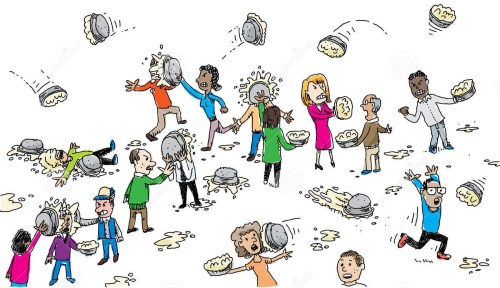
Marginalized, minoritized, and oppressed communities are not asking to share the pie. In fact, for many of us, is not even about being able to bake a pie! At the heart of the matter is what types of systems are needed to share power in order to identify the needs of the whole. It is also about coming up with solutions that address the very complex realities in which we live. It is about sharing power in all of its complexity, without taking power away from anyone. That is something the pie analogy doesn’t address. Moreover, it is this flawed analogy of the pie the one that makes it scary for the majority to engage in conversations about power dynamics. The thought of losing a piece of the pie is scary, especially when you have been socialized to believe that the piece of the pie is the seal of favor and success from your God.
Language will continue being the most important tool in human history. It is also important to know how to make use of it. Language affects the way in which we interact with each other and whether we can advance in our understanding of each other’s needs and wants. Using analogies will help us start conversations, but it cannot be the end of it. In fact, when an analogy doesn’t help frame the conversation in the best way, perhaps it is time to stop using it. My suggestion is to stop framing the conversation in relation to how the pie is to be sliced and shared, and instead talk about the nuances of shared power and systemic structural changes that will allow for more people to collaborate. The conversation can be framed in ways to collaborate and learn from each other. Instead of scaring people by suggesting that they will lose something in order to share with others, let’s start talking about the infinite amount of resources that exist in our social contexts to help collectively solve complex problems. Besides, I have never liked pies anyway…
 SocioTheology
You must be logged in to post a comment.