Category Archives: Sociology

Trying to Argue With Circular Logic

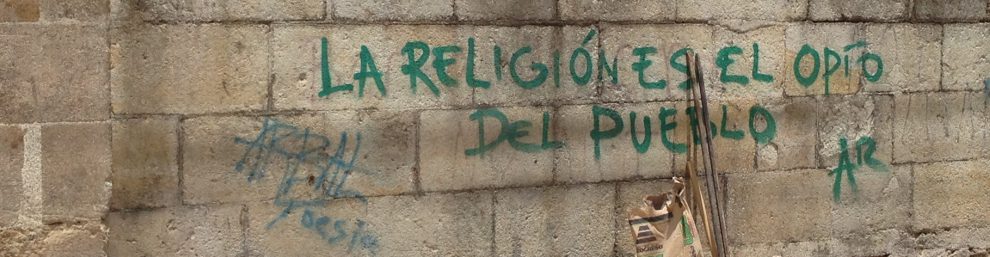
When I was in college I was introduced to the concept of circular logic or circular reasoning. This is a form of logical fallacy in which the reasoner starts with the argument they want to use as their conclusion. To some extent, the argument can be made that this type of logic is the bedrock of religious reasoning. In fact, it was through religion that I was introduced to use circular logic as my modus operandi for reasoning: the Bible is the Word of God because the Bible says it is the Word of God, therefore, it must be true that the Bible is the Word of God. There is no way of going away from this reasoning… you just have to either accept it altogether or reject it altogether. But if you are a religious person who has never been exposed to any other way of reasoning, leaving this type of logic is not an option.400px-bible_cycle

It has been a while since the last time I had a conversation with anyone who used circular logic. For the most part, I try to stay away from trying to engage in philosophical conversations with people who use this type of reasoning. Sure, I could have wonderful conversations about the weather, aspects of life, work, ourselves, etc., but it is impossible to have real conversations regarding faith with people who only use circular logic for their religious arguments. There are some people who might realize that they use this type of reasoning and, not wanting to step away from it, just accept that other people have other ways of looking at things and move on. But there are others for whom circular logic is so ingrained in their lives and way of thinking that they cannot comprehend why someone would step away from this way of thinking in order to find answers somewhere else. For some of them, trying to convince you to go back to using circular logic is not only their mission: it is their duty in life as the lives of those around them depend on it!

Unfortunately, I fell for this not long ago. When I noticed that I was engaging in a one-way conversation with someone who could only use circular logic, it was too late for me to step away. I tried, but failed miserably, to point out the invalidity of the arguments. Of course, this was to be expected! How can an argument be invalid if the only way to validate it is by going back to the premise that made the argument valid in the first place! Ha!

Although I grew up using circular logic for my religious arguments, I have come to grow in my understanding of religion and faith. I now use all the tools available to me in order to understand the religious premises that I live by. I have also come to understand that other people will have different ways of approaching the same questions I have, and that many times, depending on the approach, the answers will be different. The fact that the answer is different doesn’t make it invalid; it just makes it… well… different! I accept that. Thanks to the wonderful mentoring of Angela Figueroa, who was the sociology of religion professor who introduced me to the world of deductive and inductive logic and how to step away from circular logic, I have come to grow in my understanding of religious arguments and how to use them. I have also come to understand that “feelings”, “hunches”, and “inklings”, are not valid reasons to start arguments and to come to conclusions. That doesn’t mean they do not have a valid place in the human experience of the immaterial (or God, or the Divine), it only means that they cannot and should not be used as the bedrock of argumentation.

When I stepped out of using circular logic to “prove” my religious believes, it was a painful process. For a very long time I felt lost, confused, and completely out of control. There was a time when I even came to accept as my reality that there was no evidence of a Divine being, and therefore, there was no such thing. It took me a long time to understand that I could still be faithful, religious, and connected to a Divine being without the need to base my beliefs in circular logic. But again, this is a long and painful process. In my recent conversation, I failed to understand and accept that the person using this type of logical fallacy could have been deeply hurt by stepping out of their way of thinking. I only hope that our conversation was a small seed planted in them to be able to see the wonderful, fulfilling, and satisfying opportunity to have a faith that continues to grow and not one that is stuck in an empty sphere that takes you nowhere in your relationship with God. I also hope that I do not have to engage in another argument like this, as it was extremely painful to see how little progress you can make in trying to have an actual conversation when the other participant has already decided what the conclusion must be.
1 Comment

Filed under Church, Logic, ministry, Philosophy, Sociology, Theology

A Few Signs of Hope

I have to say that for most of the US American people, the next four years of a possible fascist-leaning regime are not the safest, nor is there much hope for most of the US American people (no, not even for the white poor who might have voted for the president-elect, as his policies *will not* benefit the larger society but just a few upper higher class individuals and corporations.)

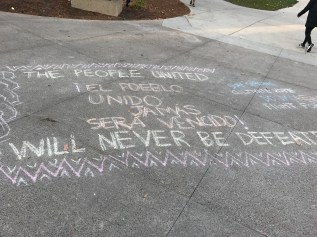
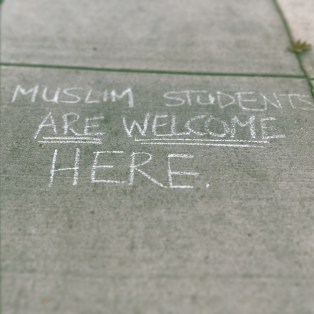
However, I did see some glimpses of hope for the future. Sure, there is no way of knowing how many of us will survive the regime. And certainly, we can’t even say for sure whether the authoritarian democratically elected will actually follow the Constitution and rule for only the allotted time. But, for whatever time we might need to suffer this regime, the signs of a hopeful future are out there. img_0579

As I was talking a walk around the campus of the university near my office, I saw many messages of hope, acceptance, and support for minorities. This gave me some hope that many young people do understand the significance of this historical time. Perhaps the older generation are so fed up with democracy that they did not care about using their democratic rights to bring an authoritarian into power, but the next generations DO care about democracy and pluralism.

img_0586The resistance has continued to grow, and just like in previous authoritarian regimes, this time there will be martyrs and victors. Sure, the democracy of the USA has come to an end for the time being, but out of this coming regime a “more perfect union” will arise… Our youth are leading the way!

#RESISTANCE

Leave a comment

November 14, 2016 · 10:40 am

I Have No More Tears Today

Oh, no! She sits alone, the city that was once full of people.                     Once great among nations, she has become like a widow.                  Once a queen over provinces, she has become a slave.                             She weeps bitterly in the night, her tears on her cheek.                           None of her lovers comfort her. All her friends lied to her;                   they have become her enemies.                                                                          Lamentations 1.1-2

I have no more tears today. I have cried since last night.

I have cried for the future of my family.
I have cried over the prospect of having a Supreme Court that will undo my marriage, and with it, all the protections that my immigrant spouse has.
I have cried for the well-being of my niece and nephew whose parents might be taken away from them.
downloadI have cried for my other relatives who live and work and contribute to the economy of this country while not being able to access proper documentation.
I have cried for the prospect of my own, Congress-imposed US citizenship been revoked with no other alternative to fall back on.

I have cried for my friends.
I have cried for my gay, lesbian and bisexual friends whose rights are now at the hands of vice-president elect Pence, who has done all in his power to strip LGB Indianans of their rights.
I have cried for my transgender siblings whose lives are placed in great danger due to the same vice-president elect and his antics.
I have cried for the many women I know – young and old – whose safety is not guaranteed anymore as a sexual predator takes over the highest elected position in this country, thus giving permission to other predators to “grab”, to touch, to violate their beings.
I have cried for the workers of this country, whose wages are going to be frozen for decades to come and whose jobs are not guaranteed anymore as they are being shipped overseas as the president-elect has done with all the other bankrupt businesses he has run.
I have cried for the poor and sick who could barely access healthcare and had a last fighting chance with the soon-to-be-overthrown Affordable Care Act.

I have cried for humanity.
I have cried for the black community whose safety – which has never been guaranteed – will now face “stop and frisk” experiences with the proposed changes in law and order.
I have cried for the Native American communities whose ancestral lands will be desecrated without impunity.
I have cried with the immigrants and refugees who will no longer find relative safety in this country nor will they be welcomed to access it anymore.
I have cried with those of us who practice some form of faith – whether Christianity, Judaism, Islam, Hinduism, Sikhism, Buddhism, or any other – whose religious liberties will be at the whim of the far-right Evangelical Christian camp that will dominate this fascist regime.
I have cried for the environment and all the relentless desecration that will occur.
I have cried for all the people of all the countries that the president-elect has promised to destroy making use of the military forces that are now under his control.
I have cried for all the children who will not be safe any longer for a generation or two as laws protecting them will be revoked.

I have no more tears today. The only thing that I still hold on to is the hope that the fascist government ahead will help this country wake up from its deep slumber and that it will shake it to its core as to make it see how terrifying the near future looks like.

Leave a comment

November 9, 2016 · 10:59 am

“What Are You?” – The Reality of Intersectional Identities

“What are you?” If you are a person of color, a person of non-white ethnic background, a practitioner of a non-Christian faith, or someone who does not follow conventional gender roles or expression, it is very likely that you have heard this question multiple times throughout your life. Heck! You might have heard this question multiple times just today! For some reason or another we all want to know where others “belong” – what tribe each person is a part of. Although I do not have scientific evidence to say this – it is a blog page after all, not my dissertation page – I believe we do this as a survival strategy; finding groups of people who will support each other in order to thrive, survive and protect each other based on the commonalities we share. However, we are humans. With being human comes the complexities of relationships and what it means to be in relation with each other, even those with whom we disagree.

intersectionality“What are you?” is, then, the amalgam of the identities we espouse and embody. These are identities that we have chosen and identities that are inherent to our being. The problem comes with the way in which the question is posed. Humans are not things. We are a very complex animal with both physiological and psychological characteristics. The integration of these characteristics is what makes us unique in the animal realm. Humans can overcome our desire to associate by tribe – or herd, or school, or pack, or whatever we call the different groups of animals that exist – precisely because we can answer the question “what are you?” Yet, the answer to this question is not an “it is” but an “I am”. In using this form of recognition of the self – something that other animals lack – we acknowledge that we are more than just our instincts.

Humans are the intersectionalities of our identities. These identities converge in order to create complex realities that define WHO – not “WHAT” – we are. I am… Puerto Rican, male, queer, cleric, cisgender, Latino, middleclass, a professional, Protestant, writer, advocate, light-skinned, etc. Each one of these identities reflects a part of who I am. Each one of these identities as well as when I choose to use them also reflect my values and what I treasure the most. Note, for instance, that I often identify as Puerto Rican first and foremost. This part of my identity is so crucial to my being that I cannot just ignore it or place it at the end of the list. With it come a whole lot of other realities that define what it means to be “Puerto Rican”. The context in which I experienced my Puerto Ricanness – growing up in the mountains, with a stable household, eldest son of a married couple, living in a coffee farm, Spanish speaker, exposed to the USA’s cultural realities while also keeping the history of a former Spaniard island possession, etc. – informs this part of my identity. Yet, my “self” is not complete without the interaction of the myriad other identities I embody or have chosen for myself.

Our realities are always intersections of the many identities we carry within ourselves. There are times when those identities are messy and even in contradiction with each other. Yet, this is part of the human experience. What makes us human is the capacity to navigate these apparent contradictions in a way that makes sense to US individually. What do I care about what others say about me? They cannot experience my identity the way I do, nor can I experience their identity the way each one of them does. My only responsibility is to try to acknowledge these differences and honor them by recognizing that each person’s multiple identities and how they converge are none of my business.

There is one aspect of the intersectionality of identities that is crucial, especially when it comes to living in a multi-everything society. Solidarity.

Solidarity is the ability to stand by the side of those who suffer because one or more aspects of their identities. Solidarity is recognizing that one or more parts of our identities might be attacked by others who do not understand the beauty of diversity. Solidarity is being wise enough to recognize that our lives are always being intertwined in such a way that the fight for justice is never to be done in isolation. As Blessed Martin Luther King taught us: “Injustice anywhere is a threat to justice everywhere.” If we do not see how the many identities we carry are intrinsically connected with the multiple identities of others, we will lose sight of the fight for justice and liberation.

There is no doubt that the question “what are you?” will continue to be a part of the daily experience of many of us. As a theologian, I like to reflect on the way in which the God of the Bible addressed this question when it was posed to God. According to the story found in Exodus, when Moses met God for the first time, he asked God whom should he say that send him to liberate God’s people. God’s answer was straightforward: I AM. That’s it! I am… You are, and others are too. It is in this present “being” that we can find commonalities in the midst of so many intersectional realities that make us who we are. Thus, the next time someone asks you “what are you?”, just answer: I AM.

Leave a comment

Filed under Culture, ethnicity, Heritage, Hispanics, Identidad, Identity, Latino, Puerto Rico, race, Sociology

I Have An Accent… Get Over It!

It was the first board meeGlobe_of_languageting of the year for a large, international organization. As there were going to be new members for the board, it was needed to go around and introduce ourselves. There were people from the four nations where the organization has a presence plus individuals from other nations who reside in one of the four nations represented. Everyone was sharing their names, location, and their job. It was right there when it happened…

With no hint of irony in her voice, the white, middle age, college-educated woman states that she lives in one of the places that was taken first from the native inhabitants and then from the nation to the south. Proudly she tells her audience – an international audience – that she “teaches foreign students how to lose their accents so they can get jobs” in the United States. Yup. Right as you read it. Immigrants who had spent years of education, who probably speak more than one or even two languages, needed this woman’s help to lose their accents so they could get in with the system.

I looked around for the reaction of my fellow immigrants and non-white colleagues, and, unsurprisingly, we all cringed a little. What this woman was saying, unconsciously, is that our accents make us look dumb, uneducated and unprepared for the professional challenges that jobs in this country offer.

Not long ago, something similar happened to me as I was about to take a new position and someone suggested that the organization paid for a coach who would help me lose my accent. (Full disclosure: I was not informed of this until after I had accepted the position, which caused much pain as I worked there.)

The USA culture states that, no matter how ethnically diverse the country is, those of us who have kept our accents from our mother tongues do not quite belong. For some immigrant communities this has meant that their ancestors’ languages have been lost because the parents are worried their children might not be able to find work or succeed in life. Interestingly, the culture has also incorporated words from other languages into the US English. Think, for instance, about words such as Kindergarten (German), pierogi (Polish), mesa (Spanish), bouquet (French), Brooklyn (Dutch), finale (Italian), tycoon (Japanese) and shtick (Yiddish), just to name a few. Other languages are part of the US culture, but nobody wants to acknowledge it. Moreover, if those of us who emigrated here from other countries with a different language use our own languages to communicate or express ourselves in English with an accent, then we are scolded for it.

Yet, nobody pays attention or asks Australians, South Africans, Jamaicans, New Zealanders, Trinidadians or British to lose their accents. Why?

It is true that communication is extremely important in academic and professional settings. (The personal settings are a bit different due to the familiarity of the people involved.) However, our accents and language backgrounds should not dictate our – the immigrant’s – capabilities to do the work. Being able to speak a language different than English does not mean that we have less education, less knowledge or less professional abilities. It only means that our education was in a language that was comprehensible to us as we grew up and became professionals. In fact, nobody questions the intelligence of English-speakers when you come to our countries and often times refuse to learn at least basic phrases to communicate with the people who live there.

Here are three other things that US Americans need to understand about people who speak other languages. First, most of us do speak English. Our accents only mean that English is a second, third and sometimes even fourth language (I had a seminary professor for whom this was the case, where English was the fourth language he learned.) The use of English along our own mother tongues only points to the fact that we are bi- or multi-lingual. How many languages you, English-speaker, are able to read, understand and speak?

Second, the truth is that every chance we have, we use to learn how to pronounce words, how to expand our vocabulary, and how to find the correct way to use your language in all contexts. Have you thought how difficult it is for a foreigner who was only exposed to “proper” English to figure out some of the common idioms and day-to-day phrases of your language? Take, for instance, “cut the mustard”. I know what the verb “cut” is, and I know that “mustard” is a condiment. How in the world am I supposed to know that “cut the mustard” means “to succeed”?! My mental references for mustard do not even allow for cutting! Mustard, as a seed, is too small to be able to be cut, and as paste, there is no need to be cut as it spreads. Do you follow my thoughts? (There’s another one!) I can tell you, from my personal experience, that I even take time to listen and practice pronouncing a word over and over and over again trying to find the correct way to pronounce it.

Third, there is the issue of pronunciation and hearing. You, who grew up listening to words in your language all the time, might be able to catch the subtle difference between “leave”, “live” and “leaf” but, trust me; it all sounds exactly the same to me! I need to pay attention to the context in which you used these words to find which one you used. How hard it is for you to do the same exercise? All of this is tiring, but it is exactly what non-English speakers have to do every day of our lives in this country (and what English-speakers have to do every day if they live in countries outside of the English-speaking world.)

There are two final thoughts I want to share with all of you. First, is the issue of regional accents within the United States. Most people fret about and want to change the accent of foreigners, but you seldom hear about changing the accents of people from different regions within the country. There are not-too-small differences between the accents of an Alaskan, a West Virginian from the mountains, a person from Brooklyn and one from Massachusetts. Yet, nobody will dare recommending that we all come to an agreement about speaking with the same “standard” English accent. Why? Because there is no such thing as a standard accent in any language! All languages have regional differences! Hence the ridiculous idea of asking British, Jamaicans, Australians, South Africans and Trinidadians to change their accents… they all speak English with regionalisms and it is a matter of adapting our ears to those regionalisms in order to understand each other.

Finally, my accent is, to me, a point of pride. It tells me that I speak more than one language, that I am able to communicate with more people than mono-lingual persons, and that I bring with me to this country a history. It defines who I am at this moment of my life and it makes me feel part of the global community, not just of a small community of either people of the United States or people of Puerto Rico. I can drive through the northern border of the USA and make myself understand just as I can cross the southern border and still engage in conversations. (Unfortunately, I do not speak French; therefore any visit to Quebec would be an adventure… And one that I would gladly welcome!)

My best advice to those who complain about my accent, or about any accent for that matter? Get over it.

Leave a comment

Filed under Culture, discrimination, ethnicity, Heritage, Hispanics, History, Puerto Rico, race, racism, Sociology, Uncategorized, United States, USA

Yes, I Am Mad as Hell!

A few years ago, while working on a predominantly white environment, I experience much racially and ethnically based discrimination. Some of this discrimination came in the form of what scholars now call “microaggressions”, while other was more overt such as questioning my abilities, my qualifications for the job or the like solely based on my ethnicity and accent. For some time I just shrugged it off as ignorance and lack of education on the part of the people who did it. At the same time, I would do an effort to educate.

fist-md However, the discrimination continued. Not only that, but I started to meet with other people of color who were also involved with this organization and heard their own stories of rejection, discrimination and paternalistic attitudes towards them because of their national origin, their accents, their skin color and the like. The pressure continued to mount inside me. I felt like a pressure cooker… until it exploded. The event that marked my anger explosion was the murder of Trayvon Martin in Florida.

Trayvon Martin’s untimely death and its circumstances touched me in a way that I was not expecting. However, many things coalesced at once. On the one hand, another young, unarmed, black human being was being gunned down for no reason. On the other hand, the murderer was a white, Hispanic man who had let his white-privilege rule his life and how he connected with the world around him. Listening and reading the reports of this tragic death, made me even angrier. The media outlets could not grasp the idea that a Hispanic person could possibly be the perpetrator of a racial crime. They also had troubles understanding the complexities of race within the Hispanic communities. But more than that, they totally misunderstood the intricate layers of relationships among the different minority groups in the United States. All of this was too much for me at the time; and I exploded in rage.

I was mad – still am. For years I had tried to understand the historical realities that have made the United States the dangerous place for people of color that this country is today. I had tried to understand that not all white people were responsible for racism. I had tried to justify many actions of racism as ignorance and lack of education on the perpetrators. I had tried to understand that my own Hispanic community was dealing with our own prejudices on top of being the target of discrimination. I had tried and tried and tried to understand and keep my composure. But I could not do it any longer.

At some point I shared my feelings with the community. I told them how it was tiring to be trying all the time to make people understand that we – people in the minority – were not the enemy. I was getting tired of being an educator at all times. I was getting tired of pretending that the words and the actions of white people didn’t hurt me. I was getting tired of pretending that I was going to understand their historical and sociological circumstance. I was getting tired… and this feeling was making me mad and angry.

As I look around and see that things have not changed a bit since the murder of Trayvon, and that black human beings continue to be murdered and their assassins walk free… As I look around and notice that other members of minority groups stay silent… As I look around and notice that the white “supporters” keep calling for what I call a “Kumbayah moment” without acknowledging the centuries of oppression that have brought us to this place… As I look around and see that even the President keeps silence when everyone is waiting for him to talk, to speak up, to raise his voice and use his power… As I look around and notice that the violence on the streets of Ferguson, Missouri are becoming just another excuse for the white majority to justify their oppression… As I look around and continue to notice all of this oppression… the only thing I can say is that I am fucking mad as hell!

Yes. Yes, I am mad. It is not a rage that started yesterday or the day before or the day I experienced racism at that institution I mentioned earlier. It is a rage that comes from a deeper, way deeper place. It is a rage that comes from fourteen years of living in a country that treats me as less than my white counterparts. It is a rage that comes the time that my country was invaded by a white, US navy that tried to impose on my ancestors their language, their religion, their way of life. It is a rage that comes from knowing that half of this country was built on lies and stealing from the natives peoples and when that was not enough, of the other settlers who lived there and spoke my language and shared my customs. It is a rage that comes from knowing that millions of my sisters and brothers’ ancestors – and I am sure mine too – were forced out of their Motherland to be brought here in chains and by force. It is a rage that comes from all the rage accumulated throughout the centuries… throughout the generations… throughout the ancestors who still live in me and within me… Yes, we are mad, and yes, we are going to continue being angry for as long as it takes for the systems to change. And yes, that anger is going to be at times violent and at times peaceful. But I do not care anymore about what the white majority thinks of my anger. I don’t care about what my Hispanic community thinks of the anger that makes me be in solidarity with my black sisters and brothers. I don’t care that my white friends – even those who are close to me and whom I love – hear me saying that I often doubt their good intentions.

I am mad as hell, and I am not going to apologize for it.

Leave a comment

Filed under Black, Culture, discrimination, ethnicity, Hispanics, History, justice, Latino, Peace, race, racism, Sociology, United States

Everyday Hispanic Heritage Project – Prof. Christian J. Roldán Santos

Prof. Christian J. Roldán Santos

Instructor of Mathematics – Black Hawk College

Rock Island, IL

The Quad Cities between Iowa and Illinois is not precisely the place to find many Latin@s, although, as everywhere else in the USA, this is rapidly changing. There is a new influx of Hispanics due to both immigration and second and third generation Hispanics moving up in the economic ladder. However, it is always difficult for those moving to new places to find the resources to adapt to their new environments. This is why we need all the help that we can get from those who are already established and who are willing to extend their hands in solidarity.

Today’s Everyday Hispanic Heritage hero moved to the American heartland over ten years ago to attend the University of Iowa in Iowa City, IA. Christian Roldán Santos graduated with honors with a degree in Mathematics from the University of Puerto Rico in Mayagüez and immediately moved to Iowa City to pursue a graduate degree. Currently, Mr. Roldán is pursuing a PhD in Higher Education at Illinois State University, Normal, Il. He fell in love with the area and decided to make of the Midwest his home.

Mr. Roldán is originally from Juana Diaz, Puerto Rico. As a gay, Puerto Rican, Latino immigrant he has found that his life is always in limbo. He states that he is “too Puerto Rican and Latino for the United States, too American for Puerto Rico, and too gay for either place.” Perhaps this is what has brought him to be deeply involved in working for justice for Latin@ immigrants as well as for the LGBT communities.

There are many fields in which Latin@s are underrepresented, and Mathematics is one of them. However, Christian has a passion for this field and through his actions has shown the upcoming Latin@ generation that it is possible to pursue a career in Math and Sciences. Mr. Roldán is currently a professor of Mathematics at Black Hawk College in Moline, IL. At Black Hawk he is the advisor to two organizations, the Association of Latin-American Students (ALAS) and Phi Theta Kappa; he also serves as the vice-president of the school’s Senate, coordinator for the school’s International Festival, and volunteers during orientation session to help with international students.

Christian is also very involved in his local community. He regularly visits local schools to give talks and presentations on college life, leadership, success, and diversity awareness. More recently, he is schedule to be a presenter at the Latino Youth Summit at Black Hawk in October. Mr. Roldán also volunteers with the newly created LGBT Metro, an organization that supports gay, lesbian, bisexual, and transgender individuals in the Quad Cities area.

Certainly, Hispanics and Latin@s moving to the heartland of the USA will find inspiration and a supporting presence in Christian Roldán Santos. For all that he does for his community in the middle of the Iowa-Illinois border, Christian is today’s Everyday Hispanic Heritage hero!

Leave a comment

Filed under Español, Gay, Hispanics, Latino, Lesbian, LGBTQ, Puerto Rico, Queer, Sociology, trans

Everyday Hispanic Heritage Project – Dr. Ralph (Ed) Myer, MD

Dr. Ralph (Ed) Myer, MD

Sea Mar Community Health Clinic

Seattle, WA

Hispanics are a very diverse people. More than a common language, Hispanics share a common history, culture, and ethos. Countries in Latin America have welcomed immigrants from Europe, Africa, Asia, the Middle East, and Oceania. This is one of the reasons why so many people find it difficult to define who, exactly, is Latin@. This can be the case with today’s “Everyday Hispanic Heritage” hero.

Ed Myer was born in the state of Washington, USA, to Mennonite missionaries, who shortly after his birth moved to Puerto Rico to serve a small, rural community called Castañer. Ed’s parents served as medical missionaries at the Castañer General Hospital, and his siblings were born there. After their time in Puerto Rico, the Myer family moved to Mexico, where Ed grew up enveloped by the rich culture of the country. After finishing high school, Ed moved back to his home in Puerto Rico where he finished his degree in Family Medicine at the University of Puerto Rico – School of Medicine. He then served at the San Juan General Hospital and a residency at the Merced Community Medical Center of the University of California before moving back to Wenatchee, WA where he worked at the local community clinic.

After some time in the USA, Dr. Myer moved to Nicaragua where he served for many years in rural communities during the civil unrest in the country. He has spent most of his professional life serving poor or rural communities throughout Central America, Mexico, and Washington State. Currently, he is on the staff at Sea Mar Community Health Clinic in Seattle.

None of his patients think of Dr. Myer as a “white” or “Anglo” doctor. On the contrary, very few people believe him when he tells them that his family is actually from the United States. Ed is, for all purposes, a Puerto Rican-Mexican-Nicaraguan and a true Hispanic. His roots are in rural Puerto Rico and Mexico, and his heart still lives in the jungles of Nicaragua where he lived and served for so many years. Providing health care to the Hispanic community in the King County area of Washington state comes easy to Dr. Myer, as he understands this as part of his commitment to this own people.

Ed Myer lives a simple life. He is deeply committed to the environment and proudly states that he produces enough house waste to fill only one bag every month. He has spent decades serving and supporting peace organizations. Dr. Myer commitment to social justice has also led him to be a vocal advocate for immigration reform, economic reform, peace building, and many other important issues of social reform. For all the work that Ed does in his local community and all the work he has done with his Puerto Rican, Mexican, and Nicaraguan communities, Dr. Myer is today’s Everyday Hispanic Heritage hero!

Leave a comment

Filed under Español, Hispanics, Latino, Peace, Puerto Rico, Sociology

The Everyday Hispanic Heritage Project

In the United States we observe Hispanic Heritage Month from September 15th through October 15th. During this time the country is encouraged to reflect on the influence of Hispanic and Latin@ culture to the larger culture of the United States. Often this means to remember and honor the great heroes and heroines of our communities like Gloria Anzaldúa, Dolores Huertas, César Chávez and other Latin@s who have helped raised awareness about the influence of Hispanics in the country. However, seldom do we hear from the “everyday Hispanics” who make a difference in their local communities.

How many of you have heard of the work of Pedro Julio Serrano, Norma Zavala, Sylvia Rivera, Karen Leslie Hernández, Karlo Karlo, Luis Alvarenga, Julio Granados…? The list can go on and on. There are millions of little known Latin@s throughout the country making a difference in their communities. This is why I have decided to start a project, the Everyday Hispanic Heritage Project, featuring one or two of these amazing individuals.

Of course, this is not and could never be a complete list. This is just the beginning. My goal is to raise awareness of the millions of unknown Juans, Marías, Pedros, Gladys, Josés, Anas who give of themselves to make their communities a better place to live.

The project has its limitations of course. One of these limitations is the fact that I do not know all the places where Latin@s are working day to day to transform the lives of others. Therefore, if you know of an amazing story of an unknown Latin@ who is doing great work locally, please feel free to email me and let me know. You can reach me at jmannysantiago@outlook.com .

Leave a comment

Filed under Hispanics, Latino, Puerto Rico, Sociology

The State and The Church

Some time ago I received an invitation to join a facebook page called “Keep God in our schools”. It came as a surprise to me, given the fact that the person who invited me is a member of a Baptist congregation. Moreover, it was a big surprise to know that God needs of our help to stay in school. Here are my reactions to these sorts of religious questions.

I am committed to the Baptist principles. Over the years, I have grown to accept, cherished, and make mine the principles upon which my denomination was established. Back in the 1600s many Baptist people suffered persecution because of their understanding that the Sate and the Church should be different and separate entities. They also suffered persecution for the – then new – idea of giving every human being the liberty to come before God as his or her conscience told them. These were ideals that we take for granted today. Yet, these ideas were new to the people who grew up in oppressive religious regimes – both Roman Catholics and Protestants.

There are various wrong ideas of what it means to uphold the principles of separation of Church and State, and liberty of conscience or soul freedom as is most commonly referred too. I would like to tackle on them today.

First, separation of Church and State is a concept that serves the Church, not the State. When the religious realm was attached to the political realm, the church was bound to the pitfalls of the State. For instance, it was the prince who would appoint clergy to different positions. There are many a story of bishops and cardinals that were more interested in war and financial riches than in the spiritual well-being of their parishioners. At the same time, political leaders would call Councils to determine theological issues, giving little if no room at all for the faithful to freely come to decisions on matters of faith and theology. The church became a business more than a place to receive consolation and guidance from God through God’s own people who were empowered by the Holy Spirit.

It was for these reasons that some early Anabaptists (Mennonites) and later the Baptists as well, joined in calling for a free Church in a free State, wherefore each institution was in charge of particular needs of the people whom they served.

The Church is called to serve the spiritual needs of the people. Some churches have schools where children learn about history, math, biology, and languages, as well as about God, Jesus, and the story of salvation. These religious schools are protected under the law and are free to teach their students in whatever way they feel is the most appropriate, as long as they follow the basic guidelines and fulfill the basic requirements of education of the State. On the other hand, public schools are places where people from a varied array of faiths come together to learn. The learning experience is not only regarding biology and literature, but also how to interact with people whose social, political, economic, and theological views are different from yours. Public schools are places where differences are experienced and lived out in order to become global citizens.

If we were to “bring God back to schools”, the first questions we must answer is: What God? This is very important since there are many religious traditions and as many understandings of “God”. For many Christians, the God of the Bible is the same as the God of the Jews and Muslims. However, some Christians understand that these three religions have a different interpretation of who God is. Moreover, Buddhists do not have any gods, while Hindus believe in a plethora of gods and goddesses. So, what God are we going to bring back?

Second, there is a fact that disturbs me greatly as a theologian. Whose God is so small, so weak, so powerless, that needs of our help to “keep God in our schools”?

It is disturbing to think that some people see God as someone who has the need for us to put “him” back in the schools because some atheist have taken “him” out of the schools. These people must have forgotten the words of Jesus when he says: “For where two or three are gathered together in my name, there am I in the midst of them” (Matthew 18.20, KJV). Is your faith so weak that you do not believe this promise?

For all of my life I attended public schools. From kindergarten to college, I was blessed to have wonderful schools where I was formed as a professional and as a citizen. Many times, I bowed my head in the cafeteria to say grace before lunch. Every time before a test I would take a few seconds to pray in silence for guidance and wisdom to answer well. There were many a conversation regarding church and God in the halls of the schools I attended. I did all these because I felt called to do it, not because a teacher asked me to. In fact, I think that I would have felt very strange if a teacher asked me to pray in class or to read from the Bible (which, by the way, was one of the many books I kept in my backpack.)

A real believer does not need of the State to control his or her faith. A real believer does not need of a teacher to tell him or her when or how to pray. A real believer looks for the opportunities God grants us to come before God – who, I should point out, is neither “he” nor “her” – and to look for God as freely as God looks out for us.

I do not need to “bring God back to our schools” because my God has never left me, and as long as I am in God and God is in me, God is present wherever I go.

Leave a comment

Filed under Church, Peace, Sociology, Theology