Category Archives: USA

La comunidad comes together in Wisconsin

In the past few months, the GOP delegation in the Wisconsin state Assembly, in the hopes to support Governor Walker’s agenda of destroying the state, have been trying to pass anti-family and immoral legislation. They have already succeeded in making easier for big developers to contaminate our waters. We all know that they were pretty successful in stripping workers from their rights, preventing heads of households from securing a future for their children and other IMG_4862dependents. More recently, they have been trying to put students’ lives in danger by proposing to allow criminals to openly carry handguns and other firearms around university campuses and even into classrooms. Now, they are also coming after whole families: immigrants, people of color, and other groups that do not conform to the wealthy, white, WASP majority. Two proposed bills are now before the Assembly, to criminalize brown people just for being brown. The legislators swear is to “protect” the communities, but this is just code talking to say that brown peoples are not to be trusted and we must be controlled just as the police has been encouraged to control black people by threatening their lives.

Yesterday, February 18th, the Latinx comunidad from around the state came together in an unprecedented way to say ¡BASTA! People from all over the state came to Madison as the Assembly debated two pieces of anti-family legislation, to let the government and the larger Wisconsin community that our lives matter, that we will not stand idle as they try to destroy our families, and that we not a comunidad and a voz to be dismissed.

Politicians, especially Republican politicians, think that they can play with our lives as they wish. They have stood up against every single moral issue that prevents our lives from being taken from us. In fact, it has been their lack of moral character what has killed so many of us – on the fields, at the hands of police, on the farms and factories, in jail and in immigration detention centers… Their hands are tainted with the blood of thousand Latinxs, yet they keep thirsting for more. It is not enough for them to see our children suffer, our parents mourn, our youth are anxious… They are not satisfied with seeing our IMG_4859suffering, they also want us to completely disappear, just as we bring them water, and tea, and their meals; just as we clean their homes and cultivate their fields or milk their cows; just as we tend to their wounds, and teach their children, and run their businesses… It is not enough. Never enough! Brown bodies are to be disposed of as if we are trash. To this, our comunidad says ¡BASTA!
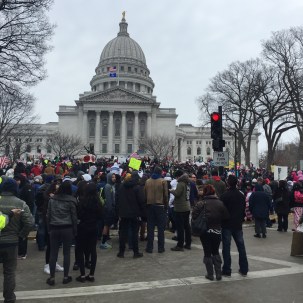
As I stood at the Capitol square with thousands and thousands of my hermanas y hermanos Latinxs and allies, I could not do anything else but be hopeful. I know that the fight is going to be long and arduous, but we are not going to keep silent. La raza es fuerte. Moreover, we are not as divided as they want others to believe. Yesterday, there were flags from all over Latin America because we know that this “divide and conquer” strategy is not going to work. We are ONE, and as such we will fight. As Calle 13 sings: “cuando más te confías las hormigas / te engañan atacan en equipo como las pirañas / aunque sean pequeñas gracias a la unión / todas juntas se convierten en camión.” We will rise and call out our ancestors, our guiding spirits and the power of the women and men who taught us how to fight and win.

To be there, in the presence of such a beautiful cloud of witnesses was a real blessing for me. It filled me with hope, knowing that I am not just one Puerto Rican fighting alone; I am a part of the great América, and we will stand together to reclaim what is rightly ours. La comunidad came together yesterday in Wisconsin, and we will stand and fight because it is the right thing to do.


Leave a comment

Filed under Culture, ethnicity, familia, Heritage, Hispanics, Hispanos, immigration, justice, Latino, race, racism, United States, USA, Wisconsin

Please, Keep Your Prayers, We Don’t Need Them!

I hate, I reject your festivals;

    I don’t enjoy your joyous assemblies.

If you bring me your entirely burned offerings and gifts of food—

        I won’t be pleased;

    I won’t even look at your offerings of well-fed animals.

Take away the noise of your songs;

        I won’t listen to the melody of your harps.

But let justice roll down like waters,

        and righteousness like an ever-flowing stream.

Amos 5.21-24

Let me start by saying that I am not saying that prayers are a bad thing. If they help you process the awfulness of recent events and of the systemic extermination of Black individuals from US society, then use prayer. But I want to make something clear: prayers alone are not keeping Black, brown and other minority individuals safe. No matter how much you pray, no matter to whom you pray, no matter how strong your faith is, no matter how powerful your god/goddess/spirit/divine being is, prayers are not working.

Upon hearing the news about the massacre of Black sisters and brothers by a white terrorist at Mother Emmanuel African Methodist Episcopal Church in Charleston, South Carolina, what first came to mind were the words from God that the prophet Amos shares in his book and with which I opened this post. Immediately I knew that many of my friends and colleagues were going to start posting images of candles and words of prayer on their social media platforms. It is always the same pattern: hear the news of a white individual – police, young man, white supremacist, state-sponsored executioners paid by tax dollars… – and immediately there is outrage by allies and people of color alike, followed by posts on Facebook/Twitter/Instagram and prayer vigils.

Black lives matter All of these are fine. Use whatever means you have at your disposal to process the rage, the hurt, the fear and the pain. But again, hear this: NO PRAYER, NO GOD, NO POST is helping save Black, brown and other minority individuals from the systemic purge that we are experiencing.

The prophet Amos states that the God of the people of Israel is disgusted with so much ritual with no action. When prayer is not followed by actions of justice, it becomes hollowed. As I interpret my relationship with God, God depends on us working together to change the world. This is collaboration. And I believe that we are way past time to take action.

Here is what I propose, particularly to my white, Anglo/Euro-American friends and allies: shut up, listen, and act. I don’t care that your best friend is Black. I don’t care that your sons and daughters are adopted from Asian countries. I don’t care that your significant other is Latin@. This systemic purge is not affecting you as a white individual as it is affecting us as people of color. Thank you for your solidarity, but please let be our voices that ones that are heard. Do you want to know what it feels like to be Black in the United States? Ask your friend! Do you want to know what it feels to be a racial minority? Ask your children or your spouse or your best friend or whomever it is that you have used as an excuse to state that you know what we are going through. But don’t pretend that you will ever understand our fear. I am Latino, queer and cisgender. I can only tell you what MY fear is. I cannot speak for my Black siblings or my trans siblings. I cannot speak for my women siblings either. I can only speak of my experience. The only experience that a white person can speak of in the United States is that of privilege (yes, even those who are poor. More on how this plays out here: http://thefeministbreeder.com/explaining-white-privilege-broke-white-person)

There are other things that I would like to share about what can be done instead of prayers to change this situation. This is not a comprehensive list, and I encourage you to post your own ideas and recommendations on the comments below. Just be respectful and civil on your comments. I monitor the comments on my page and will not tolerate racism, xenophobia, LGB-phobia, transphobia, misogyny, ableism, or any other form of hate speech.

Here are some ideas:

  1. Reach out to people of color in your communities. Be intentional in this reaching out. Form friendships and alliances.
  2. If you are white, recognize your privilege. Recognize that the system in which we currently live was created for you. You might be a fifth generation trailer park kid, but the founding people of this country were only interested in the wellbeing of the white, Anglo establishment. Things have not changed much throughout the years, and your skin color grants you privileges that are still unreachable to the rest of us.
  3. Learn about the history of privilege in the USA. Learn about the slave trade and the uprooting of millions of people from their lands. Learn about the stealing of lands from Indigenous peoples. Learn about the snatching of land from Mexico. Learn about the invasion on Cuba, the Philippines, Puerto Rico, Guam and Marshall Islands. Learn about the USA’s role in placing blood-thirsty dictators in the rest of America and in the Middle East… Learn the history of your privilege!
  4. When you see racism happening, denounce it! Publicly and loud. Don’t just lift up a prayer for the victim… ACT! We – people of color – are literally taking bullets because we are speaking up on our rights to walk on the streets, use public pools, pray in our sanctuaries… Why are you still so afraid of speaking up? Believe me, nobody is going to take out a gun to shoot YOU for speaking up. Not the police, not the KKK member, not the “unstable young man”.
  5. Use the right language when talking about these events: these are not “mentally unstable young men”; they are white supremacists with a desire to exterminate Black, brown and other minorities. These are not “unrelated events”; these are all part of the systemic extermination of non-white individuals in the USA. Language matters. How we communicate what is happening will counteract the fallacies that the media create around these acts of terror.
  6. To my Latino and Latina siblings: recognize that the violence against Black individuals is just the tip of the iceberg. You and I are marked for systemic extermination too. Additionally, recognize that racism and anti-Blackness exist in our communities.
  7. Let us scream, shout, cry, curse… This is fucking terrifying and we need to express our fears! We might even say “you” when talking to you about the terror that the white majority is inflicting on us. Just take it. We are not “coming for you”, we just need to express the panic we are feeling right now and we are NOT colorblind; we see that you are white.
  8. Related to that, we do not need you to “allow” us to do anything. We are going to do it because we are entitled to do it as human beings, not because a white person grants us permission.
  9. Be present, but don’t take over. Listen. Ask questions. Answer if we ask, not before.
  10. Do not be afraid of engaging your own family or friends in conversations about racial relations and your own privilege as white people. If you are going to be an ally and help change the system, it is not to us – people of color – that you have to be talking to. It is to your grandparents and your aunts; to your white co-workers and nephews and nieces. It is to your next door neighbor and your golf buddies…

I am sure I will come up with more ideas as I continue to process all these events. But in the meantime, we can start with this list. Just keep in mind this: God despises hollow prayers and rituals, but She states: “But let justice roll down like waters, and righteousness like an ever-flowing stream.”

Leave a comment

Filed under Black, Church, Culture, discrimination, ethnicity, justice, Latino, Peace, race, racism, Theology, USA

I Have An Accent… Get Over It!

It was the first board meeGlobe_of_languageting of the year for a large, international organization. As there were going to be new members for the board, it was needed to go around and introduce ourselves. There were people from the four nations where the organization has a presence plus individuals from other nations who reside in one of the four nations represented. Everyone was sharing their names, location, and their job. It was right there when it happened…

With no hint of irony in her voice, the white, middle age, college-educated woman states that she lives in one of the places that was taken first from the native inhabitants and then from the nation to the south. Proudly she tells her audience – an international audience – that she “teaches foreign students how to lose their accents so they can get jobs” in the United States. Yup. Right as you read it. Immigrants who had spent years of education, who probably speak more than one or even two languages, needed this woman’s help to lose their accents so they could get in with the system.

I looked around for the reaction of my fellow immigrants and non-white colleagues, and, unsurprisingly, we all cringed a little. What this woman was saying, unconsciously, is that our accents make us look dumb, uneducated and unprepared for the professional challenges that jobs in this country offer.

Not long ago, something similar happened to me as I was about to take a new position and someone suggested that the organization paid for a coach who would help me lose my accent. (Full disclosure: I was not informed of this until after I had accepted the position, which caused much pain as I worked there.)

The USA culture states that, no matter how ethnically diverse the country is, those of us who have kept our accents from our mother tongues do not quite belong. For some immigrant communities this has meant that their ancestors’ languages have been lost because the parents are worried their children might not be able to find work or succeed in life. Interestingly, the culture has also incorporated words from other languages into the US English. Think, for instance, about words such as Kindergarten (German), pierogi (Polish), mesa (Spanish), bouquet (French), Brooklyn (Dutch), finale (Italian), tycoon (Japanese) and shtick (Yiddish), just to name a few. Other languages are part of the US culture, but nobody wants to acknowledge it. Moreover, if those of us who emigrated here from other countries with a different language use our own languages to communicate or express ourselves in English with an accent, then we are scolded for it.

Yet, nobody pays attention or asks Australians, South Africans, Jamaicans, New Zealanders, Trinidadians or British to lose their accents. Why?

It is true that communication is extremely important in academic and professional settings. (The personal settings are a bit different due to the familiarity of the people involved.) However, our accents and language backgrounds should not dictate our – the immigrant’s – capabilities to do the work. Being able to speak a language different than English does not mean that we have less education, less knowledge or less professional abilities. It only means that our education was in a language that was comprehensible to us as we grew up and became professionals. In fact, nobody questions the intelligence of English-speakers when you come to our countries and often times refuse to learn at least basic phrases to communicate with the people who live there.

Here are three other things that US Americans need to understand about people who speak other languages. First, most of us do speak English. Our accents only mean that English is a second, third and sometimes even fourth language (I had a seminary professor for whom this was the case, where English was the fourth language he learned.) The use of English along our own mother tongues only points to the fact that we are bi- or multi-lingual. How many languages you, English-speaker, are able to read, understand and speak?

Second, the truth is that every chance we have, we use to learn how to pronounce words, how to expand our vocabulary, and how to find the correct way to use your language in all contexts. Have you thought how difficult it is for a foreigner who was only exposed to “proper” English to figure out some of the common idioms and day-to-day phrases of your language? Take, for instance, “cut the mustard”. I know what the verb “cut” is, and I know that “mustard” is a condiment. How in the world am I supposed to know that “cut the mustard” means “to succeed”?! My mental references for mustard do not even allow for cutting! Mustard, as a seed, is too small to be able to be cut, and as paste, there is no need to be cut as it spreads. Do you follow my thoughts? (There’s another one!) I can tell you, from my personal experience, that I even take time to listen and practice pronouncing a word over and over and over again trying to find the correct way to pronounce it.

Third, there is the issue of pronunciation and hearing. You, who grew up listening to words in your language all the time, might be able to catch the subtle difference between “leave”, “live” and “leaf” but, trust me; it all sounds exactly the same to me! I need to pay attention to the context in which you used these words to find which one you used. How hard it is for you to do the same exercise? All of this is tiring, but it is exactly what non-English speakers have to do every day of our lives in this country (and what English-speakers have to do every day if they live in countries outside of the English-speaking world.)

There are two final thoughts I want to share with all of you. First, is the issue of regional accents within the United States. Most people fret about and want to change the accent of foreigners, but you seldom hear about changing the accents of people from different regions within the country. There are not-too-small differences between the accents of an Alaskan, a West Virginian from the mountains, a person from Brooklyn and one from Massachusetts. Yet, nobody will dare recommending that we all come to an agreement about speaking with the same “standard” English accent. Why? Because there is no such thing as a standard accent in any language! All languages have regional differences! Hence the ridiculous idea of asking British, Jamaicans, Australians, South Africans and Trinidadians to change their accents… they all speak English with regionalisms and it is a matter of adapting our ears to those regionalisms in order to understand each other.

Finally, my accent is, to me, a point of pride. It tells me that I speak more than one language, that I am able to communicate with more people than mono-lingual persons, and that I bring with me to this country a history. It defines who I am at this moment of my life and it makes me feel part of the global community, not just of a small community of either people of the United States or people of Puerto Rico. I can drive through the northern border of the USA and make myself understand just as I can cross the southern border and still engage in conversations. (Unfortunately, I do not speak French; therefore any visit to Quebec would be an adventure… And one that I would gladly welcome!)

My best advice to those who complain about my accent, or about any accent for that matter? Get over it.

Leave a comment

Filed under Culture, discrimination, ethnicity, Heritage, Hispanics, History, Puerto Rico, race, racism, Sociology, Uncategorized, United States, USA

Hispanic Heritage Month 2013 Reading List

September 15th through October 15th is “Hispanic Heritage Month.” Here is a list I put together of books that talk about the Hispanic/Latin@ experience in the United States from different perspectives. I have only included books I have read and deemed interesting. I have also tried to capture different aspects of the Hispanic/Latin@ vida: from religion to sociology to economy to immigration… (I still have a very long list of other books to read… once I do read them, they will show up on this list!)

It is my hope that you can grab at least one of these books during this month and learn more about the Latin@/Hispanic experience in the United States. All of the books are in English, as my intention is to reach out to the English-speaking friends of all ethnicities and races. Hope you enjoy!

9.15.12.HispanicHeritageMonth


Religion:

1. Mañana: Christian Theology from a Hispanic Perspective by Justo L. González

2. En la lucha / In the Struggle: Elaborating a mujerista theology. A Hispanic Women’s Liberation Theology by Ada María Isasi-Díaz

3. La Cosecha: Harvesting Cotemporary United States Hispanic Theology by Eduardo C. Fernández

4. Latina Evangélicas: A Theological Survey from the Margins by Loida I. Martell-Otero, Zaida Maldonado Perez and Elizabeth Conde-Frazier

5. Galilean Journey: The Mexican-American Promise by Virgilio Elizondo

Literature:

1. When I Was Puerto Rican: A Memoir by Esmeralda Santiago

2. Almost a Woman by Esmeralda Santiago

3. The Turkish Lover by Esmeralda Santiago

4. The House on Mango Street by Sandra Cisneros

5. The Circuit : Stories From the Life of a Migrant Child by Francisco Jiménez

6. Breaking Through by Francisco Jiménez

7. Reaching Out by Francisco Jiménez

8. How the Garcia Girls Lost Their Accents by Julia Álvarez

9. Christ-Like by Emanuel Xavier

10. Americano: Growing up Gay and Latino in the USA by Emanuel Xavier

11. Santo de la Pata Alzada: Poems from the Queer/Xicano/Positive Pen by Lorenzo Herrera y Lozano

12. My Beloved World by Sonia Sotomayor

History

1. Bacardi and the Long Fight for Cuba by Tom Gjelten

2. Latino Americans: The 500-Year Legacy That Shaped a Nation by Ray Suárez

3. Latinos: A Biography of the People by Earl Shorris

4. Harvest of Empire: A History of Latinos in America by Juan González

5. Latinos: Remaking America edited by Marcelo M. Suárez-Orozco and Mariela Páez

6. Historical Perspective on Puerto Rican Survival in the United States edited by Clara E. Rodríguez and Virginia Sánchez Korrol

Cultural Studies

1. From Bomba to Hip-Hop: Puerto Rican Culture and Latino Identity by Juan Flores

2. It’s All in the Frijoles: 100 Famous Latinos Share Stories, Time-Tested Dichos, Favorite Folktales, and Inspiring Words of Wisdom by Yolanda Nava

3. Latinos in America: Philosophy and Social Identity by Jorge J. E. García

Social & Contemporary Issues

1. Empire’s Workshop: Latin America, the United States, and the Rise of the New Imperialism by Greg Grandin

2. HIS-Panic: Why Americans Fear Hispanics in the U.S. by Geraldo Rivera

3. Illegal People: How Globalization Creates Migration and Criminalizes Immigrants by David Bacon

4. The Presumed Alliance: The Unspoken Conflict Between Latinos and Blacks and What It Means for America by Nicolás C. Vaca

5. “They Take Our Jobs!” And 20 Other Myths About Immigration by Aviva Chomsky

Leave a comment

Filed under Culture, Heritage, Hispanics, History, Latino, Puerto Rico, United States, USA