Tag Archives: latina

Preventing Cultural Hegemony During Hispanic Heritage Month

When Hispanic Heritage Month was established it was with the idea of recognizing the contributions of Hispanic-Americans (as our community was known) to the United States. Since the term “Hispanic” was a government construct to group a very diverse group of people, other concepts such as “Latino/a” have been used. We understand that not all Latinos/as are Hispanics, and that any terminology used to group our community is going to fall short. Latin America is an extremely diverse region. Our ancestors are Indigenous, African, European, Asian, and of every combination thereof. There are hundreds of different languages spoken throughout the region in addition to Spanish, Portuguese, and Creole. Our histories, cuisines, faiths, values, and every aspect of culture are different. Hispanic Heritage Month is supposed to celebrate this diverse group of peoples, highlighting our contributions to the larger US society, of which Latinos/as have been a part since before the United States was formed as a country.
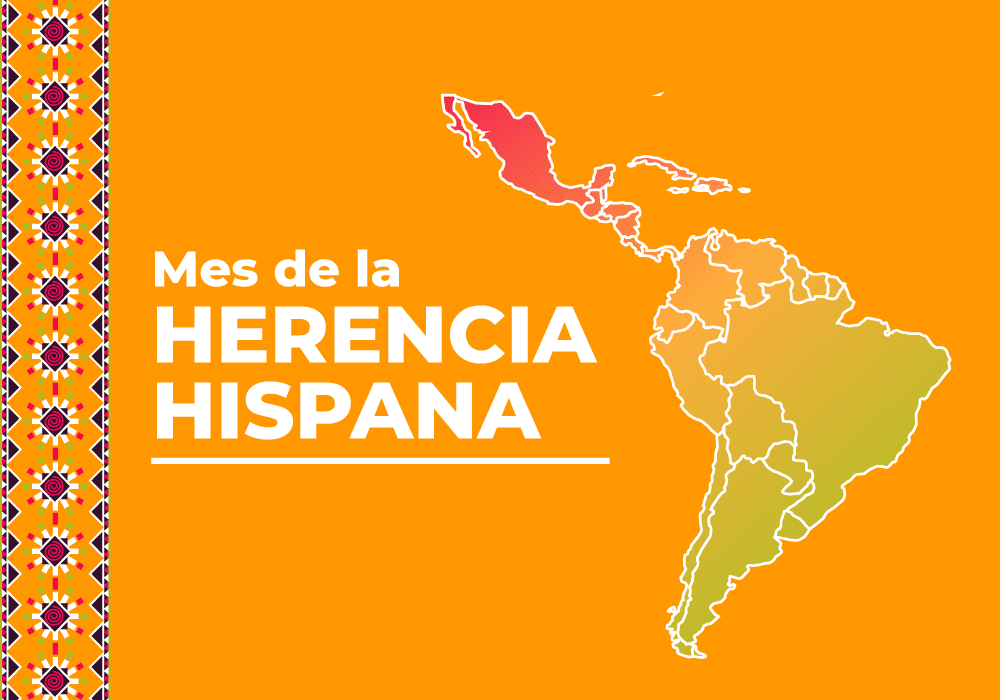
Yet, for some groups within the Latino/a community, Hispanic Heritage Month can be a reminder of how cultural hegemony erases diversity and identity. The challenge of celebrating a diverse community that does not fit the clear, simple, and binary definitions of the majority Euro-centric American culture reduces Hispanic Heritage Month to a celebration of whichever Latin American cultural heritage is most prominent in a particular context. The month that was meant to celebrate our diversity is reduced to the celebration of the Spanish-Caribbean in the eastern seaboard of the USA, or of Mexican-American communities in the Southwest and West. This cultural hegemony makes invisible large portions of our communities.

Cultural Hegemony Gets Personal

I speak to this from personal experience. When I first moved to the mainland USA it was to the eastern coast. As a Puerto Rican, it was easy for me to find representations of my culture anywhere I went. I didn’t have to adapt my dialect too much and for the most part, people understood when I said “habichuela” or “bizcocho” or “guagua.” The historic large diasporas of Spanish-Caribbean peoples to the easter parts of the USA means that our cultures, dialects, and cuisines are more prevalent. Other people of Latin American descent usually must adapt to these Spanish-Caribbean cultures (Cuba, Dominican Republic, and Puerto Rico.) Once I moved to the West coast, things were totally different. Out here, the prevalent cultures are Mexican and Mexican-American. People from all over Latin America and of any Latin American heritage must adapt to these cultures as they have been adopted by the Euro-American majority as the standard or default definition of “Latinidad.” More concerning is the expansion of this standard definition and its adoption by politicians, nonprofits, businesses, and many other groups.

The invisibilization of non-Mexican Latin people has profound consequences both for our communities and for society at large. Spanish is reduced to one dialect and one accent (usually norteño or chilango) at the expense of the plethora of dialects spoken throughout Latin America and the many variations of the Mexican dialect. Latino Indigeneity is reduced to Aztec and Maya identities at the expense of Mapuche, Arawak, Taíno, Guaraní, Garifuna, and the thousands of indigenous groups that still inhabit Latin America. The Afro-Latino/a identity is forgotten as “mestizaje” – the mixing of European and Indigenous identities – is made the standard of Latinidad. And Protestant, Evangelical, Jewish, Muslim, Buddhist, Hindu, Santero, Espiritista, and other faith traditions practiced by Latin folk are hidden in favor of a particular Roman Catholic experience that doesn’t even consider the beautifully diverse experiences and traditions of non-Mexican Latin Catholic communities. For instance, growing up Protestant, I never observed “Día de los Muertos”, or sang to “La Virgen de Guadalupe” on December 12th. Although I recognize and honor the importance these celebrations have, they do not define my Latinidad, nor do they define Latinidad for at least half of Latinos/as in the United States.

The Mexican cultural hegemony promoted by white supremacy is not only impacting non-Mexican Latin folk. This cultural hegemony also impacts other Mexicans. My husband is Mexican, from the state of Yucatán, and of Maya indigenous identity. In the white supremacist, cultural hegemonic definition of “Mexican” and of “Latinidad”, his accent, his cuisine, and his traditions do not fit. From time immemorial, the Maya people of Yucatán have celebrated “Hanal Pixan”, a month-long observance to welcome back and honor those ancestors who are before us (in Maya tradition, the past is before us, while the present is behind us because we cannot see it.) During this time, families prepare altars, present food and drinks as offerings, and have rituals of welcoming for the ancestors. On three different dates throughout the month a special tamal called “pib” is prepared and eaten with those ancestors. Hanal Pixan has been merged to

some extent with the Roman Catholic tradition of All Souls and All Saints Days, while keeping much of its Mayan roots. But you would never find a hint of this Mexican cultural tradition presented in any of the “Hispanic” celebrations of “Día de los Muertos.” Once again, cultural hegemony erases a part of our identities.

The Causes and Roots of Cultural Hegemony

There are many causes for cultural hegemony. Our own brains try to minimize the use of energy by categorizing things around us in the simplest ways. Culturally, we try to group people as to make it easier for us to understand them. White supremacy in particular has been really great at minimizing differences by grouping folk as “white” and “black” and then assigning value to each category, with lighter skin being more valuable than darker skin. This tool of control offers Latinos/as, who are of every race, a mirage opportunity to “become white” and thus, access power. The lighter our skin, the closer we are to being part of the standard definition of “American.”

It is in this context where we find the first clues to this cultural hegemony imposed in Latinidad. First, the powers-that-be decided that “Hispanic” was a good enough category for people of Latin American descent. This was regardless of their racial background or historical heritage. Whether a person was indigenous to these lands or an Austrian Jew who found refuge in Argentina, now both were classified as “Hispanic” for the mere fact that Spain conquered most of what is today Latin America. Second, when the communities reacted to this misnomer, they came up with “Latino”, and if they were progressive enough, “Latino or Latina.” This at least alleviated the reality of those who, having cultural roots in Latin America, did not have or do not want to be associated with Spanish heritage. The Euro-American majority decided how our community was going to be named, regardless of centuries of self-identification within our communities. Finally, the acceptance of mestizaje as the standard of Latinidad served the purpose of ensuring that Latinos and Latinas thought of ourselves as “almost white” people in the context of the United States. (Please know that this concept is used very differently within Latin America. But I will not be discussing this in this essay.) Erasing Afro Latinidad can only serve the white supremacy agenda, not advance the Latino/a community.

On the other hand, once the stage was set to have a homogenous definition of Latinidad, it was easier for one dominant Latin culture to ignore the rest.

Throughout the years, Mexico has been extremely successful in developing its media presence throughout Latin America. The richest man in Mexico also happens to be the most successful telecommunications executive in Latin American, Carlos Slim Helú. América Móvil, his telecommunications empire, has an almost monopoly of the communications world throughout all of Latin America with the notable exception of Cuba. The Mexican theater and film “Golden Age” marked the scenic arts in ways that no other country was able to do. Today, Mexican novelas (soap operas) and movies dominate most of the TV market throughout the continent. Pretty much any Spanish language singer – and sometimes actors – who wants to have a successful career knows that they must gain over the Mexican market, no matter how successful they might be in their countries of origin and neighboring countries.

As a result of the success of Mexican cultural exports – films, novelas, music, cuisine, etc. – there is no corner of Latin America that has not been exposed to the Mexican dialect (on its norteño and capital city versions), foods, and music, among others. Thus, although pretty much any Spanish-speaker can understand Mexican Spanish, people in Mexico and people of Mexican descent elsewhere have not had the chance to be exposed to our dialects. Therefore, although there are plenty of words in Spanish to call a cake – bizcocho, torta, queque –, pastel has become the “standard” in the USA. If they are only familiar with Mexican Spanish, someone will be very confused when a South American asks them for a torta and find out that they meant a cake, and not a sandwich. That’s because torta is the South American Spanih word for cake, while in Mexico they call cakes, pastel. There are plenty of examples like this, as words for beans (judías, habichuelas, caraotas), pepper (ají, pimiento), banana (guineo, cambur, banano), jacket (chompa, cazadora, abrigo) and many others are Mexicanized and the many different ways in which they are called elsewhere are forgotten.

This is not on the Mexican people’s backs. I am not advocating for the elimination of Mexican dialects in public or private use, nor am I complaining about Mexico’s success in investing in its own arts and cultural programs. On the contrary, I admire the fact that, with the USA being so relentless in spreading American English as the lingua franca, and American music and films as standards, Mexico has successfully overcome this by continuing to produce high-quality content in Spanish in pretty much all the art forms. What I am doing is explaining the reasons why it is so common for the Mexican dialect to be the “standard” for Spanish in the United States.

The white supremacy structures in which the USA operates make it easier for homogenization to take place. It also makes it easier for the rest of us to be invisible during a month that is supposed to highlight the contributions of all our cultures, histories, and identities.

A Possible Solution

Is it possible for this cultural hegemony to be overcome? I believe it is!

If we want to go back to the origins of Hispanic Heritage Month we can hold on to the core of its purpose: to celebrate the contributions of Hispanics and Latinos/as to the USA. It is absolutely perfect to include tacos, tamales, norteño music, and Mexican folk dances in your Hispanic Heritage Month celebrations. And it is equally important to expand this and include other cuisines, dances, histories, and symbols of more Latin American communities. Here are some ideas on how your agency, nonprofit, church, workplace, or any other group can expand their offerings to celebrate our comunidad.

  1. Don’t assume. Ask! It is so simple. Even if you are of Latino heritage, ask around to find out more about the Latino/a community in your area. Even if there is one specific national heritage more prominent than others, I assure you that you will find people of all sorts of Latina/o cultural heritage around. Ask them what would be meaningful to include in any celebration of our cultures.
  2. Learn. Read books from authors of every national background. Follow news from throughout the region so you know what’s affecting local communities with ties to those regions. Read about the history of colonization of USA in our countries of origin so you can understand the patterns of migration of our communities. Watch documentaries about our region and our countries of origin. Attend events created by and for Latinos/as, especially if they are from cultures outside of whichever is the majority Latin culture in your context.
  3. Expand the celebrations. Find out who is the small business owner of a restaurant from a Latin cuisine that is not from the majority Latin community represented in your area. Order from them instead! Introduce even other Latinas/os to cuisines different than theirs. A business can have a whole catered event with different empanadas from all throughout the continent! The same for dances and performances. Bring in tango dancers, include bachata and salsa in your parties, teach a cumbia class during one of the events. (As reggaeton becomes more and more prominent in Hispanic Heritage Month celebrations, I highly recommend checking with people who speak the dialect of the signers, as many of the lyrics can be extremely crass, offensive, and vulgar to specific communities. Also, not all reggaeton lyrics are like this, and I personally enjoy the style, so this is not a judgment on the genre, just a recommendation to make spaces more accessible and safe for all.)
  4. Have fun! Among the many things that unite all our communities is how boisterous, energetic, and fun we are! Whether we call it pachanga, farra, parranda, juerga, fiesta, pary, bembé or whatever other word we have for it, Latin parties are filled with joy and celebration. There might be a time to start, but you never know when the party will end. Have flexibility with your celebrations and let the community enjoy its time together.

Reclaiming La Herencia Hispana y Latina!

Latina trans activist Sylvia Rivera once said, “We have to be visible. We are not ashamed of who we are.” She was referring to the trans community and the LGBTQ community in general. Nevertheless, Rivera was a proud Latina woman too. She never hid her Venezuelan and Puerto Rican heritage. At times, the invisibilization of so many Latinidades makes us ashamed of being public. Many of us switch our accents or use dialects that are not natural to us. Often, we stay silent about our own heritage lest we make those in the majority uncomfortable. That is not the solution to cultural hegemony.

The solution to cultural hegemony is being visible, vocal, and proud of our individual cultural heritage and the many mixes of heritages created in the United States. Our Hispanic Heritage Month celebrations should be expansive and always expanding. It should show every aspect of Hispanic and Latino cultures. Hispanic Heritage Month should be a time to celebrate our diverse Latin heritage in all its extravagance. Let’s bring Garifuna dances, and serve Bolivian salteñas; let’s pour Chilean wines, and enjoy Guatemalan parrilladas; let’s dance to the rhythms of African drums in Puerto Rican bomba and Peruvian landó; serve sopa paraguaya and Dominican mangú… Let’s make every effort to create welcoming and diverse celebrations that honor the richness of our Latin cultures. Let’s proudly and very visibly reclaim our herencia!  
Leave a comment

Filed under Culture, ethnicity, Heritage, Hispanics, Hispanos, Identidad, Identity, Latino, race, Racial Relations, racism, resistance, tradiciones, United States, USA

How Mary of Nazareth Helped Me Regain My Faith

“Caridad, Guadalupe, and novenas are not part

of my more immediate tradition.

Yet they are part of my culture.

Does that mean that,

like my native ancestors five centuries ago

when faced by the initial Catholic ‘evangelization,’

I must renounce my cultural heritage

in order to affirm my Christianity?

I do not believe so.”

Dr. Justo González, theologian


268913_10150368732015620_6162879_n

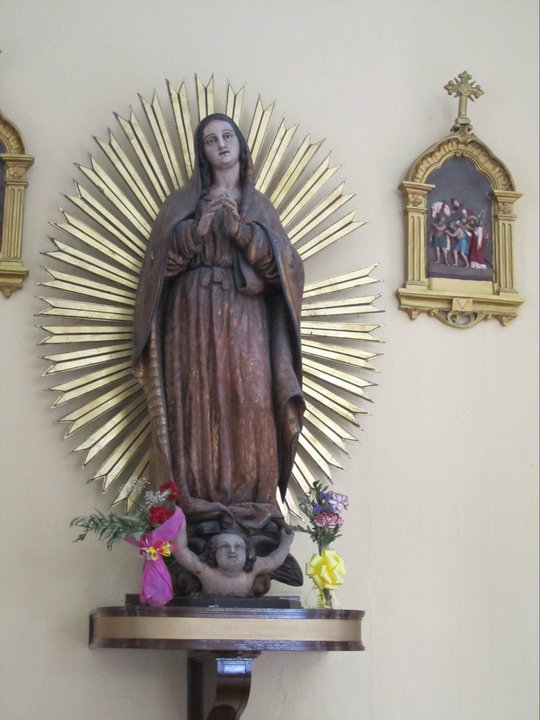
Original icon of Our Lady of Guadalupe in Ponce, Puerto Rico. This icon came from the town of Guadalupe, Spain, and has been venerated in the Island for years before the Mexican manifestation of the Virgin of Guadalupe was revealed. 

The Mother of God. The Queen of Angels. The Star of the Seas. Help of the Afflicted. Mystical Rose. Refuge of Sinners. All these and more are devotional titles for Mary, the mother of Jesus of Nazareth. She is not very prominent in the gospel stories, and is very much absent from the rest of the New Testament writings. Yet, for millions of Christians around the world, Mary of Nazareth is a central figure in their spiritual lives. Her image is present in the iconography of Roman Catholic, Eastern Orthodox, Ethiopian Orthodox, Anglican, Coptic and many other Christian traditions. Her image is even utilized by syncretic traditions such as Santería, Candomblé and sometimes Folkloric Spiritism. However, for those of us who grew up mainline Protestants – especially those of us who grew up in Africa, Asia or Latin America – the mere thought of having an image of the Virgin Mother was cringe-worthy.

My religious background is a bit confusing. I often say, for simplicity’s sake, that I grew up Protestant. But, like everything in life, the reality is a bit more complicated. My father was raised in the Northern Baptist Convention (now the American Baptist Churches, USA). My mother, on the other hand, was raised in the Kardesian Spiritist household[1]. Although, by the time that my sister and I were born neither one of our parents were practicing their respective faith traditions. By default, we were “Christians”, but no last-name was attached to it. However, there is something that has followed me since my birth.

I was born a few days after the due date. Usually this is not that big of a concern. However, in my case, when I was born I could not breath and the doctors weren’t sure if I was going to survive. As my mother tells the story, she was eagerly awaiting to welcome her firstborn, but the nurses kept mumbling and didn’t bring the kid to her. After several hours, the doctor approached my mom to let her know that I was in critical condition and they could not bring me to her side. Her first glimpse of my face was through the glass window of the maternity ward in the hospital. In addition, she became ill with a cold, and due to my delicate state, she was discharged without even being able to hold me while the doctors kept me in the hospital for almost a month. When I was discharged and due to my mom’s illness, the doctor indicated not to nurse me as I was still too frail to be exposed to any possible infection. While I was in the hospital my mom did what many parents in religious countries would do: she brought my first pair of shoes – the ones that I had never had the chance to wear – to be deposited at the feet of the Blessed Virgin Mary. This took place at the Shrine of the Virgin of the Rosary in the town of Sabana Grande in Puerto Rico. There, my mom asked the Blessed Mother to look after her firstborn and, as many mothers both from the Bible and beyond have done, she promised God and the Virgin that I would be their servant forever.

I kind of “blame” my mother’s actions for the fact that I am an ordained minister today. Without my consent, she already made the decision for me. But that’s something for another time.

Often times my parents would send me – who was always very interested in spiritual matters and in religion in general – to the Roman Catholic Church in my hometown, the parish of Our Lady of the Miraculous Medal in Castañer, Puerto Rico. Often times, these visits to Sunday Mass were with our neighbors as my parents would not necessarily come with us. I do have some memories of these visits. I also remember visiting my maternal grandfather’s séance on Sunday afternoons and seeing my grandpa lead the community in worship as their Medium. Every now and then we would also visit a home prayer meeting at my paternal grandparents’ home with the Baptist community. And thus, my religious upbringing had a little bit of three “flavors” of experiencing Christianity: Roman Catholic, Protestant and syncretic.

Around age 10 or 11 and after having been invited to a Vacation Bible School at the Baptist congregation in my neighborhood of Yahuecas in Adjuntas, Puerto Rico, I started to regularly attend Sunday services with my sister. This went on for some time until my mom started coming with us and eventually my dad joined us. Later, the whole family was involved in the life of the church and we were all baptized (or in the case of my dad, re-baptized) in that congregation.

Upon my entering in the Baptist tradition, I learned about the Protestant’s rejection of images, idols and icons for worship. I was taught to reject these as useless items that distracted us from worshiping the true God who is neither wood nor plaster but Spirit. I was taught to memorize every Bible verse that warned against the use of idols or images or anything similar in worship. Moreover, I was taught that those who used idols in worship were really worshiping the Devil, without even knowing it. What I learned was that they were kneeling before idols and not before the true God as it was instructed in Scriptures.

Fast-forward several years. I have entered seminary with the intention of pursuing ordination in a mainline Protestant tradition. Although I was not quite sure whether that tradition would be the one in which I grew up, the American Baptist denomination.

Before seminary, a friend who had served as a Presbyterian minister and was now entering the Episcopal Church, introduced me to the wonders of the liturgical world. For the first time, I had the chance to actually understand the history, the meaning, the power of images and icons and movements and sounds and smells in the life of the Church. In addition, while in seminary, I met another friend from the Roman Catholic tradition. During a conversation with him I asked why he, being so progressive in his theology, was still so tied to the Roman Catholic Church. His response moved me. He said: “One of the things that keeps me in the Church is the thought that, for generations, and even today, at every single time of the day, there is a community reciting the same prayers, making the same gestures, saying the same words that I will say when I enter Mass. We are united in prayer; not only in our daily lives and with the people from our parish, but with our sisters and brothers from around the world, and with the saints that came before us and the saints that will come after us.” That statement made me change my understanding of liturgy forever.

But, there was still the fact that I grew up believing that icons and images were contrary to God’s wish for us. All these experiences and so much contradiction made me come to what I thought would be a final conclusion: there is no god. I started thinking of myself as an atheist. Sure, one that was trained in theology and who served the Church, but an atheist nonetheless.

Some time passed. I continued to struggle with my faith and with the idea of God. I went back to wise words that had been shared with me about my faith needed to be mine and not the one I had inherited from others. I read again some of the theological classics and other contemporary writings. I continued my discernment and my journey, without knowing where it would take me, but sure that I was in this wilderness because there was something, or someone, waiting for me.

My return to the faith happened thanks to Mary. Or rather, thanks to María.

In the Latino culture, María, José, Juan, Jesús are common names. (In fact, my given name is Juan!) As I became more and more involved in activism on behalf of my Latino community and as I traveled throughout Latin America sharing time with communities in both rural and urban areas, I started to notice the faces of my people. I notices the Marías, and the Juans, and the Jesúses, and the Josés… Then, I noticed the face of God in María. Often a single mother. Often poor. Perhaps a tortilla vendor or a farmer. Sometimes a beggar on the streets. Other times she was carrying her grandkids as her own children had left for El Norte in search of a better life for those they left behind. Back home in the USA, I say her carrying signs and marching for the rights of the undocumented community. I noticed her carrying her children and cooking me a meal while I visited with them. I noticed María fighting to get access to education while holding two or three part-time jobs to support her parents who barely spoke English. I started noticing María everywhere.

I went back to some of my books. There, I read about how La Virgen Morena, Our Lady of Guadalupe, had returned their humanity to a whole indigenous community in the hills of Tepeyac. There she was, dark-skinned like the indigenous man I had fallen in love with. She was on the banners of those who fought for liberation and freedom. She had welcomed the throngs of immigrants who desperately crossed more than one border to get here. She had welcomed them with open arms in churches and shelters throughout their journey. La Virgen had walked with these people, my people, and had never left them – us – alone. In this journey of doubt and rejection of faith that I had, she was also there, just patiently waiting for me.

Two experiences had transformed my faith thanks to an encounter with La Virgen. The first one was when I stood in front of the altar to Nuestra Señora de la Caridad del Cobre (Our Lady of Charity) in El Cobre, Cuba. There she was, carrying the baby Jesus on her arms, assuring him that all will be well. Her yellow dress reminding the many pilgrims that approach her altar that she was also the embodiment of Ochún, the Yoruba Orisha that traveled with the African slaves to the Américas. I was there, standing in awe before that powerful woman who never left her children alone as they were made to cross the ocean to be enslaved and stripped of their humanity. She journeyed with them and there she was, still standing proud and valiant.

The second experience was when I stood in front of Nuestra Señora de Guadalupe in her shrine in México. I stood in awe, as I saw the dark-skinned, pregnant, indigenous Virgen welcoming us. She looked at us. She saw us. She knew us. There she was, blessing our relationship and our bond of love. I, the descendant of oppressors who massacred the children of the Morenita, standing next to one of her children, dark-skinned and indigenous, like her. She smiled at us. She forgave me. She welcomed me. La Morenita let me know that I, too, was one of her children.

I continue having doubts, of course. I also continue searching for answers that may never come. But at the end, I know that in my wilderness, Our Mother was waiting for me to come home. As I look at the Mother of God, I want to believe that, if such a loving, powerful, inspiring, courageous woman is the route to know Christ and God, I am more than happy to follow her.

—-

[1] For more information about Kardecian Spiritism, you can visit the following site: http://www.spiritist.com/archives/1862

Leave a comment

Filed under Church, Culture, Dios, ethnicity, Heritage, Hispanics, Hispanos, History, Identidad, Identity, iglesia, Latino, Puerto Rico, race, Teología, Theology, tradiciones, worship

What Will Come…

rainbow-flag

(I wrote this poem as a reaction to the recent events of terror and homophobia that have taken from us 49 of our siblings in the city of Orlando, FL.)

What will come
When the lights of the candles are extinguished
When the rage of the moment has passed
When the strength we have found
In community tonight
Has faded into the memory land

What will come
When the queers are once more
Pushed into hiding
When our voices are
Once more overwhelmed
By the money and power
Of the radical hate

What will come
When our tears are silenced
And when our pain is ignored
And when our strength faints
And our wounds are too deep but forgotten

What will happen
When the deafening silence
Of our so-called allies
Becomes once again
The norm

What will happen
When the prayers are fading
When the hugs are no more
When the lights are shut down
And the cold of the night
Overcomes our fickle souls
When the next attention-grabbing
Political squabble
Erases forever
The names and the faces
Of the saints that lay down
In a desecrated sanctuary
That our kisses once housed

What will happen
Once that all is forgotten
Once that their names are not mentioned
For ever no more

What will happen
When I will look at the mirror
And realized once again
That this is not the largest
Nor the last of them
Violence
Against people like me

What will happen
Tomorrow
I wonder
What will happen
I dream.

Leave a comment

Filed under Culture, discrimination, ethnicity, Gay, Heritage, Hispanics, Hispanos, justice, Latino, Lesbian, LGBTQ, Queer, race, racism, United States, USA

“What Are You?” – The Reality of Intersectional Identities

“What are you?” If you are a person of color, a person of non-white ethnic background, a practitioner of a non-Christian faith, or someone who does not follow conventional gender roles or expression, it is very likely that you have heard this question multiple times throughout your life. Heck! You might have heard this question multiple times just today! For some reason or another we all want to know where others “belong” – what tribe each person is a part of. Although I do not have scientific evidence to say this – it is a blog page after all, not my dissertation page – I believe we do this as a survival strategy; finding groups of people who will support each other in order to thrive, survive and protect each other based on the commonalities we share. However, we are humans. With being human comes the complexities of relationships and what it means to be in relation with each other, even those with whom we disagree.

intersectionality“What are you?” is, then, the amalgam of the identities we espouse and embody. These are identities that we have chosen and identities that are inherent to our being. The problem comes with the way in which the question is posed. Humans are not things. We are a very complex animal with both physiological and psychological characteristics. The integration of these characteristics is what makes us unique in the animal realm. Humans can overcome our desire to associate by tribe – or herd, or school, or pack, or whatever we call the different groups of animals that exist – precisely because we can answer the question “what are you?” Yet, the answer to this question is not an “it is” but an “I am”. In using this form of recognition of the self – something that other animals lack – we acknowledge that we are more than just our instincts.

Humans are the intersectionalities of our identities. These identities converge in order to create complex realities that define WHO – not “WHAT” – we are. I am… Puerto Rican, male, queer, cleric, cisgender, Latino, middleclass, a professional, Protestant, writer, advocate, light-skinned, etc. Each one of these identities reflects a part of who I am. Each one of these identities as well as when I choose to use them also reflect my values and what I treasure the most. Note, for instance, that I often identify as Puerto Rican first and foremost. This part of my identity is so crucial to my being that I cannot just ignore it or place it at the end of the list. With it come a whole lot of other realities that define what it means to be “Puerto Rican”. The context in which I experienced my Puerto Ricanness – growing up in the mountains, with a stable household, eldest son of a married couple, living in a coffee farm, Spanish speaker, exposed to the USA’s cultural realities while also keeping the history of a former Spaniard island possession, etc. – informs this part of my identity. Yet, my “self” is not complete without the interaction of the myriad other identities I embody or have chosen for myself.

Our realities are always intersections of the many identities we carry within ourselves. There are times when those identities are messy and even in contradiction with each other. Yet, this is part of the human experience. What makes us human is the capacity to navigate these apparent contradictions in a way that makes sense to US individually. What do I care about what others say about me? They cannot experience my identity the way I do, nor can I experience their identity the way each one of them does. My only responsibility is to try to acknowledge these differences and honor them by recognizing that each person’s multiple identities and how they converge are none of my business.

There is one aspect of the intersectionality of identities that is crucial, especially when it comes to living in a multi-everything society. Solidarity.

Solidarity is the ability to stand by the side of those who suffer because one or more aspects of their identities. Solidarity is recognizing that one or more parts of our identities might be attacked by others who do not understand the beauty of diversity. Solidarity is being wise enough to recognize that our lives are always being intertwined in such a way that the fight for justice is never to be done in isolation. As Blessed Martin Luther King taught us: “Injustice anywhere is a threat to justice everywhere.” If we do not see how the many identities we carry are intrinsically connected with the multiple identities of others, we will lose sight of the fight for justice and liberation.

There is no doubt that the question “what are you?” will continue to be a part of the daily experience of many of us. As a theologian, I like to reflect on the way in which the God of the Bible addressed this question when it was posed to God. According to the story found in Exodus, when Moses met God for the first time, he asked God whom should he say that send him to liberate God’s people. God’s answer was straightforward: I AM. That’s it! I am… You are, and others are too. It is in this present “being” that we can find commonalities in the midst of so many intersectional realities that make us who we are. Thus, the next time someone asks you “what are you?”, just answer: I AM.

Leave a comment

Filed under Culture, ethnicity, Heritage, Hispanics, Identidad, Identity, Latino, Puerto Rico, race, Sociology

La comunidad comes together in Wisconsin

In the past few months, the GOP delegation in the Wisconsin state Assembly, in the hopes to support Governor Walker’s agenda of destroying the state, have been trying to pass anti-family and immoral legislation. They have already succeeded in making easier for big developers to contaminate our waters. We all know that they were pretty successful in stripping workers from their rights, preventing heads of households from securing a future for their children and other IMG_4862dependents. More recently, they have been trying to put students’ lives in danger by proposing to allow criminals to openly carry handguns and other firearms around university campuses and even into classrooms. Now, they are also coming after whole families: immigrants, people of color, and other groups that do not conform to the wealthy, white, WASP majority. Two proposed bills are now before the Assembly, to criminalize brown people just for being brown. The legislators swear is to “protect” the communities, but this is just code talking to say that brown peoples are not to be trusted and we must be controlled just as the police has been encouraged to control black people by threatening their lives.
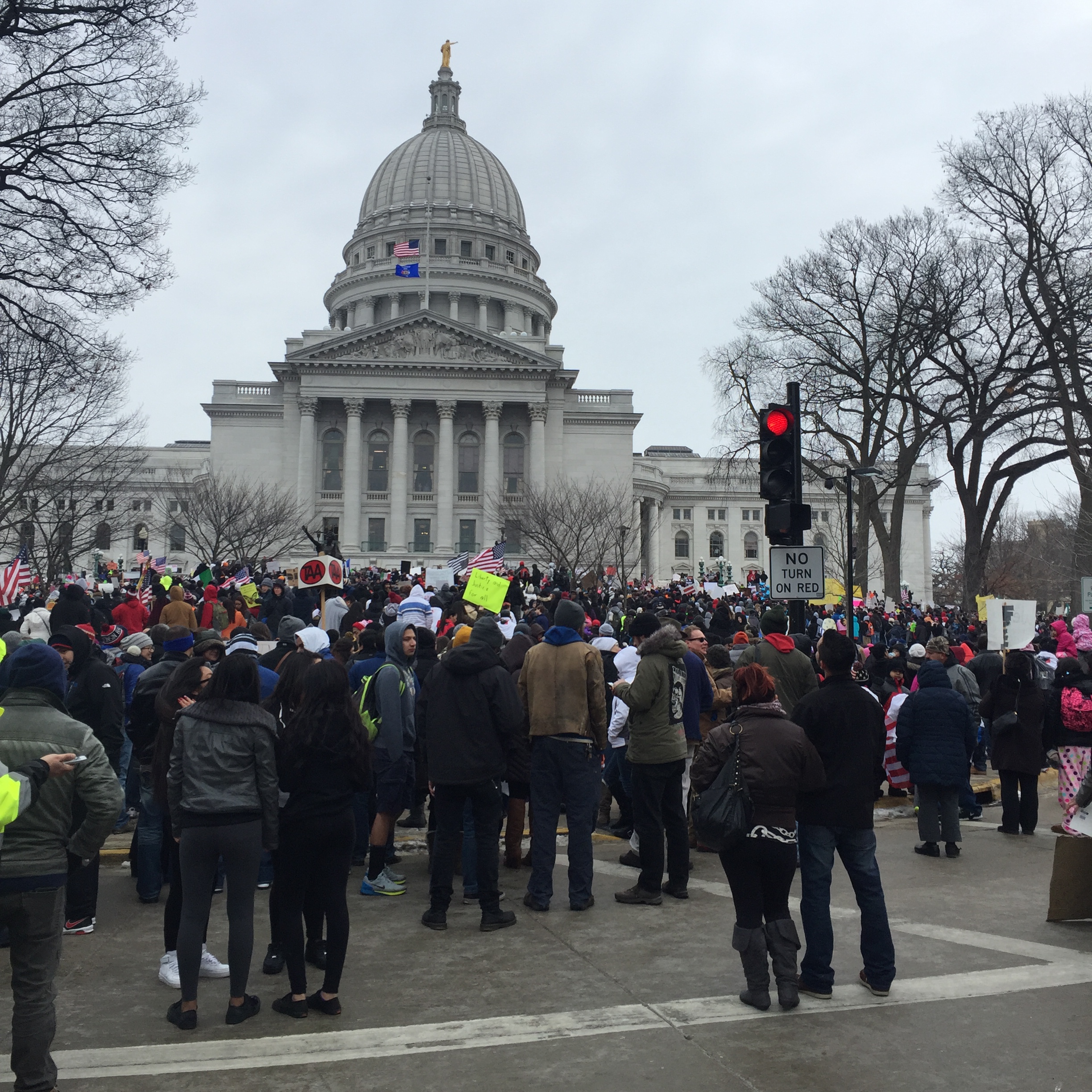
Yesterday, February 18th, the Latinx comunidad from around the state came together in an unprecedented way to say ¡BASTA! People from all over the state came to Madison as the Assembly debated two pieces of anti-family legislation, to let the government and the larger Wisconsin community that our lives matter, that we will not stand idle as they try to destroy our families, and that we not a comunidad and a voz to be dismissed.

Politicians, especially Republican politicians, think that they can play with our lives as they wish. They have stood up against every single moral issue that prevents our lives from being taken from us. In fact, it has been their lack of moral character what has killed so many of us – on the fields, at the hands of police, on the farms and factories, in jail and in immigration detention centers… Their hands are tainted with the blood of thousand Latinxs, yet they keep thirsting for more. It is not enough for them to see our children suffer, our parents mourn, our youth are anxious… They are not satisfied with seeing our IMG_4859suffering, they also want us to completely disappear, just as we bring them water, and tea, and their meals; just as we clean their homes and cultivate their fields or milk their cows; just as we tend to their wounds, and teach their children, and run their businesses… It is not enough. Never enough! Brown bodies are to be disposed of as if we are trash. To this, our comunidad says ¡BASTA!
As I stood at the Capitol square with thousands and thousands of my hermanas y hermanos Latinxs and allies, I could not do anything else but be hopeful. I know that the fight is going to be long and arduous, but we are not going to keep silent. La raza es fuerte. Moreover, we are not as divided as they want others to believe. Yesterday, there were flags from all over Latin America because we know that this “divide and conquer” strategy is not going to work. We are ONE, and as such we will fight. As Calle 13 sings: “cuando más te confías las hormigas / te engañan atacan en equipo como las pirañas / aunque sean pequeñas gracias a la unión / todas juntas se convierten en camión.” We will rise and call out our ancestors, our guiding spirits and the power of the women and men who taught us how to fight and win.

To be there, in the presence of such a beautiful cloud of witnesses was a real blessing for me. It filled me with hope, knowing that I am not just one Puerto Rican fighting alone; I am a part of the great América, and we will stand together to reclaim what is rightly ours. La comunidad came together yesterday in Wisconsin, and we will stand and fight because it is the right thing to do.

Leave a comment

Filed under Culture, ethnicity, familia, Heritage, Hispanics, Hispanos, immigration, justice, Latino, race, racism, United States, USA, Wisconsin

Los callos de mis manos

Hace ya varios meses estoy yendo al gimnasio. Por razones de salud no puedo hacer ejercicios cardiovasculares (cardio) que requieran que mi corazón se acelere mucho. Así que mi entrenador sugirió que hiciera levantamiento de pesas en su lugar. Ya van varios meses levantando pesas. Siendo que no utilizo guantes, he notado cómo mis manos se comienzan a llenar de callos.

De pequeño, mi papá me llevaba a la finca para ayudarle. Tenía mis herramientas propias para trabajar: mi canastita de mimbre para el café y mi pequeño machete para enfrentarme a las yerbas que crecían impávidas por todos lados. Para quien no ha crecido en la finca, en el campo, esta vida es romantizada.

Todo escrito que he leído donde el ambiente es el campo, nos hacen pensar que esto es el idilio. Levantarse temprano, trabajar la tierra, producir nuestro propio alimento con el sudor de nuestra propia frente. Todo muy bonito y romantizado, como he escrito, pero nada de verdad.

La verdad es que esto es trabajo duro. Es fuerte. Es trabajo que, para el niño que era, no se sentía ni romántico ni satisfactorio. Aunque no creo que mi papá nunca se haya arrepentido de haber trabajado la tierra, la verdad es que él mismo nos repetía una y otra vez, la necesidad de estudiar para poder salir del campo. Tener una carrera y bc20ee0e87b18cbfe71303719e126ee4un trabajo estable. La vida en el campo y el trabajo de la finca son duros.
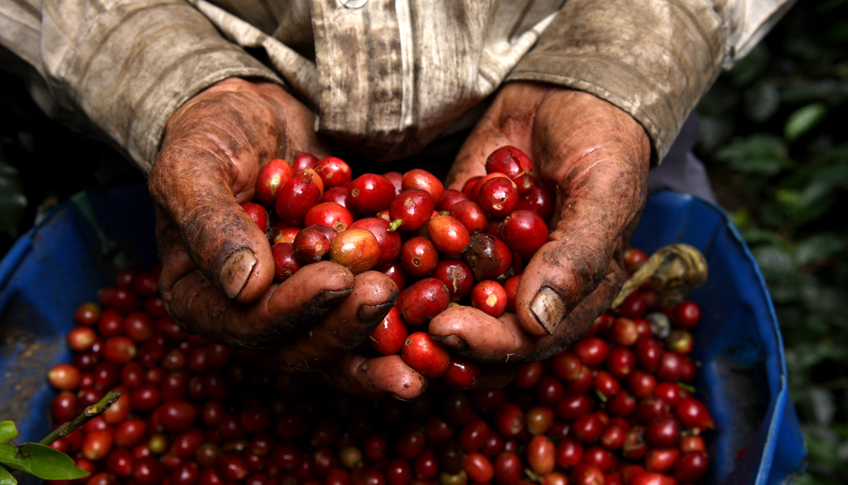
El tomar el pequeño machete me creaba callos en mis manos. Recuerdo que detestaba verme las manos al final del día y sentir la protuberancia que se convertiría en una ampolla de agua y que luego dejaría a su vez una marca callosa. Recuerdo el no querer ni siquiera mirar mis manos para no darme cuenta de esta horrorosa realidad que me marcaba como niño pobre, como niño del campo, como niño jíbaro…
Me ha parecido interesante que ahora, cuando ya estoy adulto y tengo más o menos la misma edad que tenía mi papá cuando me llevaba con él a la finca, mi comprensión de los callos en mis manos es diferente. Ahora, aunque no tengo callos por las mismas razones, veo mis manos y recuerdo a mi papá. Recuerdo el machetito que yo usaba para cortar las yerbas del patio y de la finca. Recuerdo los granos del café, color del rubí, cuando recolectábamos los granos en las cestas de mimbre. Recuerdo el levantarme temprano – quejándome, no queriendo ir – para llenarnos del sereno de la madrugada mientras subíamos y bajábamos cerros para encontrar los arbustos más llenos de los granos de café. Recuerdo las manos de mi papá, acariciándonos con cariño por el trabajo completado, por haberle acompañado, por hacerle sentir orgulloso. Recuerdo sus manos callosas sobre las mías, recordándome la importancia de los estudios para que no tuviese que vivir toda la vida en la finca.

Ahora, los callos de mis manos, aunque no vienen de las mismas tareas, me recuerdan a mi procedencia campesina. Soy parte de esa jaibería boricua que salió de las montañas, también llenas de callos y de cicatrices en sus tierras…

Leave a comment

Filed under Culture, familia, Hispanics, Hispanos, Identidad, Latino, Puerto Rico, Recuerdos, tradiciones

Please, Keep Your Prayers, We Don’t Need Them!

I hate, I reject your festivals;

    I don’t enjoy your joyous assemblies.

If you bring me your entirely burned offerings and gifts of food—

        I won’t be pleased;

    I won’t even look at your offerings of well-fed animals.

Take away the noise of your songs;

        I won’t listen to the melody of your harps.

But let justice roll down like waters,

        and righteousness like an ever-flowing stream.

Amos 5.21-24

Let me start by saying that I am not saying that prayers are a bad thing. If they help you process the awfulness of recent events and of the systemic extermination of Black individuals from US society, then use prayer. But I want to make something clear: prayers alone are not keeping Black, brown and other minority individuals safe. No matter how much you pray, no matter to whom you pray, no matter how strong your faith is, no matter how powerful your god/goddess/spirit/divine being is, prayers are not working.

Upon hearing the news about the massacre of Black sisters and brothers by a white terrorist at Mother Emmanuel African Methodist Episcopal Church in Charleston, South Carolina, what first came to mind were the words from God that the prophet Amos shares in his book and with which I opened this post. Immediately I knew that many of my friends and colleagues were going to start posting images of candles and words of prayer on their social media platforms. It is always the same pattern: hear the news of a white individual – police, young man, white supremacist, state-sponsored executioners paid by tax dollars… – and immediately there is outrage by allies and people of color alike, followed by posts on Facebook/Twitter/Instagram and prayer vigils.

Black lives matter All of these are fine. Use whatever means you have at your disposal to process the rage, the hurt, the fear and the pain. But again, hear this: NO PRAYER, NO GOD, NO POST is helping save Black, brown and other minority individuals from the systemic purge that we are experiencing.

The prophet Amos states that the God of the people of Israel is disgusted with so much ritual with no action. When prayer is not followed by actions of justice, it becomes hollowed. As I interpret my relationship with God, God depends on us working together to change the world. This is collaboration. And I believe that we are way past time to take action.

Here is what I propose, particularly to my white, Anglo/Euro-American friends and allies: shut up, listen, and act. I don’t care that your best friend is Black. I don’t care that your sons and daughters are adopted from Asian countries. I don’t care that your significant other is Latin@. This systemic purge is not affecting you as a white individual as it is affecting us as people of color. Thank you for your solidarity, but please let be our voices that ones that are heard. Do you want to know what it feels like to be Black in the United States? Ask your friend! Do you want to know what it feels to be a racial minority? Ask your children or your spouse or your best friend or whomever it is that you have used as an excuse to state that you know what we are going through. But don’t pretend that you will ever understand our fear. I am Latino, queer and cisgender. I can only tell you what MY fear is. I cannot speak for my Black siblings or my trans siblings. I cannot speak for my women siblings either. I can only speak of my experience. The only experience that a white person can speak of in the United States is that of privilege (yes, even those who are poor. More on how this plays out here: http://thefeministbreeder.com/explaining-white-privilege-broke-white-person)

There are other things that I would like to share about what can be done instead of prayers to change this situation. This is not a comprehensive list, and I encourage you to post your own ideas and recommendations on the comments below. Just be respectful and civil on your comments. I monitor the comments on my page and will not tolerate racism, xenophobia, LGB-phobia, transphobia, misogyny, ableism, or any other form of hate speech.

Here are some ideas:

  1. Reach out to people of color in your communities. Be intentional in this reaching out. Form friendships and alliances.
  2. If you are white, recognize your privilege. Recognize that the system in which we currently live was created for you. You might be a fifth generation trailer park kid, but the founding people of this country were only interested in the wellbeing of the white, Anglo establishment. Things have not changed much throughout the years, and your skin color grants you privileges that are still unreachable to the rest of us.
  3. Learn about the history of privilege in the USA. Learn about the slave trade and the uprooting of millions of people from their lands. Learn about the stealing of lands from Indigenous peoples. Learn about the snatching of land from Mexico. Learn about the invasion on Cuba, the Philippines, Puerto Rico, Guam and Marshall Islands. Learn about the USA’s role in placing blood-thirsty dictators in the rest of America and in the Middle East… Learn the history of your privilege!
  4. When you see racism happening, denounce it! Publicly and loud. Don’t just lift up a prayer for the victim… ACT! We – people of color – are literally taking bullets because we are speaking up on our rights to walk on the streets, use public pools, pray in our sanctuaries… Why are you still so afraid of speaking up? Believe me, nobody is going to take out a gun to shoot YOU for speaking up. Not the police, not the KKK member, not the “unstable young man”.
  5. Use the right language when talking about these events: these are not “mentally unstable young men”; they are white supremacists with a desire to exterminate Black, brown and other minorities. These are not “unrelated events”; these are all part of the systemic extermination of non-white individuals in the USA. Language matters. How we communicate what is happening will counteract the fallacies that the media create around these acts of terror.
  6. To my Latino and Latina siblings: recognize that the violence against Black individuals is just the tip of the iceberg. You and I are marked for systemic extermination too. Additionally, recognize that racism and anti-Blackness exist in our communities.
  7. Let us scream, shout, cry, curse… This is fucking terrifying and we need to express our fears! We might even say “you” when talking to you about the terror that the white majority is inflicting on us. Just take it. We are not “coming for you”, we just need to express the panic we are feeling right now and we are NOT colorblind; we see that you are white.
  8. Related to that, we do not need you to “allow” us to do anything. We are going to do it because we are entitled to do it as human beings, not because a white person grants us permission.
  9. Be present, but don’t take over. Listen. Ask questions. Answer if we ask, not before.
  10. Do not be afraid of engaging your own family or friends in conversations about racial relations and your own privilege as white people. If you are going to be an ally and help change the system, it is not to us – people of color – that you have to be talking to. It is to your grandparents and your aunts; to your white co-workers and nephews and nieces. It is to your next door neighbor and your golf buddies…

I am sure I will come up with more ideas as I continue to process all these events. But in the meantime, we can start with this list. Just keep in mind this: God despises hollow prayers and rituals, but She states: “But let justice roll down like waters, and righteousness like an ever-flowing stream.”

Leave a comment

Filed under Black, Church, Culture, discrimination, ethnicity, justice, Latino, Peace, race, racism, Theology, USA

Las mantillas evangélicas

IMG_3419En mis años de infancia, cuando visitaba de vez en cuando la parroquia de Nuestra Señora de la Medalla Milagrosa en Castañer, Puerto Rico, veía una que otra viejita usando mantilla. Las mantillas son esos velos que cubren la cabeza de las mujeres católicas devotas. Por lo general son negras. Las mantillas eran utilizadas mucho en los años antes del Concilio Vaticano II. Pero luego de éste Concilio, la Iglesia Católica decidió que no era necesario el que las mujeres utilizaran mantillas en la iglesia. Así que el uso de mantillas se ha mantenido solamente entre las viejitas que todavía se aferran a la tradición y a los grupos Católicos ultra-ortodoxos.

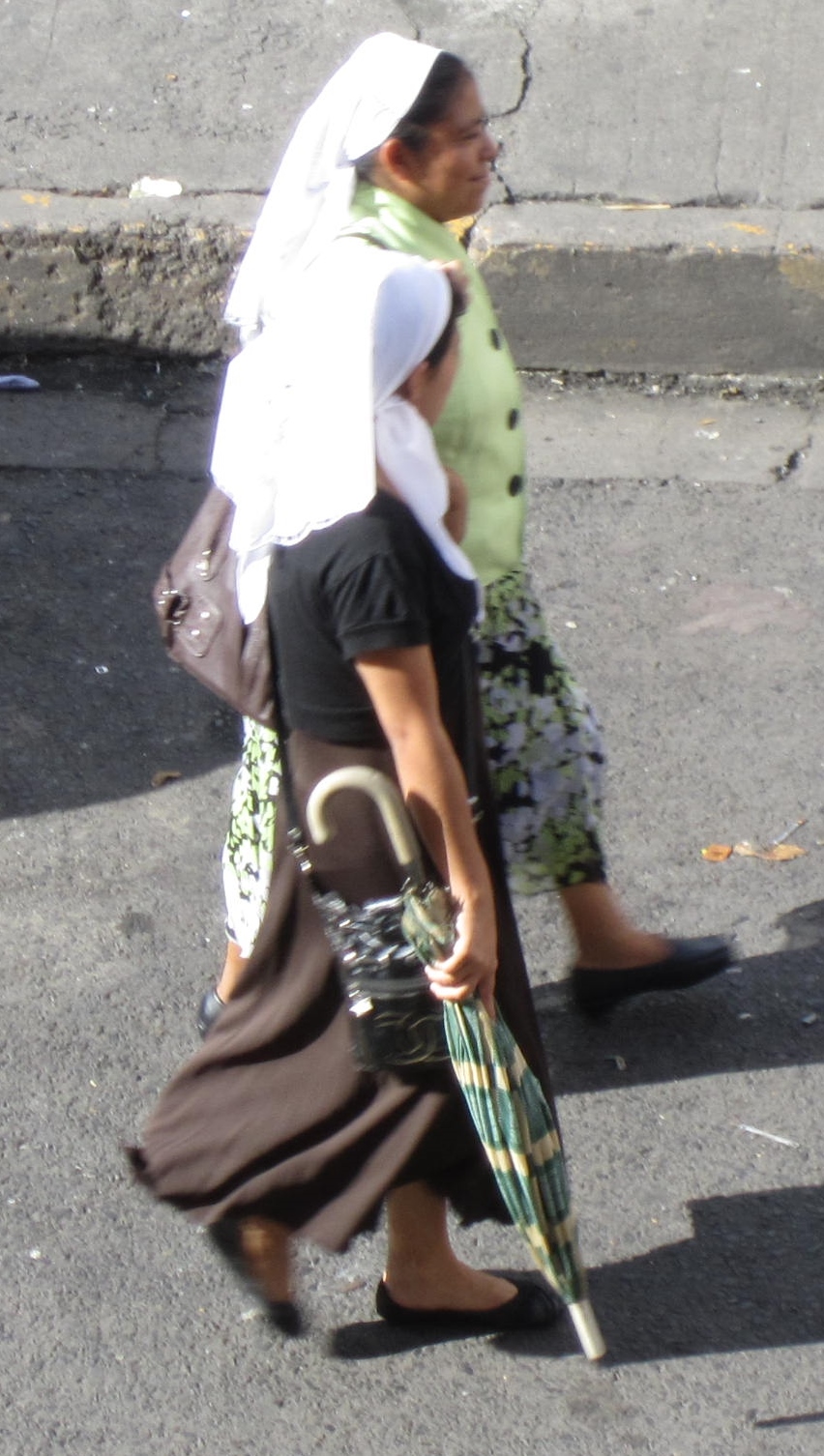
Bueno, eso era lo que creía yo, hasta que visité El Salvador hace unas semanas. Resulta que caminando por las calles de San Salvador – y en muchos otros lugares que visité en el país – me encontré con mujeres de todas las edades vistiendo mantillas. Todas llevaban mantillas blancas. Elaboradas con perlitas de mentira y bordadas con hilo fino blanco. Me pareció interesante ver tanta mujer católica aferrada a su tradición, así que le pregunté a mi amigo el porqué de tal devoción.

“¡Esas no son mujeres católicas! Quienes llevan esas mantillas son evangélicas.” Eso me dijo mi amigo. Me quedé estupefacto. ¡Mujeres evangélicas vistiendo mantillas! Yo había sido testigo de mujeres de grupos evangélicos judaizantes utilizar mantillas (en Puerto Rico, la Congregación de Yahweh es una de estas iglesias), pero nunca en público. Por  lo general, el uso de mantillas es exclusivo para el culto privado. Después de todo, aun si leemos al Apóstol Pablo literalmente en 1 Corintios 11:1-16 éste hace referencia al uso del velo por la mujer solamente en el contexto del culto.

Lo interesante de ver tanta mujer en El Salvador con velo/mantilla es que me recordó cuán similares somos a pesar de nuestras diferencias. De seguro que si les preguntara a esas mujeres evangélicas qué piensas de sus hermanas católicas, nos dirán que las católicas están mal. Criticarán su fe y su forma de expresar el cristianismo. Así mismo, las mujeres católicas quizás critiquen o no entiendan a las mujeres evangélicas. Pero interesantemente, las mujeres evangélicas son herederas de una costumbre católica romana. La han adoptado y adaptado para sí. De hecho, a quien siguen e imitan es a la misma María de Nazaret, cuya imagen siempre lleva velo/mantilla, pero cuya imagen es tan rechazada por las mismas mujeres que siguen su ejemplo.

Seguimos teniendo divisiones por cosas que no deben dividirnos. Seguimos construyendo muros que nos separan aun cuando somos similares. Seguimos rechazando otras personas porque no comprendemos el porqué de sus costumbres… Así somos… Ojalá que un día estas hermanitas evangélicas se den cuenta que sus mantillas no son suyas, las heredaron de sus hermanas católicas romanas y de María la Madre de Jesús.


Leave a comment

Filed under Church, Culture, Dios, Español, Hispanics, iglesia, Latino, mantilla, Theology, worship