Tag Archives: racism

There Is No Pie! A Reflection on Power Dynamics and Racism

There is no pie.

None. I am not writing about food, though. I am writing about power, power dynamic, and how language fails us to explain these concepts and what it is that communities of color demand from our white colleagues and fellow humans. This is a semi-long opinion essay. Here I discuss several concepts and ideas, starting with language in general, some theological concepts, and finally, various sociological concepts related to social dynamics and power. If these things interest you, this will be a fun read. (Or maybe I have a weird sense of humor…)

Language is probably the most important human invention. It is so important that many anthropologists consider language to be the human invention that helped differentiate our ancestors from other primates. Language is important and one of the most powerful tools we have at our disposal. Nevertheless, like any human invention, language is not perfect. Although language helps us to communicate as clearly as possible, there are still limitations. Many of these limitations can be seen more clearly when it comes to explaining, describing, and understanding immaterial concepts.download (3)

As many communities in the United States engage in difficult conversations about racism, anti-blackness, power dynamics, social interactions, and other relevant realities, I thought of sharing my ideas on how language fails us to describe power dynamics.

In many occasions, humans make use of the tools we have within our languages to make sense of difficult immaterial concepts. It is common for us to use similes, metaphors, analogies, and other linguistic tools to explain difficult concepts. Allow me to use some examples from a field I am quite familiar with: Christian theology.

Perhaps one of the most difficult theological concepts to explain is the Trinity. In the history of Christian theology the concept of the Trinity has been tried to be defined and explained by both Trinitarian Christians and those who object to this understanding of God. If you were raised in any form of Christianity, the concept of the Trinity was presented in simple, easy to understand analogies… that probably were far from what the theological concept of the Trinity really is. You probably heard about the Trinity being like water, which can be liquid, solid, or gas and yet it’s still H2O. Or perhaps you are more familiar with the egg analogy, where the yolk, white, and shell are all part of the egg yet not the whole egg. The analogies are many, and none actually explains what the Trinity is without falling into some sort of heresy, according to historical Trinitarian theology.

A good, simple theological explanation of the Trinity is this: a theological mystery that explains the relationship between the three Persons who make up the reality of God as Parent, Incarnate Expression, and Holy Spirit, all three being one while also being separate from each other but never subjected to each other, they each exist from eternity to eternity and are coequal with each other. Simple, right? Ha! Now you can understand why the tools our languages have to express complicated immaterial realities always fails us. There is no simple way of expressing this theological concept and thus, most theologians hold on to the simplest of explanations: the Trinity is a mystery. Period.

Thankfully, if unless like me, you are not a theologian, this mental gymnastics is not going to affect your life. Nevertheless, there are immaterial concepts that are difficult to explain in simple words and yet affect our daily lives. This is where the concept of “the pie” comes into play.

Power dynamics in the USA live in the context of a complicated history. I will not go into historical details, but I believe we can agree on certain general points that are accepted for most people. First, the USA has a history of racism with which it has not dealt appropriately. Second, racial relations – as well as other power dynamics – permeate pretty much every interaction among people in every social context, from shopping to parenting to education and politics. I would argue that even those hegemonic contexts in which everyone belongs to the same perceived racial background are not exempt from these racial realities. White people assume their superiority based on their socialization regardless of whether they have the chance to interact with people they have been socialized to believe are inferior. On the other hand, communities of color are always aware of these social and power dynamics regardless of whether we are in the presence of white folk or not. In fact, it has been my experience that even in non-academic, family interactions where all are Latino people, we implicitly or explicitly engage in conversations strategizing how to survive and thrive in the majority white contexts in which we interact. Take for instance, when my own family engages with the youngest members of our family to encourage them to be successful in school and life… making use of the patterns, systems, strategies, goals, and mores established by the white majority. We do not have to name the systems and who developed them in order to engage in conversations on how to move within them. Finally, a capitalist and an historical European, Protestant work ethic permeates these power dynamics. Those who can adapt to this socio-religious-economic ethic will have more chances of survival than others.

imagesHere comes the “pie chart” that characterizes most conversations about resources. Power is, in my opinion, another resource. It can be used by those who have it in order to advance, or to access opportunities, or to affect change – good and bad – in society. The problem is that, what I call “the pie understanding of sharing power” negatively affects the way in which we engage in conversations about what it is that minority communities demand from the majority.

In the European Protestant work ethic, resources determine success. The person with more resources has earned the favor of God, therefore, it is their right to continue amassing power. Moreover, since power is a resource granted by God, and salvation is an individual transaction between a human and their God, it is expected that individuals continue finding ways to gather power, even at the expense of others who will lose their power. This is, I believe, at the core of capitalism. This is also a self-preserving system. The more power you have, the more you show that God has favored you. Therefore, you need to continue amassing power in order to show how much God has favored you. Those with no power have the option of finding ways to obtain power, and with it, show that God has also favored them. Since power can be amassed, those who have it present themselves as an example of how you, too, can receive and amass power if you only work hard enough for it. The problem comes when everyone starts thinking that power is finite. There are several ways to obtain power, but in this context only two are relevant: you earn power by buying it from others, or you fight for it at the expense of others who will lose it to you. Or in simple terms: some people will have large pieces of the pie, others will have slimmer pieces, and others will have no pie whatsoever.

Therein lays the problem with the pie analogy for power. There is no pie! None!

The recent conversations on racism have revolved around how to divvy up the pie. It seems like for the most part, people think that communities of color and other minoritized peoples have been trying to get a piece of the pie that majority groups have been cutting for themselves. To many people who noticed that their pieces of pie were larger than that of others, this is a problem they want to fix by either redistributing the pieces of pie, or – in my opinion, the ones that are a bit more advanced in their understanding of the complex racial realities we live under – they try to share their own pieces in order to show solidarity. Both of these approaches are honorable, as those with pieces of the pie have never experienced any other way to interact with their power. They are, in my opinion, a bit closer to understanding the demands of oppressed communities. Nevertheless, I reaffirm: there is no pie.

The pie analogy is one of the ways in which language fails us. It tries to simplify a very complex concept in order to make it more digestible (yup, pun intended!) Power is, like the Trinity, a complex, immaterial concept that cannot be explained in simple terms. Just like the Trinity is neither an egg nor water, power is neither a pie nor a table in need of more chairs to accommodate minoritized communities. Although these concepts can help us start the conversation, they cannot be the ones used to engage in deep, comprehensive, and serious conversations about systemic change and power relations.       pie-fight-group-cartoon-people-cream-pies-46001112
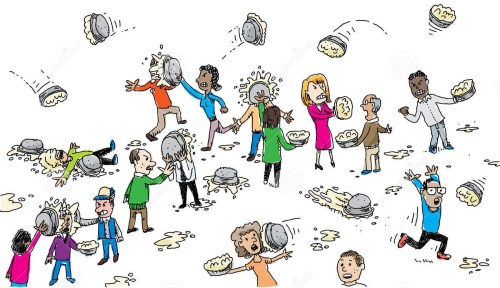
Marginalized, minoritized, and oppressed communities are not asking to share the pie. In fact, for many of us, is not even about being able to bake a pie! At the heart of the matter is what types of systems are needed to share power in order to identify the needs of the whole. It is also about coming up with solutions that address the very complex realities in which we live. It is about sharing power in all of its complexity, without taking power away from anyone. That is something the pie analogy doesn’t address. Moreover, it is this flawed analogy of the pie the one that makes it scary for the majority to engage in conversations about power dynamics. The thought of losing a piece of the pie is scary, especially when you have been socialized to believe that the piece of the pie is the seal of favor and success from your God.

Language will continue being the most important tool in human history. It is also important to know how to make use of it. Language affects the way in which we interact with each other and whether we can advance in our understanding of each other’s needs and wants. Using analogies will help us start conversations, but it cannot be the end of it. In fact, when an analogy doesn’t help frame the conversation in the best way, perhaps it is time to stop using it. My suggestion is to stop framing the conversation in relation to how the pie is to be sliced and shared, and instead talk about the nuances of shared power and systemic structural changes that will allow for more people to collaborate. The conversation can be framed in ways to collaborate and learn from each other. Instead of scaring people by suggesting that they will lose something in order to share with others, let’s start talking about the infinite amount of resources that exist in our social contexts to help collectively solve complex problems. Besides, I have never liked pies anyway…

Leave a comment

Filed under Culture, discrimination, Human Rights, Leadership, Philosophy, power, race, Racial Relations, racism, Social Movements, Sociology, USA

The Lazy Spic

10400503_18166125619_9115_nYesterday I worked a twelve-hour workday. The day before I had worked for thirteen hours straight. The day before was nine hours. I had taken exactly two days off in four months since I started my new job. I have worked on weekends and even when I have given my staff a day off, I have gone to the office or worked from home to finish a project or start a new one. My staff is always supportive and they have, on more than one occasion, asked me to take it slow, to pace down, and even encouraged me to take a day off. The Board of Directors of my organization expects me to work hard, but they have also encouraged me to practice self-care, to take time off, and to work at a healthy pace. I can show you emails, texts, and social media messages I have gotten from staff and Board members encouraging me and reminding me of practicing self-care. Yet, I continue to work.

Why do I do this? Sure, I love what I do. I thoroughly enjoy administration, management, strategic planning, and all that comes with this. But there’s a second, equally important reason why I work so much… and it is not because I am a workaholic.

The first new world in learned when I moved to New York City in 2000 was “spic.” There was a definition attached to this term. The spic is a lazy person; they live off of government handouts, they despise work, they are irresponsible, the have moved in droves to New York City and had made the space less livable, less desirable, less safe. The spic didn’t speak English and didn’t want to assimilate to the evidently superior “American” culture.

People – especially USAmericans – have been enraged with President Trump’s comments about how Puerto Ricans have not done enough to help ourselves in light of the major natural disaster we have just experienced. For Trump, we are lazy people who do not want to work collaboratively. This is what he was taught about our community in the New York City of his early childhood. For the USAmerican public, for the most part, these are atrocious accusations. For the Puerto Rican community, these are just the same comments we’ve been hearing since our community started migrating to the mainland in the 1950s.

Although I commend and welcome the rage that Trump’s comments have sparked among my USAmerican friends, you must understand that his comments are not made in a vacuum. Trump is talking about the lazy spic that I have been told I am.

As a Puerto Rican living in exile, you are taught that you are part of a group of people who are, at once, “job stealers” and “lazy people.” How is it possible that we steal “American” jobs and don’t work enough at the same time, I have no idea.

Perhaps for many of you it was a surprise that the President of the United States depicted the people of Puerto Rico as lazy people who do not help ourselves. However, this is what we have heard as a community since the 1950s when our people started migrating in droves to the USA due to the economic realities of the Island cause, precisely, by the USA’s policies towards its colonies. It is this message the one that is still ingrained in my head, to the point that I work and work and work, lest someone accuse me of being lazy and not doing enough.

This is not something I am making up. Neither is this something that happened a while ago and certainly not in so-called “progressive” spaces. On the contrary. This thinking that Puerto Ricans, and Latino people in general, are lazy is still alive. Take, for instance, what happened to me for four years while I served a progressive congregation in one of the most so-called progressive cities in the USA. A woman who self-appointed as the leader of the church would call my office at random hours of the day, just to check that I was there, just to make sure I had come to the office that day. She wouldn’t want to talk to me. She just wanted to make sure that I was there. Her excuse was that she had heard I had not been active in the community, or doing enough home visits to the folk in the congregation. She used her self-appointed status as a leader of the church to let me know that “there were concerns” in the church that I wasn’t being effective. Of course, like any good oppressor, she couldn’t notice the flaw in her argument: I had to be in the office so I could demonstrate that I was doing my job of being in the community and visiting folk.

When you are confronted with this reality every day, you learn to navigate the system. You know that you must be perfect, perform beyond what people’s perceptions of your abilities are, and work twice as hard as anybody else. No wonder the great Nuyorican poet Pedro Pietri wrote about our community:

They worked
They were always on time
They were never late
They never spoke back
when they were insulted
They worked
They never took days off
that were not on the calendar
They never went on strike

without permission
They worked
ten days a week
and were only paid for five
They worked
They worked
They worked
and they died
They died broke
They died owing
They died never knowing
what the front entrance
of the first national city bank looks like

Juan
Miguel
Milagros
Olga
Manuel
All died yesterday today
and will die again tomorrow…[1]

[1] Pedro Pietri, Puerto Rican Obituary, 1969

1 Comment

Filed under Culture, ethnicity, Heritage, Hispanics, Hispanos, Human Rights, Identity, justice, Puerto Rico, race, racism, resistance, Sociology, United States, USA

The Church Is Not A Safe Space

The last time I was in church was for the installation service of a close friend. I attended because she invited me to preach and that was a huge honor. The last time I attended church before that was the Sunday after election in the USA. Having been raised in the Church, I often relied on this community to be the safe space where I could bring my fears into with the hopes of being healed.

When Republican Party enthusiasts, emboldened by the rhetoric of President Trump and Republican leaders in the USA Congress, led a group of white supremacists, Nazis, and Ku Klux Klan sympathizers to march on the streets of a public university in Virginia, I felt the need to return to Church. I woke up on Sunday with the idea of finding a nearby congregation to attend. Somehow, I had equated church with healing and community and restoration. But then, I started to doubt it. I stopped to think about what Church had really been for me. All throughout my life, Church had not been a welcoming, healing, restoring community. On the contrary: Church was the people marching on the campus of the University of Virginia with torches, threatening many of my communities with violence and death.1374087_10152239912835620_459114692_n

Since my childhood time in Church, I had only heard hatred and violence against “sinners.” The goal was to rid the World from the sinful; to establish God’s kingdom, where the violent will reign with Christ and the Earth would be transformed into their playground. The images of fire and destruction were the ones used to exemplify this future. The King will stand to divide the crown and send some – the goats – to the pits of hell to rot for eternity, with pain and punishment unimaginable. Others – the sheep – will be lifted up to heaven to be with their Ruler.

I have been in several churches throughout my life, both as a parishioner and as a pastor. Every church has been different: my rural Baptist church in Puerto Rico, the underground Metropolitan Community Church also in Puerto Rico which I led for a few months before going to seminary, the urban, large Baptist church that sent me off to seminary, the suburban, white, moderate Baptist church that ordained me, the small, urban Hispanic Baptist church in New York City that welcomed me as their pastor, the multicultural, urban Methodist church also in NYC that provided refuge and welcomed me as a leader, the urban, liberal, white church in Seattle that made me question my call to ministry and which proved me that liberal churches are no safer than conservative ones, and the little suburban Episcopal church in Wisconsin with a worship service in Spanish that offered a few months of refuge while I served other ministries.

Here is what Church has done to me:

Church was the place where my first conversion therapy sessions happened. It was the place where I was made ashamed of my sexuality. It was the place where I learned to be secretive and embarrassed about liking men. It was the place where people gossiped about their neighbors throughout the week while coming to pray together on Sunday.

Church was the place where I had to hide my sexuality even as I was both on the ordination process and as I served as a pastor. It was the place where I was asked not to be creative with liturgy as this was not welcomed. Such experience was once again relived as I was invited to write for a white denomination’s worship resources and my work was deemed too “intimidating” because it didn’t fall within the liturgical styles of the white church. Both homophobia and white supremacy were present this weekend in Virginia. Both homophobia and white supremacy were present in this church experience for me.

Church was also the place where the white visitor who saw me walking down from my office responded to my greeting by saying “Are you the janitor?” No, I was not. I was the preacher that day, and perhaps that’s why you didn’t come back?

Church was the place where, behind closed doors and without ever telling me, the congregation had the excellent idea of paying for speech classes for me to become a better speaker of English… instead of learning how to accommodate their ears to a different accent. But that’s OK for them, because they are “liberal” and they “get it.” They too were present at the demonstrations in Virginia.

Church was the place where the fragility of the person who bullied me was most important than my safety. It was the place where I approached with caution because each time I pulled over to the parking lot, my hands started to shake and my heart started to race as the bully’s car was parked there too. It was the place where her dismissal of my leadership was encouraged; the place where they welcomed meetings with her behind my back to talk about the supposedly weak pastoral care I was providing the congregation, without ever knowing that I was often visiting, listening, calling, and praying with the elders who had asked me point blank to please keep this woman away from our household because they were afraid of her too… But I could not tell her that without facing the doubtful stares of cheering crowd. Church was the place that didn’t allow me to fall asleep from Friday night to Sunday night just because of the fear I had of coming to worship on Sundays. Even after trying different prescriptions – yes, prescriptions from my doctor – and relaxation methods, I could not do it. The bullying was that strong, and the lack of support was too much. This white fragility that didn’t allow this bully to recognize the leadership of a Latino man in church also marched in Virginia this weekend.

Church was the place where the priest addressed the violent rhetoric of the election season and the overwhelming support of white supremacists for President-elect Trump by calling the small group of Latino and Latina people by asking us… us… to come together with our oppressors and to find unity.

This was the last drop. I had tried long enough to make the Church a place of respite and community. The Church has not been such a thing for me. I need to break from this abusive relationship for good. Church, you are not safe for me as long as you march with torches and hatred.

Perhaps Church has been different for you, and for that, I am glad. Perhaps you will send a few words of “encouragement” and some apology on behalf of the Church. Don’t. I do not need them, nor do I need to explain more than I had already expressed here. Theology as a discipline and a field of study will continue to be a passion for me. The Church as a place for community, on the other hand, will not.

2 Comments

Filed under Church, Culture, discrimination, ethnicity, Gay, Human Rights, Identity, LGBTQ, ministry, Philosophy, Queer, race, racism, Sociology, Theology, United States, USA

A Few Signs of Hope

I have to say that for most of the US American people, the next four years of a possible fascist-leaning regime are not the safest, nor is there much hope for most of the US American people (no, not even for the white poor who might have voted for the president-elect, as his policies *will not* benefit the larger society but just a few upper higher class individuals and corporations.)

However, I did see some glimpses of hope for the future. Sure, there is no way of knowing how many of us will survive the regime. And certainly, we can’t even say for sure whether the authoritarian democratically elected will actually follow the Constitution and rule for only the allotted time. But, for whatever time we might need to suffer this regime, the signs of a hopeful future are out there. img_0579

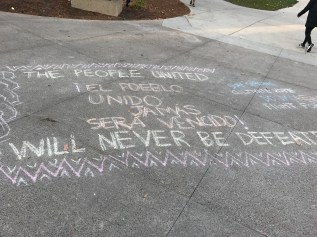
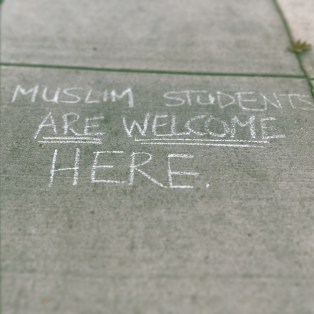
As I was talking a walk around the campus of the university near my office, I saw many messages of hope, acceptance, and support for minorities. This gave me some hope that many young people do understand the significance of this historical time. Perhaps the older generation are so fed up with democracy that they did not care about using their democratic rights to bring an authoritarian into power, but the next generations DO care about democracy and pluralism.

img_0586The resistance has continued to grow, and just like in previous authoritarian regimes, this time there will be martyrs and victors. Sure, the democracy of the USA has come to an end for the time being, but out of this coming regime a “more perfect union” will arise… Our youth are leading the way!

#RESISTANCE

Leave a comment

November 14, 2016 · 10:40 am

What Will Come…

rainbow-flag

(I wrote this poem as a reaction to the recent events of terror and homophobia that have taken from us 49 of our siblings in the city of Orlando, FL.)

What will come
When the lights of the candles are extinguished
When the rage of the moment has passed
When the strength we have found
In community tonight
Has faded into the memory land

What will come
When the queers are once more
Pushed into hiding
When our voices are
Once more overwhelmed
By the money and power
Of the radical hate

What will come
When our tears are silenced
And when our pain is ignored
And when our strength faints
And our wounds are too deep but forgotten

What will happen
When the deafening silence
Of our so-called allies
Becomes once again
The norm

What will happen
When the prayers are fading
When the hugs are no more
When the lights are shut down
And the cold of the night
Overcomes our fickle souls
When the next attention-grabbing
Political squabble
Erases forever
The names and the faces
Of the saints that lay down
In a desecrated sanctuary
That our kisses once housed

What will happen
Once that all is forgotten
Once that their names are not mentioned
For ever no more

What will happen
When I will look at the mirror
And realized once again
That this is not the largest
Nor the last of them
Violence
Against people like me

What will happen
Tomorrow
I wonder
What will happen
I dream.

Leave a comment

Filed under Culture, discrimination, ethnicity, Gay, Heritage, Hispanics, Hispanos, justice, Latino, Lesbian, LGBTQ, Queer, race, racism, United States, USA

“What Are You?” – The Reality of Intersectional Identities

“What are you?” If you are a person of color, a person of non-white ethnic background, a practitioner of a non-Christian faith, or someone who does not follow conventional gender roles or expression, it is very likely that you have heard this question multiple times throughout your life. Heck! You might have heard this question multiple times just today! For some reason or another we all want to know where others “belong” – what tribe each person is a part of. Although I do not have scientific evidence to say this – it is a blog page after all, not my dissertation page – I believe we do this as a survival strategy; finding groups of people who will support each other in order to thrive, survive and protect each other based on the commonalities we share. However, we are humans. With being human comes the complexities of relationships and what it means to be in relation with each other, even those with whom we disagree.

intersectionality“What are you?” is, then, the amalgam of the identities we espouse and embody. These are identities that we have chosen and identities that are inherent to our being. The problem comes with the way in which the question is posed. Humans are not things. We are a very complex animal with both physiological and psychological characteristics. The integration of these characteristics is what makes us unique in the animal realm. Humans can overcome our desire to associate by tribe – or herd, or school, or pack, or whatever we call the different groups of animals that exist – precisely because we can answer the question “what are you?” Yet, the answer to this question is not an “it is” but an “I am”. In using this form of recognition of the self – something that other animals lack – we acknowledge that we are more than just our instincts.

Humans are the intersectionalities of our identities. These identities converge in order to create complex realities that define WHO – not “WHAT” – we are. I am… Puerto Rican, male, queer, cleric, cisgender, Latino, middleclass, a professional, Protestant, writer, advocate, light-skinned, etc. Each one of these identities reflects a part of who I am. Each one of these identities as well as when I choose to use them also reflect my values and what I treasure the most. Note, for instance, that I often identify as Puerto Rican first and foremost. This part of my identity is so crucial to my being that I cannot just ignore it or place it at the end of the list. With it come a whole lot of other realities that define what it means to be “Puerto Rican”. The context in which I experienced my Puerto Ricanness – growing up in the mountains, with a stable household, eldest son of a married couple, living in a coffee farm, Spanish speaker, exposed to the USA’s cultural realities while also keeping the history of a former Spaniard island possession, etc. – informs this part of my identity. Yet, my “self” is not complete without the interaction of the myriad other identities I embody or have chosen for myself.

Our realities are always intersections of the many identities we carry within ourselves. There are times when those identities are messy and even in contradiction with each other. Yet, this is part of the human experience. What makes us human is the capacity to navigate these apparent contradictions in a way that makes sense to US individually. What do I care about what others say about me? They cannot experience my identity the way I do, nor can I experience their identity the way each one of them does. My only responsibility is to try to acknowledge these differences and honor them by recognizing that each person’s multiple identities and how they converge are none of my business.

There is one aspect of the intersectionality of identities that is crucial, especially when it comes to living in a multi-everything society. Solidarity.

Solidarity is the ability to stand by the side of those who suffer because one or more aspects of their identities. Solidarity is recognizing that one or more parts of our identities might be attacked by others who do not understand the beauty of diversity. Solidarity is being wise enough to recognize that our lives are always being intertwined in such a way that the fight for justice is never to be done in isolation. As Blessed Martin Luther King taught us: “Injustice anywhere is a threat to justice everywhere.” If we do not see how the many identities we carry are intrinsically connected with the multiple identities of others, we will lose sight of the fight for justice and liberation.

There is no doubt that the question “what are you?” will continue to be a part of the daily experience of many of us. As a theologian, I like to reflect on the way in which the God of the Bible addressed this question when it was posed to God. According to the story found in Exodus, when Moses met God for the first time, he asked God whom should he say that send him to liberate God’s people. God’s answer was straightforward: I AM. That’s it! I am… You are, and others are too. It is in this present “being” that we can find commonalities in the midst of so many intersectional realities that make us who we are. Thus, the next time someone asks you “what are you?”, just answer: I AM.

Leave a comment

Filed under Culture, ethnicity, Heritage, Hispanics, Identidad, Identity, Latino, Puerto Rico, race, Sociology

La comunidad comes together in Wisconsin

In the past few months, the GOP delegation in the Wisconsin state Assembly, in the hopes to support Governor Walker’s agenda of destroying the state, have been trying to pass anti-family and immoral legislation. They have already succeeded in making easier for big developers to contaminate our waters. We all know that they were pretty successful in stripping workers from their rights, preventing heads of households from securing a future for their children and other IMG_4862dependents. More recently, they have been trying to put students’ lives in danger by proposing to allow criminals to openly carry handguns and other firearms around university campuses and even into classrooms. Now, they are also coming after whole families: immigrants, people of color, and other groups that do not conform to the wealthy, white, WASP majority. Two proposed bills are now before the Assembly, to criminalize brown people just for being brown. The legislators swear is to “protect” the communities, but this is just code talking to say that brown peoples are not to be trusted and we must be controlled just as the police has been encouraged to control black people by threatening their lives.
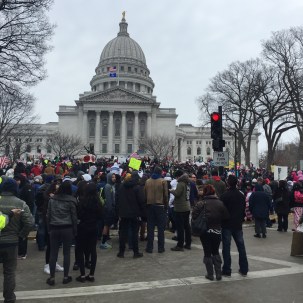
Yesterday, February 18th, the Latinx comunidad from around the state came together in an unprecedented way to say ¡BASTA! People from all over the state came to Madison as the Assembly debated two pieces of anti-family legislation, to let the government and the larger Wisconsin community that our lives matter, that we will not stand idle as they try to destroy our families, and that we not a comunidad and a voz to be dismissed.

Politicians, especially Republican politicians, think that they can play with our lives as they wish. They have stood up against every single moral issue that prevents our lives from being taken from us. In fact, it has been their lack of moral character what has killed so many of us – on the fields, at the hands of police, on the farms and factories, in jail and in immigration detention centers… Their hands are tainted with the blood of thousand Latinxs, yet they keep thirsting for more. It is not enough for them to see our children suffer, our parents mourn, our youth are anxious… They are not satisfied with seeing our IMG_4859suffering, they also want us to completely disappear, just as we bring them water, and tea, and their meals; just as we clean their homes and cultivate their fields or milk their cows; just as we tend to their wounds, and teach their children, and run their businesses… It is not enough. Never enough! Brown bodies are to be disposed of as if we are trash. To this, our comunidad says ¡BASTA!

As I stood at the Capitol square with thousands and thousands of my hermanas y hermanos Latinxs and allies, I could not do anything else but be hopeful. I know that the fight is going to be long and arduous, but we are not going to keep silent. La raza es fuerte. Moreover, we are not as divided as they want others to believe. Yesterday, there were flags from all over Latin America because we know that this “divide and conquer” strategy is not going to work. We are ONE, and as such we will fight. As Calle 13 sings: “cuando más te confías las hormigas / te engañan atacan en equipo como las pirañas / aunque sean pequeñas gracias a la unión / todas juntas se convierten en camión.” We will rise and call out our ancestors, our guiding spirits and the power of the women and men who taught us how to fight and win.

To be there, in the presence of such a beautiful cloud of witnesses was a real blessing for me. It filled me with hope, knowing that I am not just one Puerto Rican fighting alone; I am a part of the great América, and we will stand together to reclaim what is rightly ours. La comunidad came together yesterday in Wisconsin, and we will stand and fight because it is the right thing to do.

Leave a comment

Filed under Culture, ethnicity, familia, Heritage, Hispanics, Hispanos, immigration, justice, Latino, race, racism, United States, USA, Wisconsin

Please, Keep Your Prayers, We Don’t Need Them!

I hate, I reject your festivals;

    I don’t enjoy your joyous assemblies.

If you bring me your entirely burned offerings and gifts of food—

        I won’t be pleased;

    I won’t even look at your offerings of well-fed animals.

Take away the noise of your songs;

        I won’t listen to the melody of your harps.

But let justice roll down like waters,

        and righteousness like an ever-flowing stream.

Amos 5.21-24

Let me start by saying that I am not saying that prayers are a bad thing. If they help you process the awfulness of recent events and of the systemic extermination of Black individuals from US society, then use prayer. But I want to make something clear: prayers alone are not keeping Black, brown and other minority individuals safe. No matter how much you pray, no matter to whom you pray, no matter how strong your faith is, no matter how powerful your god/goddess/spirit/divine being is, prayers are not working.

Upon hearing the news about the massacre of Black sisters and brothers by a white terrorist at Mother Emmanuel African Methodist Episcopal Church in Charleston, South Carolina, what first came to mind were the words from God that the prophet Amos shares in his book and with which I opened this post. Immediately I knew that many of my friends and colleagues were going to start posting images of candles and words of prayer on their social media platforms. It is always the same pattern: hear the news of a white individual – police, young man, white supremacist, state-sponsored executioners paid by tax dollars… – and immediately there is outrage by allies and people of color alike, followed by posts on Facebook/Twitter/Instagram and prayer vigils.

Black lives matter All of these are fine. Use whatever means you have at your disposal to process the rage, the hurt, the fear and the pain. But again, hear this: NO PRAYER, NO GOD, NO POST is helping save Black, brown and other minority individuals from the systemic purge that we are experiencing.

The prophet Amos states that the God of the people of Israel is disgusted with so much ritual with no action. When prayer is not followed by actions of justice, it becomes hollowed. As I interpret my relationship with God, God depends on us working together to change the world. This is collaboration. And I believe that we are way past time to take action.

Here is what I propose, particularly to my white, Anglo/Euro-American friends and allies: shut up, listen, and act. I don’t care that your best friend is Black. I don’t care that your sons and daughters are adopted from Asian countries. I don’t care that your significant other is Latin@. This systemic purge is not affecting you as a white individual as it is affecting us as people of color. Thank you for your solidarity, but please let be our voices that ones that are heard. Do you want to know what it feels like to be Black in the United States? Ask your friend! Do you want to know what it feels to be a racial minority? Ask your children or your spouse or your best friend or whomever it is that you have used as an excuse to state that you know what we are going through. But don’t pretend that you will ever understand our fear. I am Latino, queer and cisgender. I can only tell you what MY fear is. I cannot speak for my Black siblings or my trans siblings. I cannot speak for my women siblings either. I can only speak of my experience. The only experience that a white person can speak of in the United States is that of privilege (yes, even those who are poor. More on how this plays out here: http://thefeministbreeder.com/explaining-white-privilege-broke-white-person)

There are other things that I would like to share about what can be done instead of prayers to change this situation. This is not a comprehensive list, and I encourage you to post your own ideas and recommendations on the comments below. Just be respectful and civil on your comments. I monitor the comments on my page and will not tolerate racism, xenophobia, LGB-phobia, transphobia, misogyny, ableism, or any other form of hate speech.

Here are some ideas:

  1. Reach out to people of color in your communities. Be intentional in this reaching out. Form friendships and alliances.
  2. If you are white, recognize your privilege. Recognize that the system in which we currently live was created for you. You might be a fifth generation trailer park kid, but the founding people of this country were only interested in the wellbeing of the white, Anglo establishment. Things have not changed much throughout the years, and your skin color grants you privileges that are still unreachable to the rest of us.
  3. Learn about the history of privilege in the USA. Learn about the slave trade and the uprooting of millions of people from their lands. Learn about the stealing of lands from Indigenous peoples. Learn about the snatching of land from Mexico. Learn about the invasion on Cuba, the Philippines, Puerto Rico, Guam and Marshall Islands. Learn about the USA’s role in placing blood-thirsty dictators in the rest of America and in the Middle East… Learn the history of your privilege!
  4. When you see racism happening, denounce it! Publicly and loud. Don’t just lift up a prayer for the victim… ACT! We – people of color – are literally taking bullets because we are speaking up on our rights to walk on the streets, use public pools, pray in our sanctuaries… Why are you still so afraid of speaking up? Believe me, nobody is going to take out a gun to shoot YOU for speaking up. Not the police, not the KKK member, not the “unstable young man”.
  5. Use the right language when talking about these events: these are not “mentally unstable young men”; they are white supremacists with a desire to exterminate Black, brown and other minorities. These are not “unrelated events”; these are all part of the systemic extermination of non-white individuals in the USA. Language matters. How we communicate what is happening will counteract the fallacies that the media create around these acts of terror.
  6. To my Latino and Latina siblings: recognize that the violence against Black individuals is just the tip of the iceberg. You and I are marked for systemic extermination too. Additionally, recognize that racism and anti-Blackness exist in our communities.
  7. Let us scream, shout, cry, curse… This is fucking terrifying and we need to express our fears! We might even say “you” when talking to you about the terror that the white majority is inflicting on us. Just take it. We are not “coming for you”, we just need to express the panic we are feeling right now and we are NOT colorblind; we see that you are white.
  8. Related to that, we do not need you to “allow” us to do anything. We are going to do it because we are entitled to do it as human beings, not because a white person grants us permission.
  9. Be present, but don’t take over. Listen. Ask questions. Answer if we ask, not before.
  10. Do not be afraid of engaging your own family or friends in conversations about racial relations and your own privilege as white people. If you are going to be an ally and help change the system, it is not to us – people of color – that you have to be talking to. It is to your grandparents and your aunts; to your white co-workers and nephews and nieces. It is to your next door neighbor and your golf buddies…

I am sure I will come up with more ideas as I continue to process all these events. But in the meantime, we can start with this list. Just keep in mind this: God despises hollow prayers and rituals, but She states: “But let justice roll down like waters, and righteousness like an ever-flowing stream.”

Leave a comment

Filed under Black, Church, Culture, discrimination, ethnicity, justice, Latino, Peace, race, racism, Theology, USA

Why I Vote

i-votedThere are people in the United States, especially those – usually young, and white, and from middle and upper middle classes – that espouse “anarchist” and “leftist” views, who say that voting is a waste of time. Why should we vote if the candidates all have the same platforms? Candidates all work for the same corporate interests and look only after their own kind. Why bother with voting?

I do not disagree that many, if not most, candidates are just clones one of the other. However, for me it is still important to cast my vote. Why? Because of whom I am.
It is easy to dismiss your right to vote when you are white, or young, or male, or rich, or educated, or healthy… or any combination thereof. It is easy to dismiss the electoral process and complain about politicians and their work while not wanting to be part of the process. I understand the frustration, because I have felt it myself at times. But when you are not part of the majority, your vote is extremely important.

This is why I vote: because I am not white, because I am not straight, because I am not rich, because I am an immigrant, because my first language is not English, because my spouse can’t vote, because I am a feminist, because I am a progressive, because I am a person of faith, because I am not willing to let others dictate what I think is best for me… Voting allows me to reclaim my space in the public square. Voting allows me to stand up and say that I am part of the process even when the majority of those in power do not want to recognize my mere existence. Voting allows me to stand up for what I believe, even when the politicians making the decisions are those I voted for!

No candidate and elected official are going to share all of my values. However, I feel empowered to raise my voice when I vote. I can tell those politicians and elected officials that I have the power that the US Constitution grants me and I will make use of that power. Voting is not the “fix-all” solution. It is not perfect and it is not going to make the government work exactly as it should. But, when you are not part of the majority it is extremely important to show up at the voting booth (or to mail in your ballot!)

I vote because I am not white, because I am not straight, because I am not rich, because I am an immigrant, because my first language is not English, because my spouse can’t vote, because I am a feminist, because I am a progressive, because I am a person of faith, because I am not willing to let others dictate what I think is best for me…

Leave a comment

Filed under Uncategorized

I Have An Accent… Get Over It!

It was the first board meeGlobe_of_languageting of the year for a large, international organization. As there were going to be new members for the board, it was needed to go around and introduce ourselves. There were people from the four nations where the organization has a presence plus individuals from other nations who reside in one of the four nations represented. Everyone was sharing their names, location, and their job. It was right there when it happened…

With no hint of irony in her voice, the white, middle age, college-educated woman states that she lives in one of the places that was taken first from the native inhabitants and then from the nation to the south. Proudly she tells her audience – an international audience – that she “teaches foreign students how to lose their accents so they can get jobs” in the United States. Yup. Right as you read it. Immigrants who had spent years of education, who probably speak more than one or even two languages, needed this woman’s help to lose their accents so they could get in with the system.

I looked around for the reaction of my fellow immigrants and non-white colleagues, and, unsurprisingly, we all cringed a little. What this woman was saying, unconsciously, is that our accents make us look dumb, uneducated and unprepared for the professional challenges that jobs in this country offer.

Not long ago, something similar happened to me as I was about to take a new position and someone suggested that the organization paid for a coach who would help me lose my accent. (Full disclosure: I was not informed of this until after I had accepted the position, which caused much pain as I worked there.)

The USA culture states that, no matter how ethnically diverse the country is, those of us who have kept our accents from our mother tongues do not quite belong. For some immigrant communities this has meant that their ancestors’ languages have been lost because the parents are worried their children might not be able to find work or succeed in life. Interestingly, the culture has also incorporated words from other languages into the US English. Think, for instance, about words such as Kindergarten (German), pierogi (Polish), mesa (Spanish), bouquet (French), Brooklyn (Dutch), finale (Italian), tycoon (Japanese) and shtick (Yiddish), just to name a few. Other languages are part of the US culture, but nobody wants to acknowledge it. Moreover, if those of us who emigrated here from other countries with a different language use our own languages to communicate or express ourselves in English with an accent, then we are scolded for it.

Yet, nobody pays attention or asks Australians, South Africans, Jamaicans, New Zealanders, Trinidadians or British to lose their accents. Why?

It is true that communication is extremely important in academic and professional settings. (The personal settings are a bit different due to the familiarity of the people involved.) However, our accents and language backgrounds should not dictate our – the immigrant’s – capabilities to do the work. Being able to speak a language different than English does not mean that we have less education, less knowledge or less professional abilities. It only means that our education was in a language that was comprehensible to us as we grew up and became professionals. In fact, nobody questions the intelligence of English-speakers when you come to our countries and often times refuse to learn at least basic phrases to communicate with the people who live there.

Here are three other things that US Americans need to understand about people who speak other languages. First, most of us do speak English. Our accents only mean that English is a second, third and sometimes even fourth language (I had a seminary professor for whom this was the case, where English was the fourth language he learned.) The use of English along our own mother tongues only points to the fact that we are bi- or multi-lingual. How many languages you, English-speaker, are able to read, understand and speak?

Second, the truth is that every chance we have, we use to learn how to pronounce words, how to expand our vocabulary, and how to find the correct way to use your language in all contexts. Have you thought how difficult it is for a foreigner who was only exposed to “proper” English to figure out some of the common idioms and day-to-day phrases of your language? Take, for instance, “cut the mustard”. I know what the verb “cut” is, and I know that “mustard” is a condiment. How in the world am I supposed to know that “cut the mustard” means “to succeed”?! My mental references for mustard do not even allow for cutting! Mustard, as a seed, is too small to be able to be cut, and as paste, there is no need to be cut as it spreads. Do you follow my thoughts? (There’s another one!) I can tell you, from my personal experience, that I even take time to listen and practice pronouncing a word over and over and over again trying to find the correct way to pronounce it.

Third, there is the issue of pronunciation and hearing. You, who grew up listening to words in your language all the time, might be able to catch the subtle difference between “leave”, “live” and “leaf” but, trust me; it all sounds exactly the same to me! I need to pay attention to the context in which you used these words to find which one you used. How hard it is for you to do the same exercise? All of this is tiring, but it is exactly what non-English speakers have to do every day of our lives in this country (and what English-speakers have to do every day if they live in countries outside of the English-speaking world.)

There are two final thoughts I want to share with all of you. First, is the issue of regional accents within the United States. Most people fret about and want to change the accent of foreigners, but you seldom hear about changing the accents of people from different regions within the country. There are not-too-small differences between the accents of an Alaskan, a West Virginian from the mountains, a person from Brooklyn and one from Massachusetts. Yet, nobody will dare recommending that we all come to an agreement about speaking with the same “standard” English accent. Why? Because there is no such thing as a standard accent in any language! All languages have regional differences! Hence the ridiculous idea of asking British, Jamaicans, Australians, South Africans and Trinidadians to change their accents… they all speak English with regionalisms and it is a matter of adapting our ears to those regionalisms in order to understand each other.

Finally, my accent is, to me, a point of pride. It tells me that I speak more than one language, that I am able to communicate with more people than mono-lingual persons, and that I bring with me to this country a history. It defines who I am at this moment of my life and it makes me feel part of the global community, not just of a small community of either people of the United States or people of Puerto Rico. I can drive through the northern border of the USA and make myself understand just as I can cross the southern border and still engage in conversations. (Unfortunately, I do not speak French; therefore any visit to Quebec would be an adventure… And one that I would gladly welcome!)

My best advice to those who complain about my accent, or about any accent for that matter? Get over it.

Leave a comment

Filed under Culture, discrimination, ethnicity, Heritage, Hispanics, History, Puerto Rico, race, racism, Sociology, Uncategorized, United States, USA