Tag Archives: religion

Seven Words of Christmas

Word ArtThe news have reported that the current White House administration instructed the Centers for Disease Control (CDC) from using seven words on their budget documents. With seven days left for Christmas, I decided to take the time to write a piece each day highlighting one of the seven words.

In the Christian tradition there is the sharing of the Seven Words. These are phrases that Jesus shared while being crucified. Many Christian churches share and preach on these Seven Words during their Good Friday liturgies. The Seven Words are the climax of what Christian theology calls “the story of salvation.” The last words that Jesus shares are: “it is finished” (John 19.30) and “into your hands I commend my spirit” (Luke 23.46.) After these words, Jesus expires.

According to the timeline of events, after Jesus expires on the cross he is placed into the tomb and on the third day he is resurrected. This is the hope of the Christian person: no matter how difficult the journey is, no matter how painful the culmination of life is, there is always the hope of resurrection. This is the message of Holy Week.

Why am I writing about Holy Week on the season of Advent leading into Christmas? Because the Seven Banned Words of the CDC are a mirror of those other Seven Words of Holy Week.

The current federal administration has been crucifying the remnants of the facsimile of democracy that the United States had. With each carefully orchestrated move, the current administration tries to diminish the people’s confidence and trust on institutions serve the country. They are intentional in the use of words to describe the institutions that keep some resemblance of democracy. The administration’s furious attack on the free press, their obsession with political rallies a year after elections, their systemic appointment of people completely unprepared and unqualified to lead the agencies they are appointed to oversee, their deliberate construction of lies disguised as truth, the unashamed use of FOX News as state propaganda television, and a myriad other big and small actions that undermine democratic processes are just the tip of the iceberg. The United States democracy is being crucified.

Diversity

Fetus

Transgender

Vulnerable

Entitlement

Science-based

Evidence-based

These words represent all that society stands for when they are on their way to progress. French philosopher and founder of Sociology, Auguste Comte, wrote about the stages of human progress. In Comte’s theory, societies move towards progress. There are three stages of society: theological, metaphysical, and positivist. A theological society looks at an unknown occurrence and places all responsibility on unseen beings that control our destinies. Any possibility of progress is thwarted by the society’s fear of angering their mythological beings. A metaphysical society is in the middle stage. Societies in this stage begin to understand that there are certain things that have an explanation. The understanding of actions and their consequences are part and parcel of this society’s natural development. Neither one of these two types of societies is inherently corrupt or ignorant. You cannot know what you do not know. However, these are not ideal societies. The ideal society is one in which members are exposed to a systemic way of understanding truth. To this Comte called a “positivist society.”

Although Auguste Comte’s positivist approach to explaining society is not ideal, it does have merit, especially taking into consideration the banning of words in certain official documents by the current administration. A positivist society understands that humanity is on a journey forward. This journey cannot be contained, no matter how much the powers that be may try to stop it. Resurrection is the conclusion to the crucifixion. Progress is the conclusion to temporary repression.

Democracies are vulnerable entities. They can suffer from the ego of leaders who place power over service. Interestingly, Christmas is the time of vulnerability. In the Christian tradition, Christmas commemorates the birth of a vulnerable child, from a vulnerable family, who was threatened, even as a fetus, with destruction by its enemies – political, economic, societal, cultural, and religious, among others. Christianity proclaims that this child that was born transcended what humanity understood at that moment about the relationship between humanity and its divine sovereign. Some theologians propose that this transcending experience of God made Sophia, the common image of God as Wisdom, take the form of Christ in the person of Jesus, thus making God a transgender reality showing humanity how close the Divinity is to all of humanity. The diversity of opinions that ages of science-based social studies and evidence-based conclusions have shown us, is evidence that societies do tend to move forward towards progress and positivism. It is our responsibility, our duty, and even out entitlement as engaged members of a functional society, to be in solidarity with the vulnerable democracy that we are so desperately trying to save. Resurrection is the conclusion of crucifixion, even during the time of Advent and Christmas.

Leave a comment

Filed under Academy, Creativity, Culture, discrimination, Human Rights, Identity, LGBTQ, Philosophy, Queer, resistance, Sociology, Theology, trans, transgender, United States, USA

The Church Is Not A Safe Space

The last time I was in church was for the installation service of a close friend. I attended because she invited me to preach and that was a huge honor. The last time I attended church before that was the Sunday after election in the USA. Having been raised in the Church, I often relied on this community to be the safe space where I could bring my fears into with the hopes of being healed.

When Republican Party enthusiasts, emboldened by the rhetoric of President Trump and Republican leaders in the USA Congress, led a group of white supremacists, Nazis, and Ku Klux Klan sympathizers to march on the streets of a public university in Virginia, I felt the need to return to Church. I woke up on Sunday with the idea of finding a nearby congregation to attend. Somehow, I had equated church with healing and community and restoration. But then, I started to doubt it. I stopped to think about what Church had really been for me. All throughout my life, Church had not been a welcoming, healing, restoring community. On the contrary: Church was the people marching on the campus of the University of Virginia with torches, threatening many of my communities with violence and death.1374087_10152239912835620_459114692_n

Since my childhood time in Church, I had only heard hatred and violence against “sinners.” The goal was to rid the World from the sinful; to establish God’s kingdom, where the violent will reign with Christ and the Earth would be transformed into their playground. The images of fire and destruction were the ones used to exemplify this future. The King will stand to divide the crown and send some – the goats – to the pits of hell to rot for eternity, with pain and punishment unimaginable. Others – the sheep – will be lifted up to heaven to be with their Ruler.

I have been in several churches throughout my life, both as a parishioner and as a pastor. Every church has been different: my rural Baptist church in Puerto Rico, the underground Metropolitan Community Church also in Puerto Rico which I led for a few months before going to seminary, the urban, large Baptist church that sent me off to seminary, the suburban, white, moderate Baptist church that ordained me, the small, urban Hispanic Baptist church in New York City that welcomed me as their pastor, the multicultural, urban Methodist church also in NYC that provided refuge and welcomed me as a leader, the urban, liberal, white church in Seattle that made me question my call to ministry and which proved me that liberal churches are no safer than conservative ones, and the little suburban Episcopal church in Wisconsin with a worship service in Spanish that offered a few months of refuge while I served other ministries.

Here is what Church has done to me:

Church was the place where my first conversion therapy sessions happened. It was the place where I was made ashamed of my sexuality. It was the place where I learned to be secretive and embarrassed about liking men. It was the place where people gossiped about their neighbors throughout the week while coming to pray together on Sunday.

Church was the place where I had to hide my sexuality even as I was both on the ordination process and as I served as a pastor. It was the place where I was asked not to be creative with liturgy as this was not welcomed. Such experience was once again relived as I was invited to write for a white denomination’s worship resources and my work was deemed too “intimidating” because it didn’t fall within the liturgical styles of the white church. Both homophobia and white supremacy were present this weekend in Virginia. Both homophobia and white supremacy were present in this church experience for me.

Church was also the place where the white visitor who saw me walking down from my office responded to my greeting by saying “Are you the janitor?” No, I was not. I was the preacher that day, and perhaps that’s why you didn’t come back?

Church was the place where, behind closed doors and without ever telling me, the congregation had the excellent idea of paying for speech classes for me to become a better speaker of English… instead of learning how to accommodate their ears to a different accent. But that’s OK for them, because they are “liberal” and they “get it.” They too were present at the demonstrations in Virginia.

Church was the place where the fragility of the person who bullied me was most important than my safety. It was the place where I approached with caution because each time I pulled over to the parking lot, my hands started to shake and my heart started to race as the bully’s car was parked there too. It was the place where her dismissal of my leadership was encouraged; the place where they welcomed meetings with her behind my back to talk about the supposedly weak pastoral care I was providing the congregation, without ever knowing that I was often visiting, listening, calling, and praying with the elders who had asked me point blank to please keep this woman away from our household because they were afraid of her too… But I could not tell her that without facing the doubtful stares of cheering crowd. Church was the place that didn’t allow me to fall asleep from Friday night to Sunday night just because of the fear I had of coming to worship on Sundays. Even after trying different prescriptions – yes, prescriptions from my doctor – and relaxation methods, I could not do it. The bullying was that strong, and the lack of support was too much. This white fragility that didn’t allow this bully to recognize the leadership of a Latino man in church also marched in Virginia this weekend.

Church was the place where the priest addressed the violent rhetoric of the election season and the overwhelming support of white supremacists for President-elect Trump by calling the small group of Latino and Latina people by asking us… us… to come together with our oppressors and to find unity.

This was the last drop. I had tried long enough to make the Church a place of respite and community. The Church has not been such a thing for me. I need to break from this abusive relationship for good. Church, you are not safe for me as long as you march with torches and hatred.

Perhaps Church has been different for you, and for that, I am glad. Perhaps you will send a few words of “encouragement” and some apology on behalf of the Church. Don’t. I do not need them, nor do I need to explain more than I had already expressed here. Theology as a discipline and a field of study will continue to be a passion for me. The Church as a place for community, on the other hand, will not.

2 Comments

Filed under Church, Culture, discrimination, ethnicity, Gay, Human Rights, Identity, LGBTQ, ministry, Philosophy, Queer, race, racism, Sociology, Theology, United States, USA

La iglesia que sueño

Es indiscutible que la iglesia perfecta no existe. De hecho, creo que es indiscutible que nunca podremos encontrar una iglesia que llene todas nuestras expectativas. Habiendo sido pastor de varias congregaciones – hispanas, anglo-americanas y étnicamente diversas – puedo dar fe de que es imposible el crear congregaciones que logren complacer a toda persona al mismo tiempo. Siempre es posible encontrar congregaciones que llenen las expectativas sobre uno o varios aspectos de lo que consideramos una iglesia perfecta. Pero en definitiva, no podremos crear una congregación que llene todas las expectativas, todo el tiempo y de toda la gente.teologia-de-la-liberacion

Ahora, habiendo dicho esto, también es importante escuchar cuales son las características que las personas creen importantes para una congregación que sea la más apropiada para ellas. Esto no quiere decir que lograremos crear tal congregación. Es solo un ejercicio de soñar con nuestra congregación ideal.

Cuando me mudé a la ciudad donde vivo actualmente y ya que tenía la oportunidad de pasar del púlpito a los bancos, era el momento ideal para buscar una congregación hispana, que llenara mi necesidad de adoración en español, con una comunidad de gente con la que me pudiera identificar mejor. Visité varias comunidades y elegí una. Como he dicho, ninguna es perfecta, pero encontré una comunidad que me aceptó, que me gustó y en la que me he sentido cómodo. De todos modos, sueño con una comunidad de fe que sea más progresista, que realmente refleje mis valores y teología. No sé si sea posible encontrarla, en especial sabiendo la cantidad limitada de congregaciones hispanas en donde vivo, pero sigo soñando con una iglesia que sea más adecuada para mis necesidades.

¿Cuál es la iglesia que sueño? Pues una iglesia que sea así…

  • Una iglesia que no tengo miedo en tomar posiciones teológicas progresistas; que no se amilane de decir las cosas como son y de condenar el pecado de la soberbia, de la corrupción, de la intolerancia, del racismo, de la xenofobia, de la homofobia, de la violencia, de la transfobia, de la misoginia, del sexismo, de la opresión. En fin, una iglesia que tenga una voz profética.
  • Una iglesia que no le tema a la innovación litúrgica; donde se pueda ser flexible y expansivo con la liturgia. Una iglesia donde la rigidez se deje atrás y se de paso a la innovación, a una liturgia dinámica, a una liturgia apasionada, a una liturgia contagiosa y atractiva.
  • Una iglesia que haga uso del lenguaje inclusivo, donde “Dios” no sea solo presentado en forma masculina, sino que se utilicen todas las imágenes bíblicas para la Divinidad; una iglesia donde se hable del Dios que es como una Madre, como una Doncella, como una Mujer Parturienta, como una Viuda que busca una moneda… En fin, una iglesia que reconozca la naturaleza expansiva de Dios.
  • Una iglesia que no tenga miedo de confrontar la injusticia donde la vea; que se muestre solidaria con las personas marginadas, que se muestre solidaria con quienes sufren, con las personas en necesidad, con la niñez, con los inmigrantes, con las minorías étnicas, etc. Una iglesia que se enfrente a la supremacía blanca con valentía y que la denuncia como lo que es: pecado.
  • Una iglesia que esté bien fundamentada en sus principios cristianos pero que también participe y se nutra de las muchas tradiciones religiosas que existen. Al mismo tiempo, que sea una iglesia de vanguardia con respecto a la ciencia y la educación, que estas sean utilizadas para enseñar la grandeza de la Divinidad y no que se deje llevar por la falsa dicotomía de “ciencia contra religión”.
  • Una iglesia que se atreva a ser política – en el sentido de denunciar políticas públicas que afecten a los grupos más oprimidos mientras también deje bien clara su posición con respecto a políticas públicas de beneficio para toda la sociedad.
  • Una iglesia que atesore la tradición musical de los himnos antiguos mientras también incluya, celebre y cree nuevas formas musicales.
  • Una iglesia que atesore la tradición teológica mientras a la vez acepte la naturaleza siempre expansiva del conocimiento que ofrece el Espíritu de Dios.
  • Una iglesia que utilice más de una versión de la Biblia en español; que entienda que cada traducción es una interpretación y que no todas las interpretaciones son iguales ni apropiadas para todas las veces.
  • Una iglesia donde se proclame la Palabra de Dios en los sermones y no que se ofrezca un mensaje para sentirse bien; una iglesia que confronte, que enseñe, que rete, que desafíe a la feligresía a vivir su fe y no solamente a creer.
  • Una iglesia que celebre; que celebre la diversidad, que celebre la vida, que celebre a Dios, que celebre las culturas, que celebre la música, que celebre la Creación, ¡que celebre todo el tiempo!
  • Una iglesia que sea también bálsamo y refugio para quien busca dirección en su vida.
  • Una iglesia donde la niñez que llegue sea tratada como parte integrante de la misma; que se escuchen niñas y niños jugar y llorar en el santuario, que las madres y los padres se sienten en la libertad de correr tras sus hijas e hijos, donde la voz de la niñez es celebrada, escuchada y empoderada.
  • Una iglesia donde la mesa esté abierta; donde el pan y el vino nunca se acaben ni estén restringidos solo para un grupo; donde regularmente se invite a la gente a participar de la mesa de gratitud – eucharistía – y donde el llamado a compartir esta mesa sea contextualizado para el momento en que se vive; donde los elementos reflejen las comunidades donde se celebra, o sea, que no sea solo pan y vino, pero tortillas y tostones y pan dulce y casabe y jugo de naranja y de jamaica y de coco y café y mate y…
  • Una iglesia donde se sienta el Espíritu vivo de Jesús.

En fin, no sé si esta iglesia llegue a existir, pero espero que alguien por ahí escuche y, si es posible, que acepte el llamado de comenzar a hacer realidad la iglesia que sueño.

1 Comment

Filed under Dios, Español, familia, Hispanos, Identidad, iglesia, Latino, Teología

Trying to Argue With Circular Logic

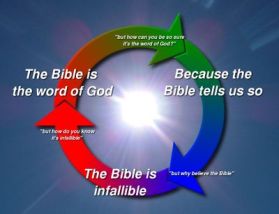
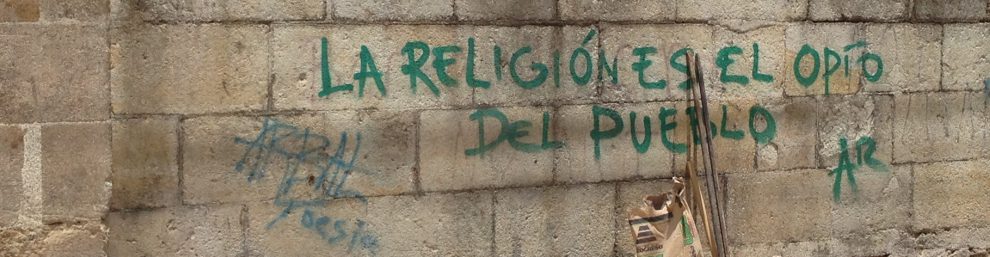
When I was in college I was introduced to the concept of circular logic or circular reasoning. This is a form of logical fallacy in which the reasoner starts with the argument they want to use as their conclusion. To some extent, the argument can be made that this type of logic is the bedrock of religious reasoning. In fact, it was through religion that I was introduced to use circular logic as my modus operandi for reasoning: the Bible is the Word of God because the Bible says it is the Word of God, therefore, it must be true that the Bible is the Word of God. There is no way of going away from this reasoning… you just have to either accept it altogether or reject it altogether. But if you are a religious person who has never been exposed to any other way of reasoning, leaving this type of logic is not an option.400px-bible_cycle

It has been a while since the last time I had a conversation with anyone who used circular logic. For the most part, I try to stay away from trying to engage in philosophical conversations with people who use this type of reasoning. Sure, I could have wonderful conversations about the weather, aspects of life, work, ourselves, etc., but it is impossible to have real conversations regarding faith with people who only use circular logic for their religious arguments. There are some people who might realize that they use this type of reasoning and, not wanting to step away from it, just accept that other people have other ways of looking at things and move on. But there are others for whom circular logic is so ingrained in their lives and way of thinking that they cannot comprehend why someone would step away from this way of thinking in order to find answers somewhere else. For some of them, trying to convince you to go back to using circular logic is not only their mission: it is their duty in life as the lives of those around them depend on it!

Unfortunately, I fell for this not long ago. When I noticed that I was engaging in a one-way conversation with someone who could only use circular logic, it was too late for me to step away. I tried, but failed miserably, to point out the invalidity of the arguments. Of course, this was to be expected! How can an argument be invalid if the only way to validate it is by going back to the premise that made the argument valid in the first place! Ha!

Although I grew up using circular logic for my religious arguments, I have come to grow in my understanding of religion and faith. I now use all the tools available to me in order to understand the religious premises that I live by. I have also come to understand that other people will have different ways of approaching the same questions I have, and that many times, depending on the approach, the answers will be different. The fact that the answer is different doesn’t make it invalid; it just makes it… well… different! I accept that. Thanks to the wonderful mentoring of Angela Figueroa, who was the sociology of religion professor who introduced me to the world of deductive and inductive logic and how to step away from circular logic, I have come to grow in my understanding of religious arguments and how to use them. I have also come to understand that “feelings”, “hunches”, and “inklings”, are not valid reasons to start arguments and to come to conclusions. That doesn’t mean they do not have a valid place in the human experience of the immaterial (or God, or the Divine), it only means that they cannot and should not be used as the bedrock of argumentation.

When I stepped out of using circular logic to “prove” my religious believes, it was a painful process. For a very long time I felt lost, confused, and completely out of control. There was a time when I even came to accept as my reality that there was no evidence of a Divine being, and therefore, there was no such thing. It took me a long time to understand that I could still be faithful, religious, and connected to a Divine being without the need to base my beliefs in circular logic. But again, this is a long and painful process. In my recent conversation, I failed to understand and accept that the person using this type of logical fallacy could have been deeply hurt by stepping out of their way of thinking. I only hope that our conversation was a small seed planted in them to be able to see the wonderful, fulfilling, and satisfying opportunity to have a faith that continues to grow and not one that is stuck in an empty sphere that takes you nowhere in your relationship with God. I also hope that I do not have to engage in another argument like this, as it was extremely painful to see how little progress you can make in trying to have an actual conversation when the other participant has already decided what the conclusion must be.

1 Comment

Filed under Church, Logic, ministry, Philosophy, Sociology, Theology

I Have No More Tears Today

Oh, no! She sits alone, the city that was once full of people.                     Once great among nations, she has become like a widow.                  Once a queen over provinces, she has become a slave.                             She weeps bitterly in the night, her tears on her cheek.                           None of her lovers comfort her. All her friends lied to her;                   they have become her enemies.                                                                          Lamentations 1.1-2

I have no more tears today. I have cried since last night.

I have cried for the future of my family.
I have cried over the prospect of having a Supreme Court that will undo my marriage, and with it, all the protections that my immigrant spouse has.
I have cried for the well-being of my niece and nephew whose parents might be taken away from them.
downloadI have cried for my other relatives who live and work and contribute to the economy of this country while not being able to access proper documentation.
I have cried for the prospect of my own, Congress-imposed US citizenship been revoked with no other alternative to fall back on.

I have cried for my friends.
I have cried for my gay, lesbian and bisexual friends whose rights are now at the hands of vice-president elect Pence, who has done all in his power to strip LGB Indianans of their rights.
I have cried for my transgender siblings whose lives are placed in great danger due to the same vice-president elect and his antics.
I have cried for the many women I know – young and old – whose safety is not guaranteed anymore as a sexual predator takes over the highest elected position in this country, thus giving permission to other predators to “grab”, to touch, to violate their beings.
I have cried for the workers of this country, whose wages are going to be frozen for decades to come and whose jobs are not guaranteed anymore as they are being shipped overseas as the president-elect has done with all the other bankrupt businesses he has run.
I have cried for the poor and sick who could barely access healthcare and had a last fighting chance with the soon-to-be-overthrown Affordable Care Act.

I have cried for humanity.
I have cried for the black community whose safety – which has never been guaranteed – will now face “stop and frisk” experiences with the proposed changes in law and order.
I have cried for the Native American communities whose ancestral lands will be desecrated without impunity.
I have cried with the immigrants and refugees who will no longer find relative safety in this country nor will they be welcomed to access it anymore.
I have cried with those of us who practice some form of faith – whether Christianity, Judaism, Islam, Hinduism, Sikhism, Buddhism, or any other – whose religious liberties will be at the whim of the far-right Evangelical Christian camp that will dominate this fascist regime.
I have cried for the environment and all the relentless desecration that will occur.
I have cried for all the people of all the countries that the president-elect has promised to destroy making use of the military forces that are now under his control.
I have cried for all the children who will not be safe any longer for a generation or two as laws protecting them will be revoked.

I have no more tears today. The only thing that I still hold on to is the hope that the fascist government ahead will help this country wake up from its deep slumber and that it will shake it to its core as to make it see how terrifying the near future looks like.

Leave a comment

November 9, 2016 · 10:59 am

How Mary of Nazareth Helped Me Regain My Faith

“Caridad, Guadalupe, and novenas are not part

of my more immediate tradition.

Yet they are part of my culture.

Does that mean that,

like my native ancestors five centuries ago

when faced by the initial Catholic ‘evangelization,’

I must renounce my cultural heritage

in order to affirm my Christianity?

I do not believe so.”

Dr. Justo González, theologian
 

268913_10150368732015620_6162879_n

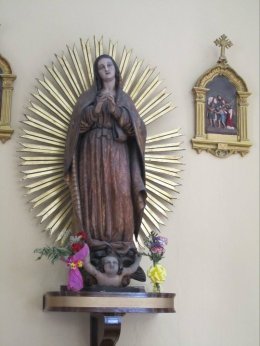
Original icon of Our Lady of Guadalupe in Ponce, Puerto Rico. This icon came from the town of Guadalupe, Spain, and has been venerated in the Island for years before the Mexican manifestation of the Virgin of Guadalupe was revealed. 

The Mother of God. The Queen of Angels. The Star of the Seas. Help of the Afflicted. Mystical Rose. Refuge of Sinners. All these and more are devotional titles for Mary, the mother of Jesus of Nazareth. She is not very prominent in the gospel stories, and is very much absent from the rest of the New Testament writings. Yet, for millions of Christians around the world, Mary of Nazareth is a central figure in their spiritual lives. Her image is present in the iconography of Roman Catholic, Eastern Orthodox, Ethiopian Orthodox, Anglican, Coptic and many other Christian traditions. Her image is even utilized by syncretic traditions such as Santería, Candomblé and sometimes Folkloric Spiritism. However, for those of us who grew up mainline Protestants – especially those of us who grew up in Africa, Asia or Latin America – the mere thought of having an image of the Virgin Mother was cringe-worthy.

My religious background is a bit confusing. I often say, for simplicity’s sake, that I grew up Protestant. But, like everything in life, the reality is a bit more complicated. My father was raised in the Northern Baptist Convention (now the American Baptist Churches, USA). My mother, on the other hand, was raised in the Kardesian Spiritist household[1]. Although, by the time that my sister and I were born neither one of our parents were practicing their respective faith traditions. By default, we were “Christians”, but no last-name was attached to it. However, there is something that has followed me since my birth.

I was born a few days after the due date. Usually this is not that big of a concern. However, in my case, when I was born I could not breath and the doctors weren’t sure if I was going to survive. As my mother tells the story, she was eagerly awaiting to welcome her firstborn, but the nurses kept mumbling and didn’t bring the kid to her. After several hours, the doctor approached my mom to let her know that I was in critical condition and they could not bring me to her side. Her first glimpse of my face was through the glass window of the maternity ward in the hospital. In addition, she became ill with a cold, and due to my delicate state, she was discharged without even being able to hold me while the doctors kept me in the hospital for almost a month. When I was discharged and due to my mom’s illness, the doctor indicated not to nurse me as I was still too frail to be exposed to any possible infection. While I was in the hospital my mom did what many parents in religious countries would do: she brought my first pair of shoes – the ones that I had never had the chance to wear – to be deposited at the feet of the Blessed Virgin Mary. This took place at the Shrine of the Virgin of the Rosary in the town of Sabana Grande in Puerto Rico. There, my mom asked the Blessed Mother to look after her firstborn and, as many mothers both from the Bible and beyond have done, she promised God and the Virgin that I would be their servant forever.

I kind of “blame” my mother’s actions for the fact that I am an ordained minister today. Without my consent, she already made the decision for me. But that’s something for another time.

Often times my parents would send me – who was always very interested in spiritual matters and in religion in general – to the Roman Catholic Church in my hometown, the parish of Our Lady of the Miraculous Medal in Castañer, Puerto Rico. Often times, these visits to Sunday Mass were with our neighbors as my parents would not necessarily come with us. I do have some memories of these visits. I also remember visiting my maternal grandfather’s séance on Sunday afternoons and seeing my grandpa lead the community in worship as their Medium. Every now and then we would also visit a home prayer meeting at my paternal grandparents’ home with the Baptist community. And thus, my religious upbringing had a little bit of three “flavors” of experiencing Christianity: Roman Catholic, Protestant and syncretic.

Around age 10 or 11 and after having been invited to a Vacation Bible School at the Baptist congregation in my neighborhood of Yahuecas in Adjuntas, Puerto Rico, I started to regularly attend Sunday services with my sister. This went on for some time until my mom started coming with us and eventually my dad joined us. Later, the whole family was involved in the life of the church and we were all baptized (or in the case of my dad, re-baptized) in that congregation.

Upon my entering in the Baptist tradition, I learned about the Protestant’s rejection of images, idols and icons for worship. I was taught to reject these as useless items that distracted us from worshiping the true God who is neither wood nor plaster but Spirit. I was taught to memorize every Bible verse that warned against the use of idols or images or anything similar in worship. Moreover, I was taught that those who used idols in worship were really worshiping the Devil, without even knowing it. What I learned was that they were kneeling before idols and not before the true God as it was instructed in Scriptures.

Fast-forward several years. I have entered seminary with the intention of pursuing ordination in a mainline Protestant tradition. Although I was not quite sure whether that tradition would be the one in which I grew up, the American Baptist denomination.

Before seminary, a friend who had served as a Presbyterian minister and was now entering the Episcopal Church, introduced me to the wonders of the liturgical world. For the first time, I had the chance to actually understand the history, the meaning, the power of images and icons and movements and sounds and smells in the life of the Church. In addition, while in seminary, I met another friend from the Roman Catholic tradition. During a conversation with him I asked why he, being so progressive in his theology, was still so tied to the Roman Catholic Church. His response moved me. He said: “One of the things that keeps me in the Church is the thought that, for generations, and even today, at every single time of the day, there is a community reciting the same prayers, making the same gestures, saying the same words that I will say when I enter Mass. We are united in prayer; not only in our daily lives and with the people from our parish, but with our sisters and brothers from around the world, and with the saints that came before us and the saints that will come after us.” That statement made me change my understanding of liturgy forever.

But, there was still the fact that I grew up believing that icons and images were contrary to God’s wish for us. All these experiences and so much contradiction made me come to what I thought would be a final conclusion: there is no god. I started thinking of myself as an atheist. Sure, one that was trained in theology and who served the Church, but an atheist nonetheless.

Some time passed. I continued to struggle with my faith and with the idea of God. I went back to wise words that had been shared with me about my faith needed to be mine and not the one I had inherited from others. I read again some of the theological classics and other contemporary writings. I continued my discernment and my journey, without knowing where it would take me, but sure that I was in this wilderness because there was something, or someone, waiting for me.

My return to the faith happened thanks to Mary. Or rather, thanks to María.

In the Latino culture, María, José, Juan, Jesús are common names. (In fact, my given name is Juan!) As I became more and more involved in activism on behalf of my Latino community and as I traveled throughout Latin America sharing time with communities in both rural and urban areas, I started to notice the faces of my people. I notices the Marías, and the Juans, and the Jesúses, and the Josés… Then, I noticed the face of God in María. Often a single mother. Often poor. Perhaps a tortilla vendor or a farmer. Sometimes a beggar on the streets. Other times she was carrying her grandkids as her own children had left for El Norte in search of a better life for those they left behind. Back home in the USA, I say her carrying signs and marching for the rights of the undocumented community. I noticed her carrying her children and cooking me a meal while I visited with them. I noticed María fighting to get access to education while holding two or three part-time jobs to support her parents who barely spoke English. I started noticing María everywhere.

I went back to some of my books. There, I read about how La Virgen Morena, Our Lady of Guadalupe, had returned their humanity to a whole indigenous community in the hills of Tepeyac. There she was, dark-skinned like the indigenous man I had fallen in love with. She was on the banners of those who fought for liberation and freedom. She had welcomed the throngs of immigrants who desperately crossed more than one border to get here. She had welcomed them with open arms in churches and shelters throughout their journey. La Virgen had walked with these people, my people, and had never left them – us – alone. In this journey of doubt and rejection of faith that I had, she was also there, just patiently waiting for me.

Two experiences had transformed my faith thanks to an encounter with La Virgen. The first one was when I stood in front of the altar to Nuestra Señora de la Caridad del Cobre (Our Lady of Charity) in El Cobre, Cuba. There she was, carrying the baby Jesus on her arms, assuring him that all will be well. Her yellow dress reminding the many pilgrims that approach her altar that she was also the embodiment of Ochún, the Yoruba Orisha that traveled with the African slaves to the Américas. I was there, standing in awe before that powerful woman who never left her children alone as they were made to cross the ocean to be enslaved and stripped of their humanity. She journeyed with them and there she was, still standing proud and valiant.

The second experience was when I stood in front of Nuestra Señora de Guadalupe in her shrine in México. I stood in awe, as I saw the dark-skinned, pregnant, indigenous Virgen welcoming us. She looked at us. She saw us. She knew us. There she was, blessing our relationship and our bond of love. I, the descendant of oppressors who massacred the children of the Morenita, standing next to one of her children, dark-skinned and indigenous, like her. She smiled at us. She forgave me. She welcomed me. La Morenita let me know that I, too, was one of her children.

I continue having doubts, of course. I also continue searching for answers that may never come. But at the end, I know that in my wilderness, Our Mother was waiting for me to come home. As I look at the Mother of God, I want to believe that, if such a loving, powerful, inspiring, courageous woman is the route to know Christ and God, I am more than happy to follow her.

—-

[1] For more information about Kardecian Spiritism, you can visit the following site: http://www.spiritist.com/archives/1862
Leave a comment

Filed under Church, Culture, Dios, ethnicity, Heritage, Hispanics, Hispanos, History, Identidad, Identity, iglesia, Latino, Puerto Rico, race, Teología, Theology, tradiciones, worship

Recuerdos del Día de Reyes Magos

Me parece que en la adultez, todas las historias que contamos comienzan con las mismas palabras: “recuerdo cuando era pequeño…” Quizás es porque las memorias son lo único 2f115ab7a7a379b4164f57fdef3aabc0--reyes-pr

que nos quedan de días pasados; días que, si no mejores – porque ningún tiempo pasado fue mejor, sino que es mejor solo el recuerdo – por lo menos fueron suficientemente gratos para guardar en algún rincón de nuestras mentes.


Esta historia también comienza como las demás. Recuerdo cuando era pequeño la gran emoción que el Día de los Reyes Magos traía consigo.

Recuerdo la noche anterior, cuando en aquella casita con los bloques de cemento expuestos, la que nunca se terminó de construir y quedaba en medio de los cafetales del barrio Guayabo Dulce de Adjuntas, mi hermana y yo salíamos a recoger la yerba pa’ los camellos. Recuerdo cuando pasábamos bastante tiempo buscando esa yerba, porque tenía que ser la mejor. Después de todo, los Reyes y sus camellos venían del Lejano Oriente. Me enteré, en alguna conversación con mi mamá, que “Lejano Oriente” era Arabia. Recuerdo también que no tenía idea de qué significaban esas cosas, pero el mismo nombre del lugar del cual venían los Reyes decía que era lejano, así que entendía que tanto camellos como reyes habrían de estar hambrientos cuando llegaran a tan remoto lugar de la Isla. Lo que no recuerdo es el por qué solo poníamos yerba pa’ los camellos pero nunca le dejamos nada a los reyes. “Son magos” imagino que diría mi mamá. Con magia no se necesita comer, me imagino.

Recuerdo que llegando noviembre ya buscábamos la mejor caja de zapatos para poner la yerba de los camellos. Recuerdo que siempre tenía que ser una caja de zapatos aunque no recuerdo el por qué. Como sabemos, los recuerdos son selectivos. Recordamos aquello que nos interesa recordar. Aun así, recordamos aquello que nos interesa de la manera que nos interesa.

Recuerdo que la noche anterior al Día de Reyes, dejábamos las cajitas de zapatos debajo de la cama que alguna vez fue cuna, pero ya no tenía las barras de los lados que me mantuvieron seguro cuando todavía la cama funcionaba como cuna. Teníamos la ilusión de que los Reyes trajeran algo; que dejaran sus preciados regalos debajo de la cama y que nos sorprendieran con aquello que habíamos pedido. Recuerdo que mis listas siempre incluían lo siguiente: libros, pintura, una enciclopedia, un microscopio, una colección de rocas, algún cuadro de un pintor puertorriqueño famoso (en aquellos tiempos todavía no era feminista y solo pedía cosas hechas por hombres. Fue hasta mucho después que descubrí que las mujeres también pintaban, también escribían, también volaban a la luna…)

Recuerdo también que el Día de Reyes me despertaba emocionado y al mirar debajo de la cama, siempre había algo. Recuerdo que nunca lo que hubo debajo de la cama era lo que pedía; nunca encontré un libro, un cuadro o un microscopio. Recuerdo que la ilusión no se detenía y a pesar de que lo que llegaba no era lo que pedía, me sentía especial porque los Reyes Magos no se olvidaron de mí y de mi hermana. ¡Siempre llegaba algo! Recuerdo que la mayoría de las veces, lo que nos llegaban eran simples regalos que habíamos visto en alguna vitrina de las tiendas de Yauco cuando visitábamos a madrina Carmita y a titi Betsy. ¿Cómo sabían los reyes comparar en esas tiendas? ¿Cómo nadie nunca los veía recorrer el Paseo del Café en el centro del pueblo? Nunca se me ocurrió preguntar; o quizás pregunté pero no recuerdo.

Recuerdo también que el Día de Reyes, luego de abrir nuestros regalos y de compartir la emoción, nos montábamos en cualquiera que fuera el carro que mi papá tenía esa semana y nos dirigíamos al barrio Guayo, a casa de mi abuelo Quino y mi abuela Margot. Allí, junto a mis primas y primos, esperábamos por la cabalgata de Reyes Magos que siempre pasaba por la casa. Era parte de su ruta hacia el parque en Castañer, donde el Hospital General recibiría a todo el niñerío de Castañer para repartir regalos y dulces y para que disfrutáramos de este día mágico. Recuerdo que cuando los Reyes cabalgaban frente a casa de abuela y abuelo, nos tiraban dulces desde sus caballos. ¡Qué emoción sentíamos! ¡Qué maravilla el ver los Reyes, los Tres Santos Reyes Melchor, Gaspar y Baltazar, pasar justo frente a casa de abuelo y abuela! La cabalgata seguía por la carretera paralela al río Guayo, la misma carretera que pasaba por el Hospital Viejo y que llegaba al puente Cifontes y cruzaba de Adjuntas a tierras de Lares. Recuerdo cómo en ocasiones seguíamos la cabalgata hasta el parque de béisbol en Castañer. En ese tiempo no había plaza pública en el poblado, solo unos inmensos árboles de maga entre la escuela elemental y las tiendas del otro lado.

Recuerdo cómo nos arremolinábamos para recoger nuestros regalos de Reyes Magos del camión que el Hospital rentaba para traerlos. No había una niña o un niño en Castañer que se quedara sin regalo. En un poblado tan pequeño, todo el mundo se conoce y Mingo Monroig, el administrador del hospital, conocía cada familia, cada niña, cada niño y adolescente de Castañer. Recuerdo que después que los regalos se repartían, empezaba la música y el jolgorio, porque las Navidades no han terminado todavía el 6 de enero. ¡Qué va! Las Navidades están en todo su esplendor todavía y después del Día de Reyes vienen las Octavitas y continúan las parrandas. Recuerdo cómo seguíamos jugando con nuestros juguetes por varios días. Recuerdo que la escuela no comenzaba sino hasta mediados de enero porque había que darle espacio al estudiantado a jugar con sus regalos de Reyes Magos.

Ahora, también recuerdo cuando todo comenzó a cambiar… Pero esos son recuerdos que prefiero no tener hoy. Hoy, seguiré recordando el Día de Reyes Magos con la ilusión del niño que fui y que todavía se emociona cada vez que viene el 6 de enero. Seguiré recordando los regalos y la yerba y los primos y la familia y la cabalgata y el parque lleno de bache donde celebrábamos. Seguiré recordando a Guayabo Dulce y a Guayo y a Castañer. Seguiré recordando los cafetales y el rio Guayo y el puente Cifontes y la casita sin terminar y la cuna convertida en cama. Seguiré recordando que el Día de Reyes es mi día favorito del año y el que más me gusta de las Navidades. Seguiré recordando que, aunque esté lejos y ya no tengo ni tiempo de celebrar este día, el Día de Reyes Magos me hace el boricua que soy.

Leave a comment

Filed under Heritage, Hispanics, Hispanos, Identidad, Latino, niña, niñez, niño, Puerto Rico, tradiciones

Carta Abierta a la Legislatura PNP de Puerto Rico

Quiero decir esto públicamente con la esperanza de que llegue a los oídos de los legisladores y las legisladoras PNP de Puerto Rico.

¿Han leído alguna vez las Constituciones – de EEUU y Puerto Rico – que juraron defender? Creo que no. Lo más probable es que sean medio analfabetas, porque la verdad que sus acciones no son de personas que tengan una mínima educación. Alguien que sepa leer, no haría las burradas que están haciendo.

Las iglesias – o cualquier otra institución religiosa – tienen todo el derecho de negarle el rito matrimonial a cualquier pareja. (Si esto es “moral” o no es otra cosa. Pero no entremos en eso.) Las Constituciones explícitamente prohíben al Estado el determinar la teología, creencias y prácticas de las religiones. Eso es lo que se llama “separación de Iglesia y Estado”. Les pongo un ejemplo sencillo: la Iglesia Católica Romana NO casa a personas divorciadas cuyo matrimonio anterior no haya sido declarado nulo por un Tribunal Eclesiástico (claro, con las ya sabidas exepciones del Arzobispo de San Juan casando a la Sra. Sila María Calderón o a la Sra. Olga Tañón, ambas divorciadas cuando caminaron por el pasillo de la Catedral en sus trajes blancos.) Este derecho está en la Constitución: es la Iglesia, no el Estado, quién determina lo que es “matrimonio” para quienes pertenecen a esa tradición.

Por otro lado, hay iglesias que definen el matrimonio como la unión de CUALQUIER dos personas. Estas iglesias ofrecen el rito matrimonial a cualquier pareja – dos hombres, dos mujeres, o un hombre y una mujer. Esa es prerrogativa de la Iglesia gracias a la separación de Iglesia y Estado. Como dije, esto está en las Constituciones que ustedes, queridos legisladores PNP, no han leído.

Finalmente, NADIE puede obligar a un ministro, sacerdote, pastor, etcétera, el llevar a cabo un matrimonio entre dos personas que el líder religioso no crea que estén preparadas para entrar en esta unión.

Todo esto quiere decir lo siguiente, queridos legisladores analfabetos: su gran idea de someter legislación para “protejer” a ministros o más bien, para PROHIBIR a ministros seguir su conciencia con relación al matrimonio, es una intromisión INCONSTITUCIONAL en determinar la teología de las iglesias. Es similar a querer legislar a quién pueden o no pueden las iglesias bautizar, ordenar, hacer funerales, invitar a predicar…

Como ministro, me da terror el pensar que la teología de cualquier iglesia pueda ser determinada por cualquier legislatura, es especial una donde ninguna persona tiene la más mínima educación teológica.

Más está decir que la reciente decisión del Tribunal Supremo de EEUU no cambió en nada la definición del matrimonio en ninguna iglesia. Cada iglesia seguirá definiendo “matrimonio” de acuerdo a su interpretación de las Escrituras que determinen sagradas. Sin embargo, es entendible que ustedes, ignorantes legisladores, hayan creído la mentira que tanto repitieran los grupos fundamentalistas puertorriqueños. Tanto repetir la mentira de que una decisión que no tiene nada que ver con teología iba a afectar sus iglesias, ha creado la ilusión de que es verdad esa mentira. Pero no, nada ha cambiado. Lo único que ha cambiado es que ahora las iglesias tienen que explicarle mejor a sus feligreses – en especial a los más jóvenes – porqué excluyen del rito matrimonial a algunas personas. Ese era el único miedo que tenían los líderes religiosos. Pero, de nuevo, eso serán temas teológicos que cada iglesia te drá que enfrentar por su cuenta.

Ahora, queridos ignorantes legisladores PNPs, espero que dejen de tratar de meterse en temas que no les importan y de los que no tienen idea – en este caso, teología – y se pongan a buscar la forma de trabajar junto al otro grupo de idiotas que tienen por compañeros a ver si hacen algo para sacar a la Isla del hoyo que ustedes mismos – penepés y populares – la han metido.

Leave a comment

Filed under iglesia, matrimonio, Puerto Rico, Teología

Please, Keep Your Prayers, We Don’t Need Them!

I hate, I reject your festivals;

    I don’t enjoy your joyous assemblies.

If you bring me your entirely burned offerings and gifts of food—

        I won’t be pleased;

    I won’t even look at your offerings of well-fed animals.

Take away the noise of your songs;

        I won’t listen to the melody of your harps.

But let justice roll down like waters,

        and righteousness like an ever-flowing stream.

Amos 5.21-24

Let me start by saying that I am not saying that prayers are a bad thing. If they help you process the awfulness of recent events and of the systemic extermination of Black individuals from US society, then use prayer. But I want to make something clear: prayers alone are not keeping Black, brown and other minority individuals safe. No matter how much you pray, no matter to whom you pray, no matter how strong your faith is, no matter how powerful your god/goddess/spirit/divine being is, prayers are not working.

Upon hearing the news about the massacre of Black sisters and brothers by a white terrorist at Mother Emmanuel African Methodist Episcopal Church in Charleston, South Carolina, what first came to mind were the words from God that the prophet Amos shares in his book and with which I opened this post. Immediately I knew that many of my friends and colleagues were going to start posting images of candles and words of prayer on their social media platforms. It is always the same pattern: hear the news of a white individual – police, young man, white supremacist, state-sponsored executioners paid by tax dollars… – and immediately there is outrage by allies and people of color alike, followed by posts on Facebook/Twitter/Instagram and prayer vigils.

Black lives matter All of these are fine. Use whatever means you have at your disposal to process the rage, the hurt, the fear and the pain. But again, hear this: NO PRAYER, NO GOD, NO POST is helping save Black, brown and other minority individuals from the systemic purge that we are experiencing.

The prophet Amos states that the God of the people of Israel is disgusted with so much ritual with no action. When prayer is not followed by actions of justice, it becomes hollowed. As I interpret my relationship with God, God depends on us working together to change the world. This is collaboration. And I believe that we are way past time to take action.

Here is what I propose, particularly to my white, Anglo/Euro-American friends and allies: shut up, listen, and act. I don’t care that your best friend is Black. I don’t care that your sons and daughters are adopted from Asian countries. I don’t care that your significant other is Latin@. This systemic purge is not affecting you as a white individual as it is affecting us as people of color. Thank you for your solidarity, but please let be our voices that ones that are heard. Do you want to know what it feels like to be Black in the United States? Ask your friend! Do you want to know what it feels to be a racial minority? Ask your children or your spouse or your best friend or whomever it is that you have used as an excuse to state that you know what we are going through. But don’t pretend that you will ever understand our fear. I am Latino, queer and cisgender. I can only tell you what MY fear is. I cannot speak for my Black siblings or my trans siblings. I cannot speak for my women siblings either. I can only speak of my experience. The only experience that a white person can speak of in the United States is that of privilege (yes, even those who are poor. More on how this plays out here: http://thefeministbreeder.com/explaining-white-privilege-broke-white-person)

There are other things that I would like to share about what can be done instead of prayers to change this situation. This is not a comprehensive list, and I encourage you to post your own ideas and recommendations on the comments below. Just be respectful and civil on your comments. I monitor the comments on my page and will not tolerate racism, xenophobia, LGB-phobia, transphobia, misogyny, ableism, or any other form of hate speech.

Here are some ideas:

  1. Reach out to people of color in your communities. Be intentional in this reaching out. Form friendships and alliances.
  2. If you are white, recognize your privilege. Recognize that the system in which we currently live was created for you. You might be a fifth generation trailer park kid, but the founding people of this country were only interested in the wellbeing of the white, Anglo establishment. Things have not changed much throughout the years, and your skin color grants you privileges that are still unreachable to the rest of us.
  3. Learn about the history of privilege in the USA. Learn about the slave trade and the uprooting of millions of people from their lands. Learn about the stealing of lands from Indigenous peoples. Learn about the snatching of land from Mexico. Learn about the invasion on Cuba, the Philippines, Puerto Rico, Guam and Marshall Islands. Learn about the USA’s role in placing blood-thirsty dictators in the rest of America and in the Middle East… Learn the history of your privilege!
  4. When you see racism happening, denounce it! Publicly and loud. Don’t just lift up a prayer for the victim… ACT! We – people of color – are literally taking bullets because we are speaking up on our rights to walk on the streets, use public pools, pray in our sanctuaries… Why are you still so afraid of speaking up? Believe me, nobody is going to take out a gun to shoot YOU for speaking up. Not the police, not the KKK member, not the “unstable young man”.
  5. Use the right language when talking about these events: these are not “mentally unstable young men”; they are white supremacists with a desire to exterminate Black, brown and other minorities. These are not “unrelated events”; these are all part of the systemic extermination of non-white individuals in the USA. Language matters. How we communicate what is happening will counteract the fallacies that the media create around these acts of terror.
  6. To my Latino and Latina siblings: recognize that the violence against Black individuals is just the tip of the iceberg. You and I are marked for systemic extermination too. Additionally, recognize that racism and anti-Blackness exist in our communities.
  7. Let us scream, shout, cry, curse… This is fucking terrifying and we need to express our fears! We might even say “you” when talking to you about the terror that the white majority is inflicting on us. Just take it. We are not “coming for you”, we just need to express the panic we are feeling right now and we are NOT colorblind; we see that you are white.
  8. Related to that, we do not need you to “allow” us to do anything. We are going to do it because we are entitled to do it as human beings, not because a white person grants us permission.
  9. Be present, but don’t take over. Listen. Ask questions. Answer if we ask, not before.
  10. Do not be afraid of engaging your own family or friends in conversations about racial relations and your own privilege as white people. If you are going to be an ally and help change the system, it is not to us – people of color – that you have to be talking to. It is to your grandparents and your aunts; to your white co-workers and nephews and nieces. It is to your next door neighbor and your golf buddies…

I am sure I will come up with more ideas as I continue to process all these events. But in the meantime, we can start with this list. Just keep in mind this: God despises hollow prayers and rituals, but She states: “But let justice roll down like waters, and righteousness like an ever-flowing stream.”

Leave a comment

Filed under Black, Church, Culture, discrimination, ethnicity, justice, Latino, Peace, race, racism, Theology, USA

A Pastor’s Reflection After-Mother’s Day

Every second Sunday in May in the United States there is the celebration of Mother’s Day. Like every other celebration in the country, this too has been over-commercialized. Stores try to take advantage of the day and sell everything they can; from postcards to clothes to fancy dinners and even cars! “Your mom is so special”, they seem to say, “that you ought to spend all your money on her.”images

Of course, the problem with the previous statement is that not all mothers are “special” and not everyone has or had a mother. In fact, Mother’s Day can be a very painful day for many of us. Single mothers have to find ways to provide for their children, seldom with any outside help. Single fathers are not recognized for their maternal instincts. Women who have no kids feel excluded. For other people, their mother was – or is – absent or an abuser. And still others have a difficult relationship with their mothers, like in my case. For these and many other reasons, Mother’s Day can be a painful day.

As Mother’s Day approached this year, I read, once again, the many reasons why some of my colleagues in ministry were not going to observe the day in church. Others expressed their discomfort with the day and how churches should not recognize mothers in any form on this day, and rather call for some other way of recognizing womanhood. Yet others expressed their pain and their dissatisfaction at their own experiences and how much hurt the day brings.

Four years ago, my own mother cut all communications with me, and even before that, after my coming out as queer, my relationship with my mother was difficult. As my sister became more and more conservative in her religious beliefs and as she started to influence my parents’ opinions more and more, our relationship as a family has deteriorated to a point that we are now estranged. I do not know if things will mend in the future; I only know the present. This is why Mother’s Day is also a very painful day for me. It reminds me that there is a void in my life; a void that was previously filled by the nurturing love of the woman who gave birth to me. Yet, as a pastor and now as a minister with no parish but still active in the life of the church, observing Mother’s Day is important to me.

Certainly, going to church on the second Sunday of May is difficult. But there is something more important than the pain I have for having lost my mother to Christian fundamentalism: the importance of celebrating motherhood in all of its fierceness, in all of its variations, in all of its strength, and doing it in a community of faith. Being part of a church means that there will be times when we do not fit in. There are also times when we can’t connect with what is being said from the pulpit or with the theme for the day. There are times when we attend church and come out without having felt any transformation whatsoever – which is supposed to be the point of having gone to worship, after all. Yet, we continue attending (or we complain, whine and find another church of our liking or, as it is more common nowadays, start our own.) If we do continue going to church, is not because every single Sunday there will be something for “me”, but because we are committed to life in community.

Life in community means that at times I have to sacrifice my own personal comfort in order to uplift those who are around me. It means that I am committed to live as part of something that is bigger than I am. It means that I trust that the Spirit works in mysterious ways and that I have no control over what the person next to me needs to hear that day.

This is the main reason I gladly attend worship on Mother’s Day. I especially enjoy the fact that I have, for some time now, belonged to congregations that understand the many facets of motherhood: single mothers, single fathers, people who have been like mothers to others, mothers who have lost children, single people who have given of themselves to others as any mother would have done, first-time mothers who anxiously awaited the arrival of their children – whether by birth or by adoption – and whose first celebration of the day reminds them of their struggle, gay men who have given up on the idea of being parents, gay men who are parents, transgender mothers whose children still address them as “dad” because their love for their children is so big that they are willing to sacrifice their own identity in order to make them feel comfortable… All these are examples of motherhood that I have had the blessing of experiencing in my own ministry.

As pastors, it is a challenge to find a “middle-ground” in which all the people in worship can feel included. The truth is that, at some point or another, someone is going to be left out. What is important to remember is that these celebrations are not about “me”, but about “us.” I believe that the best way to address our own pain of not having a mother with us on Mother’s Day is to firmly and honestly share with our spiritual leader our pain. She or he will hopefully understand (if they don’t, perhaps they are not the most qualified person to shepherd us). Perhaps it is best for us to stay away from worship that day, and honor our own pain by some other means (remember, there is no sin in skipping worship!) Perhaps it is best for us to find a mother figure in our midst and share with them the joy of motherhood in whichever way she or he celebrates it.

This past Sunday when my church celebrated Mother’s Day, I rejoiced in celebrating the many people who have been like mothers to me. I also celebrated the priest’s courage to say that he, too, feels like he has been called to be a mother hen to his parishioners; he too feels the power of motherhood as a parent and as a priest. These words were powerful for me, for it was the first time I had ever heard a heterosexual man acknowledging his motherly instincts. This past Sunday, I also celebrated the other mothers who were present worshiping in the same sacred space I was: the mother whose children run around and smile at us and hug us during the passing of the peace and who make a joyful noise every time we sing; I celebrated the mother whose face and hands are filled with wrinkles after so many years of motherhood, who has stood by the side of her gay son and her divorced daughter; I celebrated the mother whose 268913_10150368732015620_6162879_ndaughter is the music she creates for us and with us and who has given her life to fight for equality and justice for all of her children… I celebrated with all the mothers, some women, some men, who brought all of whom they are to church that day and who held me in prayer as I shared with them my hurt.

Finally, I also celebrated the fact that I can count on Mother Mary of Nazareth, who has loved me even when I ignored her for so many years. Singing that final hymn to Mary made me realized how important her figure is in the history of my faith tradition. It also made me realized how much we depend on her; she is our Mother and our Guardian, she is our Companion and our Protector, she is the Guide and the Advocate, she is Madre María, who has never left us… who has suffered the pain of motherhood in all of its manifestation, and yet, continues granting us the strength to go on. Perhaps I Christian fundamentalism took my mother away, but the ancient Christian community to which I now belong, has given me another reason to celebrate Mother’s Day.

Leave a comment

Filed under Uncategorized